
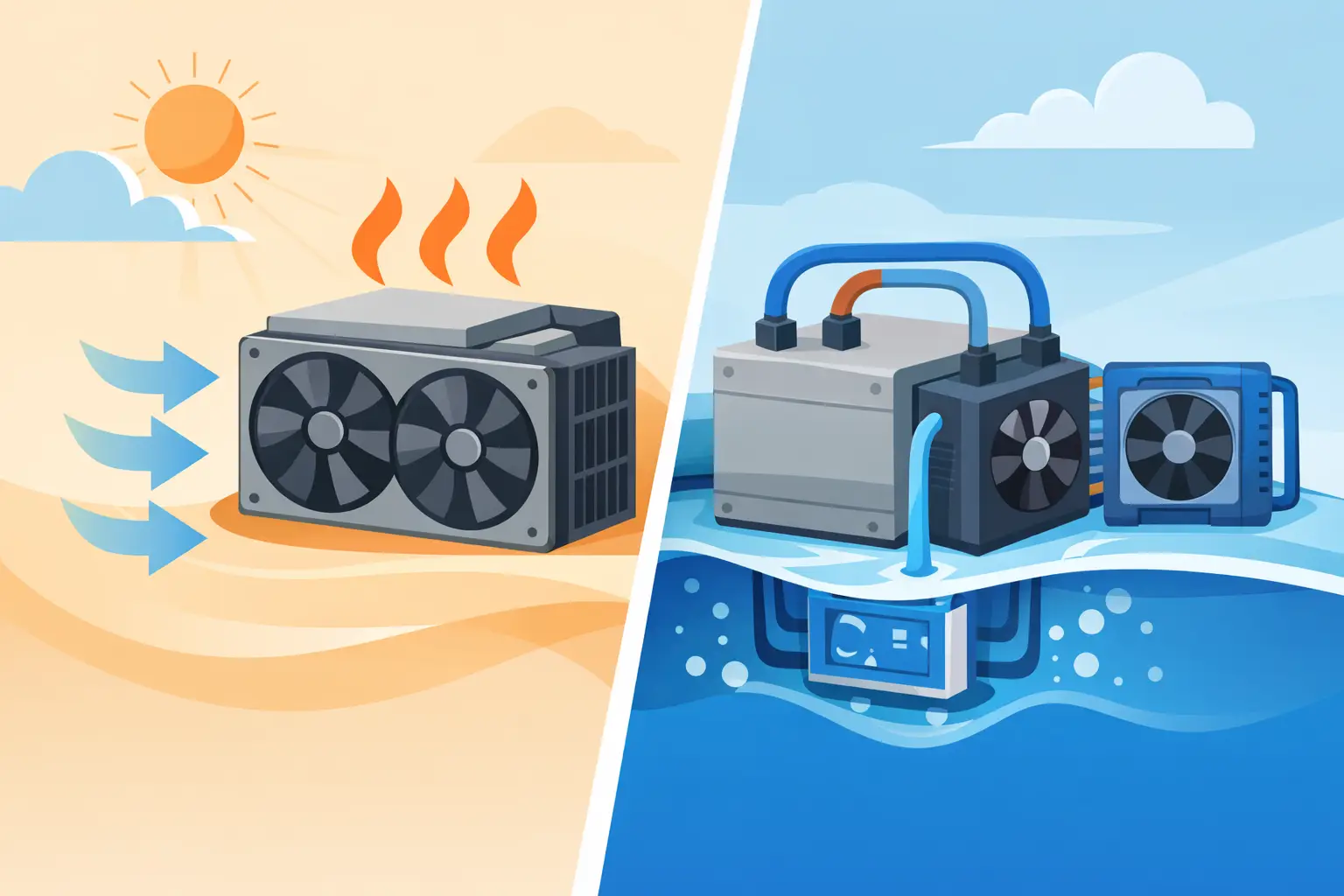
A mining site can have competitive power pricing and the newest ASICs, then still lose output to heat, dust, throttling and avoidable downtime. That is why air cooling versus hydro cooling is not simply a hardware preference. It is an infrastructure decision that affects deployment speed, operating costs, site design and the hashrate you can sustain over time.
For some portfolios, air-cooled miners remain the fastest route to go live. For others, hydro-cooled ASICs justify their higher upfront requirements through greater density and more controlled operating conditions. The right answer depends on the machine, the climate, the power arrangement and how much operational complexity the owner is prepared to manage.
How air-cooled ASIC mining works
Air-cooled ASICs use high-speed fans to pull air across heat sinks attached to the miner’s chips. The fans expel the resulting hot air into the room or through a contained exhaust system. It is the familiar design behind many popular Bitcoin miners, and it can be deployed efficiently when the facility has sufficient ventilation, filtration and heat removal capacity.
The principal advantage is simplicity. Air-cooled units are widely available, familiar to technicians and relatively straightforward to install, replace and repair. A hosting facility can rack a large number of machines quickly without building liquid distribution loops to every unit. For a miner buying a small portfolio or expanding in stages, this reduces initial Capex and speeds up commissioning.
Air cooling also gives operators flexibility. Machines can be relocated more easily, and replacement stock is generally easier to source. If a fan fails, the repair is usually contained and inexpensive compared with work on a liquid-cooling circuit.
That simplicity does not mean air cooling is low-maintenance. ASIC fans run at very high speeds, consume power and create significant noise. Dust, sand, humidity and poor airflow management can degrade thermal performance quickly. In hot regions, ambient temperature becomes a direct commercial variable: the hotter the intake air, the harder a miner must work to keep chip temperatures within range.
Where air cooling performs best
Air cooling is often the practical choice for standardised fleets, especially where the facility already has a well-designed hot-aisle and cold-aisle layout. It works well when the power density per rack is moderate, the climate is manageable or the site has enough mechanical cooling and airflow capacity to protect the miners during peak heat.
It is also the sensible route when flexibility matters more than maximum density. A portfolio of conventional ASICs can be deployed rapidly, monitored through miner-management software and scaled machine by machine. For first-time miners, a managed hosting package can remove much of the operational burden while retaining the lower entry point of air-cooled hardware.
The weak point is that air systems must move enormous volumes of air. As fleet size grows, so do the demands on louvres, filtration, exhaust paths, fan maintenance and building design. An inefficient airflow layout can create recirculation, where hot exhaust air finds its way back to the intake side. That raises chip temperatures, increases fan speed and can reduce performance precisely when mining economics demand stable output.
What hydro cooling changes
Hydro-cooled ASICs circulate a coolant through cold plates or internal channels that absorb heat from the chips. The warmed liquid is then transferred through piping to heat exchangers, dry coolers or other heat-rejection equipment. The term is sometimes used loosely, but hydro cooling is different from immersion cooling, where complete miners are placed in dielectric fluid.
The attraction is thermal control. Liquid transfers heat far more effectively than air, allowing a facility to operate much higher power density in a smaller footprint. Hydro miners typically need fewer or no high-speed unit fans, which materially reduces noise at the machine level and cuts one common maintenance point.
For industrial deployments, this can turn a cooling constraint into an expansion opportunity. More hashrate can be installed per container, rack or square metre, provided the liquid loop, pumps, heat exchangers and water treatment systems are engineered correctly. Hydro cooling can also support more consistent chip temperatures, helping operators run equipment closer to its intended performance envelope.
That does not mean hydro cooling automatically produces better profitability. The miner, electrical infrastructure and cooling plant must be considered as one system. Pump power, fan power at external coolers, coolant management and maintenance all contribute to Opex. A poorly sized hydro installation can be as disruptive as a poorly ventilated air-cooled hall, only with a more specialised fault to diagnose.
Air cooling versus hydro cooling: the commercial trade-off
The most useful comparison starts with total operating economics, not a headline efficiency figure. Air-cooled mining usually requires less specialised infrastructure and has a lower barrier to deployment. Hydro cooling generally requires higher initial investment in distribution manifolds, piping, pumps, heat rejection and controls. It may also require a more deliberate site design before the first ASIC is connected.
In return, hydro cooling can deliver higher density, more stable thermal conditions and a better fit for large-scale sites where available space is limited or local temperatures make air handling expensive. It can also reduce the acoustic challenge of operating a high-output fleet, although external cooling equipment will still generate noise.
Hardware choice matters. A hydro model should be assessed against an air-cooled model using the same commercial lens: purchase price, hashrate, watts, expected pool output, hosting rate, electricity price and projected uptime. A higher-hashrate hydro miner may look compelling, but the gain can disappear if the facility cannot provide reliable liquid flow and heat rejection.
For air-cooled fleets, do not ignore fan power and heat-related derating. A machine that is nominally efficient on a specification sheet can produce weaker real-world returns if it spends the hottest hours throttling or repeatedly requiring intervention. The relevant number is sustained productive hashrate, not the best reading achieved in ideal conditions.
Site conditions decide more than the brochure
Climate and facility design should carry substantial weight in the decision. In a cool, dry location with a purpose-built airflow system, air cooling can be exceptionally effective. In a high-temperature environment, air cooling may remain viable, but the site needs enough ventilation, filtration and possibly mechanical support to prevent hot-air recirculation and thermal stress.
Hydro cooling is particularly attractive where operators need to concentrate substantial electrical load within a compact facility. It can be a strong option for dedicated data-centre projects, large containers and professional fleets that benefit from repeatable thermal performance. The engineering standard is non-negotiable: pipework must be pressure-tested, coolant quality monitored, connections inspected and leak detection incorporated into the operational plan.
Water availability deserves careful treatment as well. Hydro cooling does not necessarily mean constant consumption of fresh water. Many systems operate as closed loops, but heat still has to be rejected. The best design depends on local ambient conditions, the chosen cooler technology, maintenance capability and applicable regulations.
Maintenance and uptime risk
Air cooling concentrates risk at the miner and building-airflow level. Fans fail, filters clog, heat sinks collect debris and room conditions can change quickly. These issues are familiar and usually easy to isolate, but they multiply across hundreds or thousands of machines. Proactive cleaning schedules, environmental sensors and 24/7 monitoring make a measurable difference.
Hydro cooling moves some of that risk into shared infrastructure. Pumps, valves, manifolds and heat exchangers become critical components. A fault affecting a common loop can affect many machines at once if redundancy has not been designed in. Professional hydro sites therefore require duty and standby pumps, monitored flow and temperature readings, isolation valves and technicians who understand both ASIC diagnostics and cooling systems.
Neither approach is maintenance-free. Air cooling tends to create more frequent, machine-level interventions. Hydro cooling can reduce fan-related work but demands stronger central-plant discipline. For serious operators, uptime is protected by monitoring, spare parts planning, clear response procedures and a hosting partner that owns the outcome rather than merely renting rack space.
Choosing the right route for your fleet
Choose air cooling when rapid deployment, lower initial infrastructure cost and hardware flexibility are the priorities. It is often the best fit for conventional ASIC portfolios, phased growth and facilities designed around well-managed airflow.
Choose hydro cooling when you are planning for high density, controlled thermals and industrial-scale expansion, and when the site can support the added engineering from day one. It is especially compelling when machine selection, electrical capacity and cooling plant are designed together rather than assembled as separate purchases.
BitHash approaches this decision as an operational model, not a product checkbox. The strongest mining setup is the one that matches the ASIC to the facility, protects uptime and makes every kilowatt work towards productive hashrate. Before committing capital, model the full system under real site conditions, including the hottest operating period. That is where the better cooling decision reveals itself.