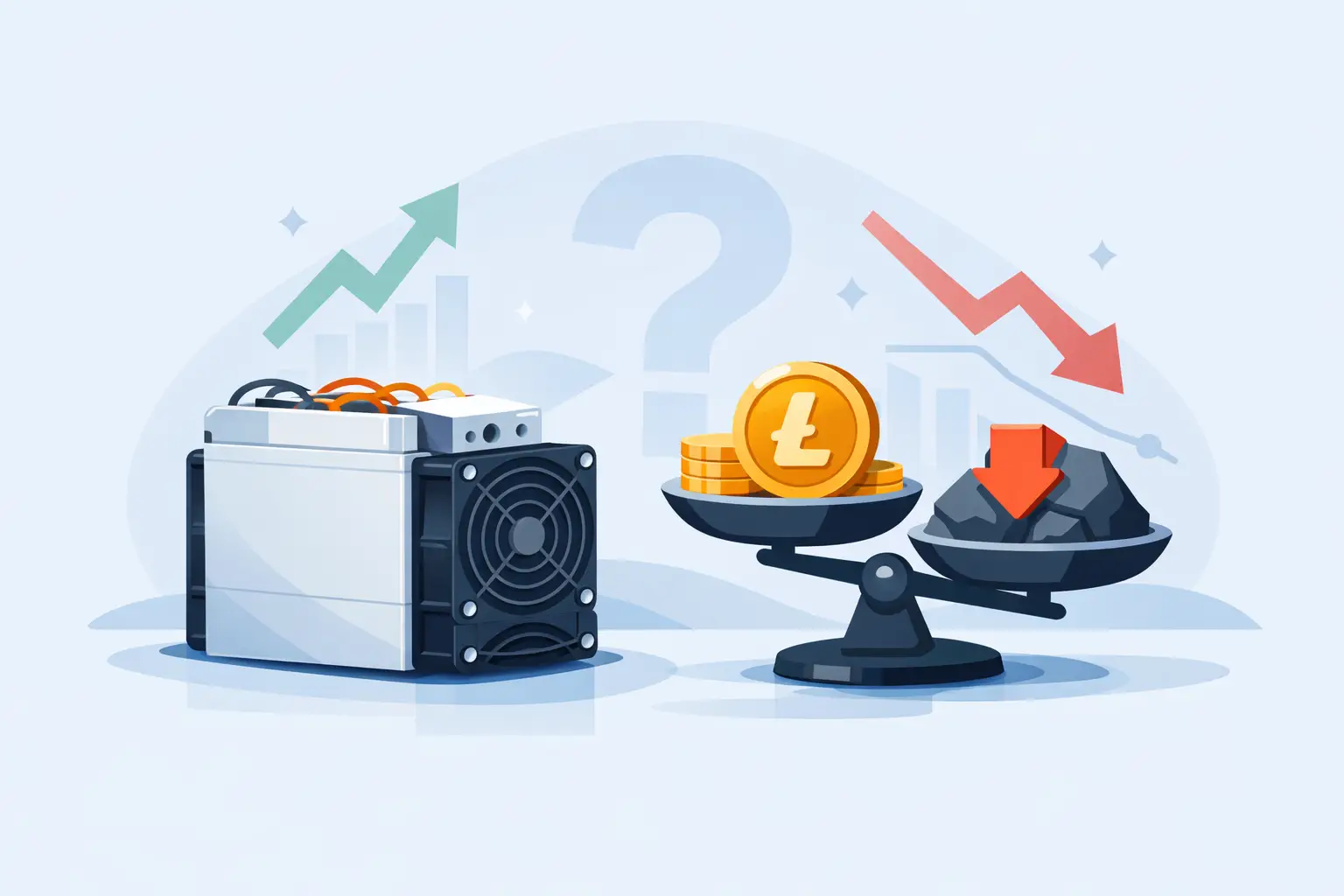
The Antminer L9 is built for a simple commercial purpose: turn serious Scrypt hashrate into a mining operation that can be measured, managed and scaled. For miners looking beyond Bitcoin-only exposure, it is one of the most relevant current-generation ASICs because it combines high output with efficiency that older Litecoin and Dogecoin machines cannot match.
That does not make it an automatic buy. An L9’s return depends far less on the headline hashrate than on electricity pricing, pool strategy, uptime, cooling, coin-market conditions and the quality of the site running it. The machine may be compact enough to purchase as a single unit, but its operational demands are firmly professional.
What the Antminer L9 is designed to mine
The Antminer L9 is a Scrypt ASIC. Scrypt is the algorithm used by Litecoin, and because Litecoin and Dogecoin are merge-mined, the same work can generate exposure to both networks. This is the core appeal: miners are not choosing between LTC and DOGE on a machine-by-machine basis. A properly configured pool can distribute rewards from merge mining, typically paying out in the assets or payout format selected by the operator.
Depending on the version, the L9 is commonly available around the 15 to 17 GH/s range, with power consumption of roughly 3.3 kW. Its efficiency is usually quoted near 210 J/GH, although the precise figure changes with the model, ambient conditions and actual power draw at the wall.
For context, 16 GH/s is not a minor incremental improvement over legacy Scrypt hardware. It changes the economics of a site. A fleet can produce meaningful hashrate with fewer units, fewer power connections and less physical space than would be required with previous-generation miners. That helps, but it does not remove the need for sound infrastructure.
Antminer L9 economics start with power, not revenue
A miner can see an attractive daily revenue estimate and still make a poor operational decision. Revenue calculators are snapshots. They cannot promise a future LTC or DOGE price, network difficulty, transaction-fee environment, pool payout or machine uptime.
Power is the cost an operator can model with the most confidence. At approximately 3.3 kW, an L9 running continuously consumes close to 79 kWh per day. Multiply that by a contracted all-in electricity rate, then add hosting, pool fees and an allowance for maintenance or downtime. This creates a more useful baseline than gross revenue alone.
For example, a small change in kWh pricing has a direct effect on margin because the machine runs 24 hours a day. A difference of £0.03 per kWh is not a minor detail when applied across every hour of every machine in a fleet. For investors comparing home operation, colocation and managed hosting, this is often the decisive figure.
The correct question is not, “How much does an L9 make today?” It is, “What margin does this machine retain across plausible downside conditions?” Run projections using conservative coin prices, higher network difficulty and realistic uptime. If the investment only works under the most optimistic calculator result, it is not yet a dependable mining plan.
Hashrate is valuable only when it stays online
A 16 GH/s machine operating at 90% uptime produces less than an 15 GH/s unit achieving stable, round-the-clock availability. Downtime can come from overheating, unstable power, network failures, pool configuration errors, dust ingress or a delayed repair process.
This is why a low hosting quote should be examined carefully. Ask what is included in the rate: power, racking, installation, remote monitoring, security, firmware support, rebooting, repair labour and spare-part handling can materially change the true operating cost. Transparent packages make it easier to forecast Opex and compare providers on a like-for-like basis.
Cooling and electrical requirements are non-negotiable
An Antminer L9 converts most of its electrical consumption into heat. At roughly 3.3 kW, one unit behaves like a continuous industrial heater. Put ten machines in a poorly planned room and the heat load is no longer a comfort issue – it is a performance and hardware-risk issue.
Air-cooled L9 units require controlled airflow, appropriate separation between hot and cold air paths, clean intake conditions and adequate extraction. High ambient temperatures cause fans to work harder and may contribute to throttling, faults or accelerated wear. Dust and humidity add further risk, particularly where machines are placed in improvised premises rather than a mining-ready environment.
Electrical design deserves the same attention. Each unit needs correctly rated circuits, cabling, protection and connectors. Operators should calculate continuous load rather than treating the nameplate figure as an occasional peak. A site also needs capacity for networking equipment, ventilation, lighting and operational headroom. Overloading a circuit to save on installation costs is a false economy.
For larger portfolios, hydro-cooling can be worth considering where the facility and fleet design support it. It can improve heat management and reduce the noise associated with high-speed air cooling, but it introduces different requirements: fluid management, compatible hardware, leak prevention, heat rejection and specialist maintenance. Hydro is an infrastructure decision, not simply an accessory purchase.
Home mining versus managed hosting
A single L9 can appeal to a hands-on miner who wants direct control. Yet home operation quickly exposes practical constraints. Noise is substantial, heat is continuous, domestic electricity is often expensive, and standard household electrical arrangements may not be suitable for a high-load ASIC running without interruption.
Managed hosting is normally more compelling when the goal is predictable operation rather than a weekend technical project. A suitable facility provides industrial power arrangements, cooling design, network redundancy, physical security and technicians who can respond when an issue appears. It also removes the need to store, wire and maintain machines on-site.
The trade-off is that the operator must select the provider carefully. A hosted miner is only as dependable as the site, electricity agreement and support team behind it. Before committing, request clarity on the kWh rate, contract term, uptime approach, maintenance process, payout arrangement, access to monitoring data and the procedure for shipping or redeploying machines.
BitHash approaches this as an infrastructure service rather than a hardware handover: procurement, deployment, monitoring and support need to work as one operating chain if the miner is to go live quickly and remain productive.
How to assess an L9 before buying
The best purchase decision starts with the exact model and a complete cost picture. Manufacturers and suppliers may offer several hashrate variants, and an advertised unit should be checked against its stated GH/s output, wattage, efficiency, condition, warranty terms and delivery timeline. Do not compare machines on purchase price alone. A cheaper unit with lower efficiency can cost more over its working life.
Build a basic operating model before payment. Include Capex, delivery, import exposure where relevant, rack or installation charges, power cost, hosting fee, pool fee and a maintenance reserve. Then model three cases: conservative, expected and strong market conditions. This makes the capital risk visible and avoids treating an ASIC as a fixed-income product.
Pool selection also matters. Evaluate fee structure, reliability, merged-mining support, payout thresholds, reporting detail and payout assets. A professional operator should be able to see hashrate, accepted shares, worker status, revenue history and alerts without chasing support for routine information.
Finally, plan for the machine’s full lifecycle. ASICs are revenue-producing equipment, but they depreciate and market competition evolves. Consider resale options, repair access, firmware controls and whether your hosting provider can support a future fleet expansion. A good location and service model can remain valuable even when the next hardware generation arrives.
The operational edge is where returns are protected
The L9 is a powerful Scrypt miner, but it is not a shortcut around mining economics. It rewards operators who secure competitive power, control heat, monitor performance and respond quickly when hardware needs attention. For a single unit, those disciplines protect a personal investment. For a fleet, they become the difference between nominal hashrate and dependable production.
If the numbers work under realistic assumptions, focus next on the operating environment. The right machine deserves an electrical, cooling and support setup designed to keep it earning – not merely switched on.