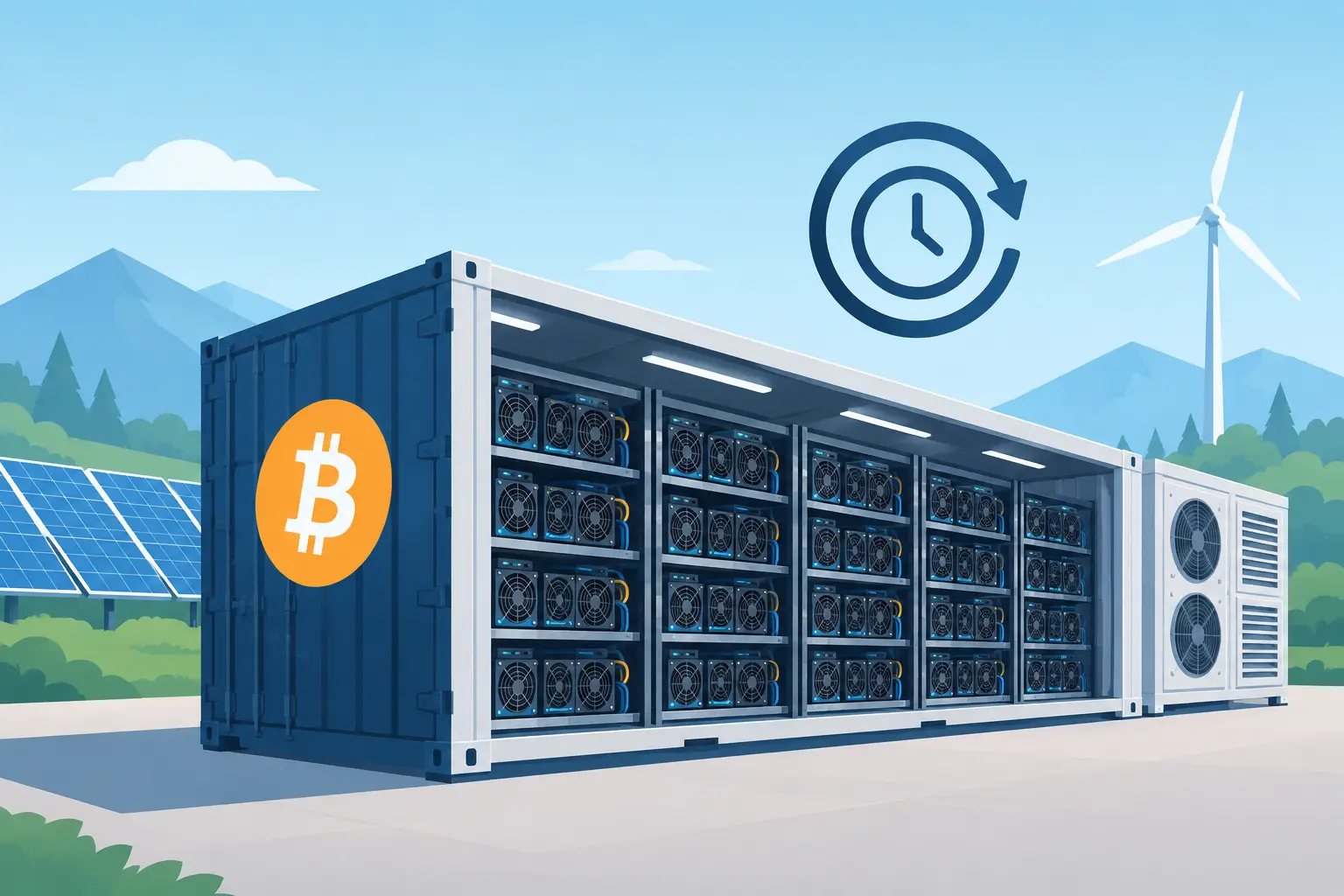
A bitcoin mining container setup can turn a fleet of ASICs into a deployable mining site, but the container itself is only the shell. The real performance comes from what sits behind it: correctly sized electrical infrastructure, controlled airflow or liquid cooling, remote monitoring, physical security and a maintenance plan that keeps machines hashing when conditions become difficult.
For a few machines, a container may not be the most economical answer. For operators planning a meaningful fleet, however, it creates a repeatable unit of capacity that can be installed, monitored and expanded without building a conventional data centre from the ground up. The difference between a profitable installation and an expensive outage is found in the design details.
Start with the economics, not the container
Before selecting a container length, calculate the operating profile of the ASIC fleet. Start with the miner model, its hashrate, nominal power draw and expected quantity. Then add infrastructure load: extraction fans, pumps for hydro-cooling, lighting, networking, control systems and losses in transformers or switchgear.
A fleet of 100 air-cooled ASICs drawing 3.5 kW each does not need a 350 kW site. It needs headroom. Continuous operation, high ambient temperatures, fan start-up loads and future expansion all affect final capacity planning. Designing too close to the theoretical load leaves little room for stability or maintenance. Designing far beyond it increases Capex without improving return.
Electricity price matters, but the contract structure matters too. Operators should understand whether their kWh pricing includes delivery charges, demand charges, taxes, curtailment terms and minimum commitments. A low headline rate can look very different once peak-demand penalties or generator-backed supply are included. For larger installations, the reliability of the power source and the terms of a PPA can be as material as the tariff itself.
Your financial model should also allow for network difficulty, pool fees, downtime, repair costs and the possibility that a newer-generation miner will replace older hardware sooner than expected. A container should support an operational strategy, not force one.
Choose the right bitcoin mining container setup
Most containerised sites fall into two categories: air-cooled and hydro-cooled. The right choice depends on local climate, available power density, fleet size, water strategy and appetite for operational complexity.
Air-cooled containers
Air-cooled containers use high-volume intake and exhaust airflow to carry heat away from miners. They are familiar, comparatively straightforward to service and well suited to standard air-cooled ASICs. Their limitation is environmental exposure. Dust, humidity, corrosive air and high ambient temperatures can reduce fan life, clog heatsinks and make it harder to sustain peak performance.
Airflow must be deliberate. Cold intake air needs a clear route to the miner inlets, while hot exhaust must leave the container without recirculating. Poor pressure balance and gaps around doors, cable routes or fan walls can pull hot air back into the intake side. That raises chip temperatures, increases fan speed and can trigger thermal throttling or shutdowns.
Hydro-cooled containers
Hydro-cooling supports higher power density and reduces dependence on large volumes of outside air. Instead of relying on miner fans to move heat into the atmosphere, a coolant loop transfers heat through manifolds, dry coolers or other heat-rejection equipment. This can be particularly valuable in hot climates or where site space is limited.
The trade-off is that hydro-cooling needs disciplined engineering. Pump redundancy, filtration, leak detection, pipework quality, coolant chemistry and heat-exchanger capacity all become critical. A poorly maintained liquid system can take down more machines at once than an individual air-cooling fault. For professional fleets, the added complexity is often justified by density, thermal control and potentially longer hardware life. For a smaller deployment, air-cooled hosting may be the more practical route.
Build the electrical system for continuous load
Mining is a 24/7 industrial load. The electrical design should be signed off by qualified engineers and built around local codes, equipment ratings and site conditions. The usual chain includes utility supply or generation, transformer, main switchgear, distribution boards, busbars or PDUs, branch circuits and the miner connection itself.
Every point in that chain needs the correct rating and protection. Cable size, breaker coordination, earthing, surge protection and isolation procedures are not areas to reduce costs. Heat from loose terminations or overloaded conductors can become an operational and safety event very quickly.
Plan for measurement at more than one level. Utility-level metering confirms what the site receives and pays for. Container-level metering reveals infrastructure consumption. Circuit-level visibility helps identify imbalanced phases, overloaded branches and unexplained losses. Without accurate data, it is difficult to separate an inefficient container from a fleet that is simply drawing more power than expected.
Redundancy should match the business case. Full N+1 redundancy across every component may not be commercially sensible for every mining operation. But single points of failure that can disable an entire container, such as one unprotected control circuit or one undersized network switch, deserve attention. The goal is not complexity for its own sake. It is controlled downtime when something fails.
Treat heat, dust and noise as operating costs
ASICs create a relentless heat load. A container that looks tidy on installation day can lose performance after weeks of dust accumulation, blocked filters and degraded fans. Site selection and intake design should reflect the real environment, including seasonal temperature peaks, sand or dust exposure, rainfall and prevailing wind direction.
Filtration protects hardware, but restrictive filters also increase static pressure and can reduce airflow. They need an inspection and replacement schedule based on site conditions rather than a calendar assumption. In particularly dusty locations, pre-filtration and positive-pressure intake systems can reduce contamination, provided fan capacity is sized accordingly.
Noise requires planning too. Air-cooled ASICs and extraction fans can create a significant acoustic footprint. That affects planning approvals, neighbouring operations and staff working near the container. Acoustic louvres, fan selection and container placement can help, but they may also restrict airflow. This is another design trade-off: quieter operation is valuable only if thermal performance remains reliable.
Monitoring turns hardware into an operation
A container without remote visibility is a site that will eventually surprise its owner. Miner-management software should show hashrate, uptime, temperatures, fan status, power consumption, rejected shares and fault alerts at fleet, container and individual-miner level. Monitoring should also cover environmental conditions, network health, door access and critical electrical alarms.
Alerts need an escalation path. A temperature warning at 2am is useful only if someone is responsible for assessing it and can act. Define who can reboot a miner, isolate a faulty circuit, dispatch a technician or approve replacement parts. For large fleets, keep a record of serial numbers, firmware versions, repair history and warranty status. That information shortens troubleshooting and makes fleet decisions less dependent on memory.
Physical security belongs in the same operating model. Containers should have controlled access, cameras, intrusion alerts and a documented visitor process. ASICs are compact, valuable and easy to move. Site security is not an add-on once the fleet is live.
Commission in stages, then scale with evidence
Do not energise a full container and assume every detail will behave as designed. Commission in stages, beginning with electrical verification and control systems, followed by a small number of miners, then progressive load increases. At each stage, compare measured power, temperatures and airflow against design assumptions.
A practical commissioning record should include at least these five checks:
- Phase balance and voltage stability under load
- Intake and exhaust temperatures across the container
- Miner hashrate, rejected-share rate and pool connectivity
- Breaker, cable and busbar temperatures using appropriate inspection methods
- Alarm response, remote reboot capability and network failover behaviour
The first weeks of live operation are when weak points appear: a fan wall that cannot maintain pressure during the hottest part of the day, a circuit with recurring trips, or a filter schedule that is too infrequent. Correcting those issues early protects uptime and prevents a small fault becoming a fleet-wide interruption.
Decide what to own and what to outsource
A self-managed container gives experienced operators direct control over hardware, staffing and site design. It also makes the operator responsible for permits, power negotiations, logistics, spares, security, monitoring and every hour of downtime. That model can work well where the team already has energy and data-centre expertise.
Managed hosting shifts much of that operational burden to a specialist provider. It is often the faster route for investors who want ASIC exposure without building a power and maintenance organisation around it. The key is transparency: confirm the electricity structure, deployment timeline, service scope, maintenance response, security controls and how performance data will be reported.
For operators who need a container built around a defined fleet and power profile, BitHash can combine ASIC sourcing, deployment and managed infrastructure support rather than leaving those decisions fragmented across multiple suppliers.
A container becomes a high-performing mining asset when its design is tested against real operating conditions, not brochure specifications. Start with power and heat, instrument everything that affects uptime, and choose an operating model that lets your team spend more time managing returns than chasing faults.
BitHash Editorial
Verified AnalystBitHash Infrastructure, UAE Colocation & Mining Intelligence Team