A new ASIC can be earning within hours, but buying the machine is only the first decision. Where it runs, how consistently it runs, and who responds when it stops are often more consequential than a small difference in the purchase price. Bitcoin mining hosting is the operational layer that turns hardware ownership into an active mining position without requiring you to build and manage a facility yourself.
For a single miner owner, that can mean avoiding noise, heat, electrical upgrades and round-the-clock troubleshooting. For a fleet operator, it can mean securing capacity, controlling Opex and gaining a reliable path to scale. The right hosting arrangement is not simply rack space and a power socket. It is a service model built around energy, infrastructure, security, monitoring and accountability.
What Bitcoin Mining Hosting Includes
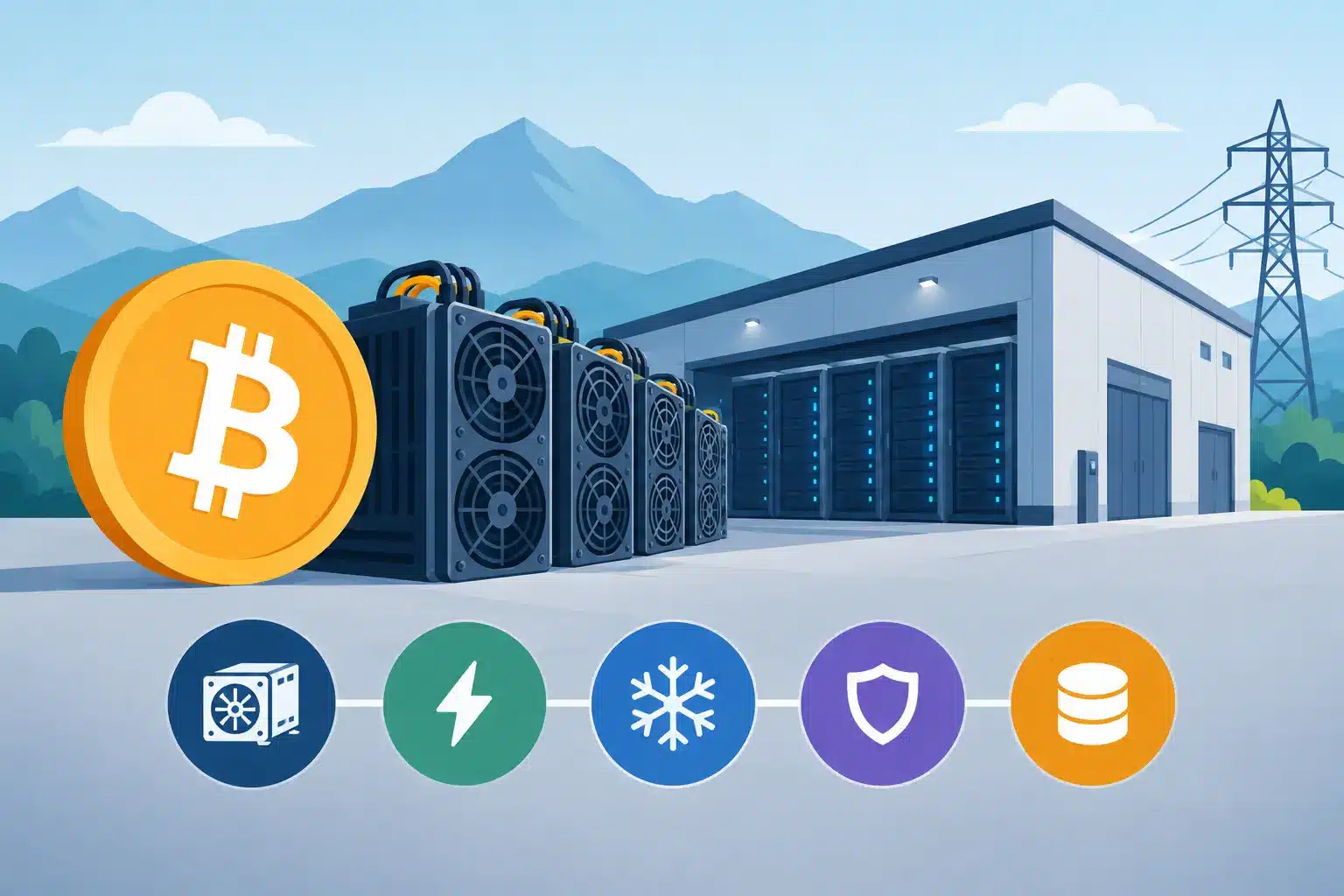
In a hosted model, you own or lease the ASIC miners while a specialist provider installs and operates them in a mining facility. The provider typically handles receiving, racking, power distribution, network connectivity, ventilation or liquid cooling, physical security and day-to-day oversight. Your machines contribute hashrate to the selected mining pool, while you retain visibility of their status and earnings.
The practical value is operational focus. ASICs are designed to run hard, continuously and in demanding conditions. A current-generation machine consumes significant power and produces significant heat. Operating it from a home or unsuitable commercial site can create safety, noise and reliability problems before economics even enter the conversation.
A professional host is built to manage those realities at scale. That includes electrical infrastructure sized for continuous load, cooling engineered for high-density equipment, spares processes, secure access controls and technicians who understand common ASIC faults. Hosting does not remove mining risk, but it removes a large part of the operational burden that can turn a promising deployment into idle hardware.
The Cost Behind the Headline kWh Rate
Electricity pricing is usually the first number a miner asks for, and rightly so. Power is the dominant ongoing cost for most ASIC operations. Yet a low advertised kWh rate is not automatically the lowest all-in cost. The key question is what the rate includes and what happens outside normal operation.
Some packages include electricity, rack space, cooling, monitoring and routine operational support in one transparent figure. Others separate charges for installation, pool configuration, repairs, firmware work, storage, curtailment or management software. Neither structure is inherently wrong, but the commercial terms need to be clear before machines are dispatched.
Ask whether pricing is fixed, variable or linked to an electricity agreement such as a PPA. Establish the billing currency, payment frequency, deposit requirements and any minimum commitment. If the site uses variable pricing or demand-response programmes, understand when miners may be curtailed and whether that interruption is reflected in the rate.
A useful way to compare offers is to model the total monthly operating position, not just the headline tariff. Include estimated power consumption, hosting fees, expected uptime, pool fees, repair allowance and shipping or deployment costs. A slightly higher rate may make commercial sense when it comes with stronger uptime, faster intervention and fewer unexplained charges. Conversely, premium infrastructure cannot overcome an uncompetitive energy price for a highly inefficient machine.
Uptime Is a Financial Metric
A miner that is switched off earns nothing while it continues to represent capital tied up in hardware. That makes uptime more than a technical statistic. It is a direct driver of realised hashrate and potential revenue.
No credible provider should promise that every machine will operate perfectly every minute of the year. Networks fail, fans wear out, hashboards develop faults and site-level events happen. What separates a capable hosting partner is the way it detects, communicates and resolves these events.
Look for 24/7 monitoring, alerting at the machine level, clear incident escalation and an agreed process for rebooting, diagnosing and repairing equipment. A dashboard or miner-management software should make it easy to see hashrate, temperature, worker status and historical performance without repeatedly requesting updates.
For larger deployments, ask how the provider manages failed units and whether critical spares are held on site. A repair workflow measured in days rather than vague promises protects more than convenience. It reduces the time your capital is sitting unproductive.
Cooling changes the operating equation
Air cooling remains practical for many deployments, but it depends on clean airflow, ambient conditions and disciplined maintenance. Dust, heat and poor circulation can increase fan failures, thermal throttling and component stress. Facility design matters as much as the miner specification.
Hydro-cooling can support higher-density operations and more stable thermal performance, particularly where the equipment and facility are designed for it from day one. It also introduces different infrastructure requirements, including coolant management, pumps, heat exchange and specialist maintenance. It is not automatically the right choice for every portfolio.
The decision depends on fleet size, ASIC model, site conditions and growth plans. The point is not to choose the most complex cooling system. It is to choose an environment that keeps equipment operating within its intended thermal range while supporting the economics of the deployment.
Questions to Ask Before You Ship an ASIC
The strongest hosting relationships begin with specifics. Before committing machines, clarify the facility location, deployment timeline and the exact steps between payment confirmation and live hashrate. Fast deployment has value, especially when machines are new and mining conditions are favourable, but it should not come at the expense of proper intake checks and configuration.
You should also understand ownership and access. How are machines labelled and inventoried? Who can authorise pool changes, firmware updates or removal from the site? What insurance applies to equipment in transit and while hosted? What physical security measures protect the facility?
For the commercial agreement, focus on the terms that affect control:
- the all-in electricity and hosting rate, including taxes or additional service fees
- minimum contract term, cancellation conditions and capacity commitments
- expected deployment lead time and how delays are handled
- uptime reporting, maintenance response and repair approval limits
- withdrawal, relocation and resale procedures for your machines
These are not administrative details. They define whether the service remains flexible when market conditions, hardware efficiency or your capital strategy changes.
Hosting for One Miner Versus a Growing Fleet
A first-time miner may value simplicity above all else. The ideal arrangement is often a clear package: select a suitable ASIC, pay for procurement and hosting, receive confirmation when it goes live, then monitor performance through a straightforward portal. The goal is zero hassle, not pretending that mining economics are risk-free.
A professional operator has different requirements. With 150 machines or more, capacity certainty, dedicated support, power allocation, reporting standards and repair turnaround become central. The operator may need a tailored hosting agreement, phased deployment, a dedicated area or a route towards a purpose-built data centre. At that scale, even small improvements in uptime, cooling efficiency or repair velocity can have material financial impact.
A capable partner should serve both cases without forcing a small customer into an enterprise process or treating a large fleet as a collection of individual retail orders. BitHash approaches hosting as part of a wider infrastructure service, connecting hardware sourcing, installation, monitoring, maintenance and scaling under one accountable operational team.
Mining Economics Still Need Active Oversight
Hosting makes operations easier to manage. It does not guarantee profitability. Bitcoin price, network difficulty, transaction-fee conditions, pool performance, machine efficiency and electricity cost all move over time. A profitable miner can become marginal after a difficulty rise; an older unit can regain relevance if market conditions improve.
That is why hosted miners should review performance regularly. Compare actual hashrate against the manufacturer specification, track downtime, confirm power charges and assess whether each unit remains competitive. If a machine needs repeated repairs or operates at a weak efficiency level, relocating, selling, upgrading or retiring it may be more rational than continuing by default.
The best hosting provider gives you the infrastructure to make those decisions from evidence rather than assumption. Choose one that can explain the rate, show the machine status and act quickly when equipment needs attention. When your ASICs are working around the clock, operational clarity is not a luxury – it is part of the return you are paying for.