Bitcoin Mining Versus Kaspa Mining Compared
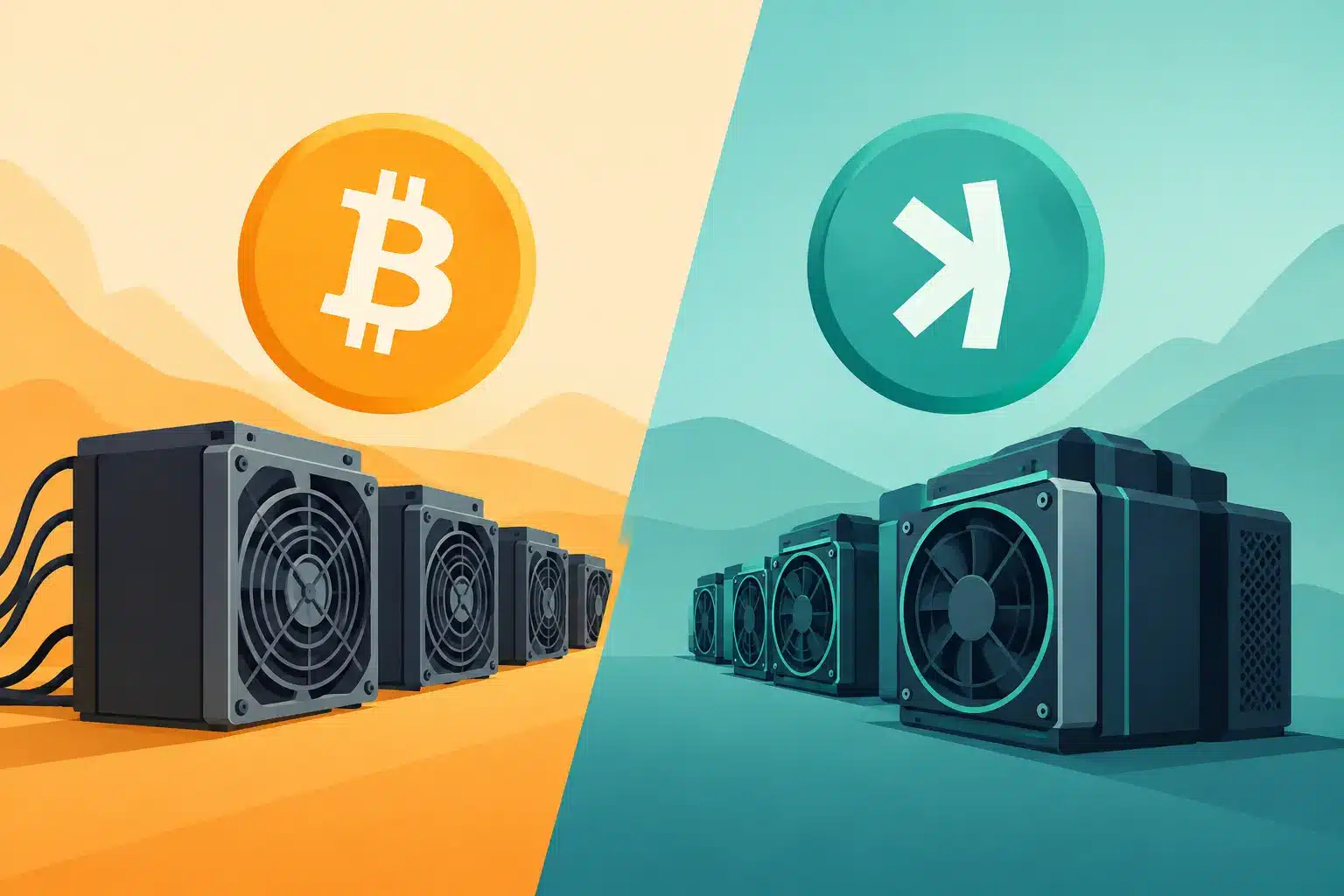
A miner can look profitable on a calculator and still become an expensive problem once power, downtime, network difficulty and resale value enter the picture. That is the real question behind Bitcoin mining versus Kaspa mining: not simply which coin produces more revenue today, but which ASIC operation best fits your capital, risk tolerance and hosting plan.
Bitcoin gives miners the deepest liquidity and the most established ASIC market. Kaspa can offer higher-growth exposure and, at times, compelling revenue per kilowatt, but it comes with a younger ecosystem and sharper shifts in mining economics. Neither is automatically the better choice. The right decision depends on how you intend to operate.
Bitcoin mining versus Kaspa mining: the core difference
Bitcoin mining secures the Bitcoin network using the SHA-256 algorithm. It is dominated by purpose-built ASICs from established manufacturers, with a vast global installed base and mature markets for hosting, repairs, spare parts and second-hand hardware. The block reward is currently 3.125 BTC, following the 2024 halving, while mining difficulty adjusts regularly to keep block production close to Bitcoin’s target schedule.
Kaspa uses the kHeavyHash algorithm. It also requires dedicated ASIC miners for competitive performance, but its industrial mining market is considerably newer. That creates opportunity: a new generation of efficient Kaspa machines can change the hashrate landscape quickly, and early access to efficient equipment may capture attractive returns. It also creates risk, because the arrival of further ASIC capacity can rapidly dilute each machine’s share of network rewards.
The practical distinction is maturity. Bitcoin is the established, highly liquid proof-of-work market. Kaspa is a more speculative alternative proof-of-work allocation with potentially stronger upside and more operational volatility.
Revenue is only the first number
Headline daily revenue is useful, but it should never be the final investment case. A mining decision starts with expected coin output, then tests whether the operation remains viable after electricity, hosting, pool fees, downtime and the likely increase in network difficulty.
For Bitcoin, the key variables are the BTC price, global SHA-256 hashrate, mining difficulty, transaction-fee conditions and your machine’s joules per terahash efficiency. Efficient current-generation miners can remain competitive for longer than older units, particularly where electricity pricing is tightly managed. However, Bitcoin’s scale means difficulty is relentlessly competitive. Large fleets come online continuously, and inefficient machines are usually the first to be switched off when margins tighten.
For Kaspa, price and network hashrate carry even more weight. A profitable kHeavyHash ASIC can attract substantial new capacity to the network. When this happens, yield per machine may decline much faster than an investor expected from an initial profitability snapshot. Kaspa’s market value can also move more sharply than Bitcoin’s, magnifying both the upside and the downside in fiat terms.
A sound model should test at least three cases: a favourable market, a base case and a stressed case involving higher difficulty, lower coin price and a short period of reduced uptime. If the investment only works in the favourable case, it is not a stable mining strategy.
Hardware economics and useful life
Bitcoin ASIC selection is usually an efficiency and reliability exercise. A miner with stronger energy efficiency may cost more upfront, yet lower power consumption can protect its operating margin over years of deployment. Hardware liquidity matters too. Popular SHA-256 models often have clearer resale demand, which gives fleet operators more options when they need to rotate equipment or rebalance Capex.
Kaspa ASIC selection is more exposed to generation risk. The difference between one machine generation and the next can be material, especially in a young algorithm-specific market. A unit bought at a premium during a profitability surge may face a shorter economic window if newer, more efficient hardware ships at volume. That does not mean Kaspa hardware is a poor purchase. It means procurement timing, supplier credibility and deployment speed are central to the return.
This is where a delayed delivery can hurt more than it appears. A machine that arrives weeks late may miss the highest-revenue period of its cycle while still carrying the same acquisition cost. For time-sensitive alternative-coin deployments, confirmed stock, tested equipment and fast installation are commercial advantages, not merely service features.
Think in watts, not just hashrate
Hashrate tells you how much work an ASIC can perform. Watts tell you what it costs to keep that work running. The relationship between them determines efficiency, and efficiency determines how resilient the machine is when conditions worsen.
A lower-priced ASIC with weaker efficiency can produce attractive gross revenue, but it may become unprofitable first as difficulty rises. Compare machines using power draw, efficiency, expected uptime and delivered cost – including shipping, import handling, rack space, commissioning and any electrical infrastructure required. The cheapest machine is not necessarily the cheapest mining capacity.
Power, cooling and uptime decide the operation
Both Bitcoin and Kaspa ASICs are high-density loads. They generate substantial heat, operate continuously and require clean, dependable power. A weak hosting setup can erase the advantage of even the best hardware through curtailment, thermal throttling, avoidable downtime or slow repair turnaround.
Bitcoin fleets tend to benefit from the maturity of their operational ecosystem. Hosting providers are accustomed to SHA-256 machine profiles, airflow requirements and common failure modes. Kaspa rigs can require equally disciplined support, particularly when a model is newer and spare parts or field experience are less widely available.
For either asset, examine the hosting agreement as closely as the ASIC specification. Ask how electricity is priced, whether the rate is fixed or variable, how uptime is measured, what maintenance is included, and how failed machines are diagnosed and repaired. Also establish who is responsible for firmware, pool configuration, monitoring and replacement parts.
In hot climates, cooling architecture deserves particular attention. Air cooling can be effective with properly engineered ventilation, filtration and heat removal. Hydro-cooling may make better sense for dense fleets where noise, thermal stability and rack-level power density are priorities. The correct design depends on site conditions, machine selection and the scale of the deployment, not on a single fashionable cooling method.
Liquidity, treasury strategy and operational risk
Bitcoin is generally easier to treat as a long-term treasury asset. It has deep global liquidity, broad institutional participation and an established derivatives market. A Bitcoin miner can hold BTC, sell regularly to cover Opex, or use a structured blend of both. For operators who want predictable reporting and easier capital planning, that maturity has real value.
Kaspa may suit an investor who is comfortable holding a higher-beta asset and actively reviewing the position. Its liquidity and market depth are smaller than Bitcoin’s, so converting larger mining proceeds may require more care. If you mine Kaspa, define your treasury policy before deployment: how much will be sold for operating costs, how much will be held, and at what point will you reduce exposure if network economics change?
The same principle applies to pooled mining. Pools reduce variance by distributing rewards more regularly, but their fee structures, payout terms and operational reputation matter. A reliable pool connection and correctly configured firmware are modest details until a misconfiguration costs several days of production.
Which strategy fits your portfolio?
Bitcoin mining is often the stronger fit for investors seeking a core proof-of-work position with clearer liquidity, mature hardware options and a more established path to scaling. It is particularly suitable where the goal is a long-running fleet supported by disciplined power procurement and professional hosting.
Kaspa mining can make sense as a measured satellite allocation. It may appeal to operators pursuing growth potential beyond Bitcoin and willing to monitor difficulty, new hardware releases and market liquidity closely. The allocation should be sized for volatility. Treating a young ASIC market as if it carries Bitcoin’s stability is an avoidable mistake.
A blended portfolio can also be rational. Bitcoin machines can form the operational base, while a smaller Kaspa allocation provides exposure to a different network and potential upside. The balance should reflect your ability to absorb a rapid decline in alternative-coin revenue without disrupting electricity payments, hosting commitments or planned fleet expansion.
Build the decision around execution
The best machine on paper has limited value if it sits uninstalled, runs in an overheated facility or lacks support when a board fails. Before committing capital, model total deployed cost, verify stock and delivery terms, assess the provider’s monitoring and repair process, and make sure the electricity arrangement is transparent.
For miners who want to move from hardware purchase to active production without managing every operational layer, BitHash combines ASIC sourcing, hosting, monitoring and maintenance into one accountable infrastructure process. That matters whether your strategy is a single miner or an industrial fleet.
Bitcoin offers the steadier foundation; Kaspa offers a more aggressive opportunity set. Choose the network whose risks you can finance, whose hardware cycle you can manage and whose operating requirements your infrastructure can support. The strongest mining return is rarely created by chasing yesterday’s profitability figure – it is created by keeping efficient machines online when the market becomes less forgiving.
Written by BitHash Editorial
BitHash Infrastructure & Mining Research Team