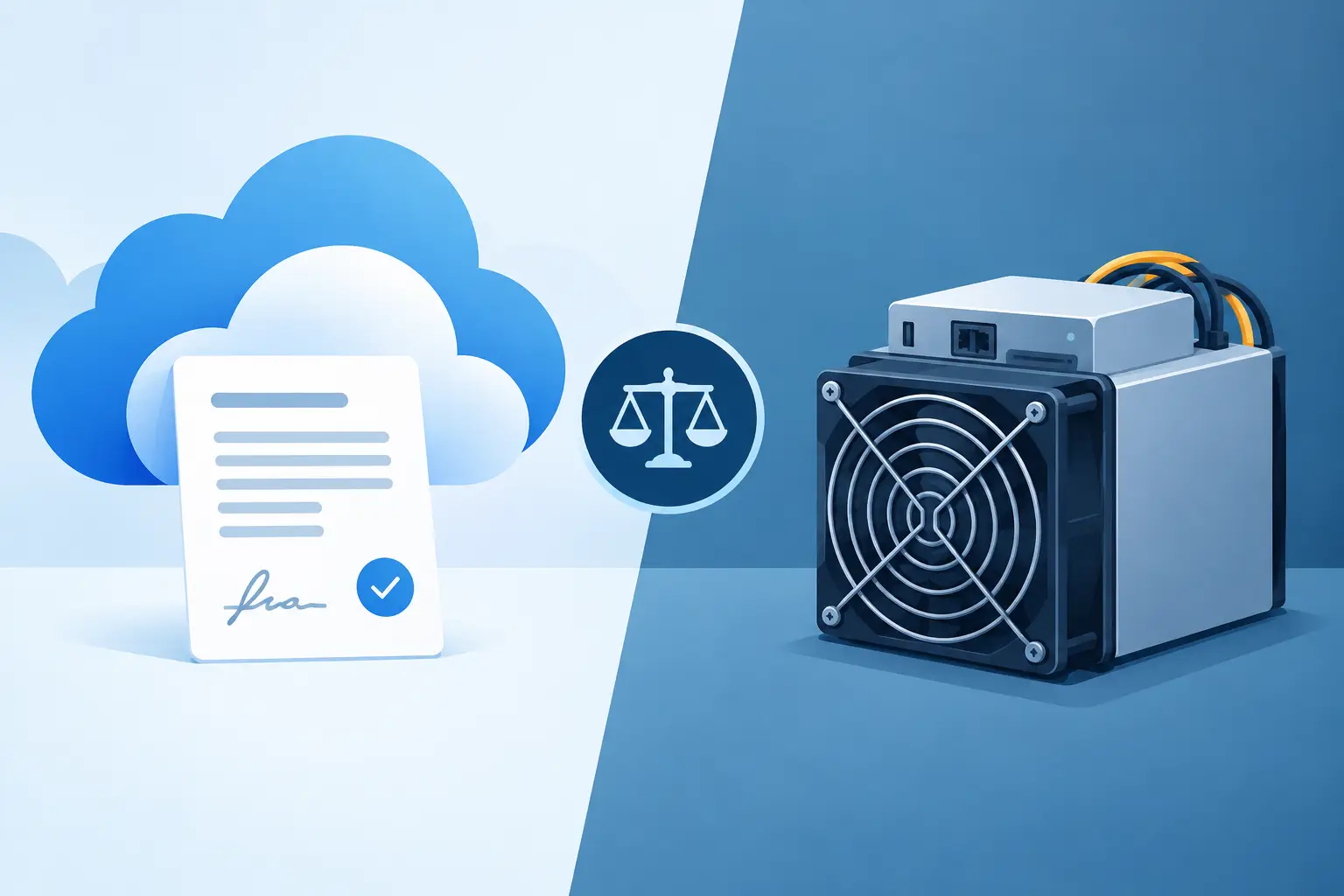
A mining position can look profitable on a spreadsheet long before its operating model is understood. With cloud contracts versus ASIC ownership, the key question is not simply which option has the lower entry price. It is who controls the hardware, who carries the operational risk, and what remains in your hands when market conditions change.
For a miner seeking predictable access to hashrate, both routes can have a place. But they create very different levels of control, visibility and long-term flexibility. The right decision depends on your capital, timeframe, technical confidence and appetite for managing mining infrastructure.
Cloud contracts versus ASIC ownership: know what you are buying
A cloud mining contract gives you exposure to a specified amount of hashrate for an agreed period or under an agreed commercial structure. You do not receive a physical miner. The provider selects, operates and maintains the machines, then allocates mining output according to the contract terms.
ASIC ownership means you purchase the machine itself. You can operate it at your own site, although that is rarely practical for serious miners, or place it with a professional hosting provider. In a hosted model, the provider supplies the power, cooling, rack space, security, monitoring and on-site maintenance while you retain ownership of the ASIC.
That distinction matters. A cloud customer owns contractual access to hashrate. An ASIC owner owns a depreciating but saleable piece of mining equipment. Managed hosting sits between self-operation and cloud mining: you own the asset, while a specialist team handles the daily operational workload.
The commercial difference: Capex, Opex and provider margin
Cloud contracts can appear simpler because the upfront amount is usually clear. There is no separate ASIC purchase, no logistics to arrange and no need to negotiate installation. For an investor who wants a small allocation to mining without building an operational process, that convenience has value.
However, simplicity does not remove cost. The cloud provider must recover its hardware investment, energy spend, facility overheads, maintenance costs and commercial margin. These costs are reflected in the contract price, service charge, output allocation or a combination of all three. Before committing, establish exactly how electricity, pool fees, management fees and downtime are treated.
ASIC ownership requires higher initial Capex. You pay for the machine, then fund ongoing Opex through electricity and hosting charges. In return, you have a clearer line of sight to the cost base. If your hosting agreement specifies a transparent kWh rate, service scope and maintenance process, you can model machine-level performance rather than relying solely on a provider’s contract projections.
Neither structure guarantees a return. Bitcoin price, network difficulty, transaction-fee conditions, pool performance and machine efficiency all affect revenue. But ownership generally gives you more options if the original economics change. You may move machines, change hosting arrangements, sell equipment or upgrade selectively as new ASIC generations reach the market.
Control has a direct value
Control is not only about choosing a mining pool. It affects how quickly you can respond when a machine underperforms, a site has constrained capacity or a more efficient hardware model changes the economics of your fleet.
With a cloud contract, operational decisions remain with the provider. You may receive reporting and hashrate allocations, but you will not usually decide which units are deployed, when a machine is repaired, which firmware is used or whether a unit is sold and replaced. That may be acceptable if your priority is hands-off exposure.
With owned ASICs in managed hosting, you can retain strategic control without taking on the burden of running a data centre. You can select the model, assess its efficiency in joules per terahash, set pool credentials and monitor individual units through miner-management software. A capable host should provide clear uptime reporting, ticket handling, repair updates and electricity billing rather than leaving you to chase operational information.
For portfolios of several machines or more, this level of visibility can materially improve decision-making. You can identify weaker units, compare site performance and plan expansion based on measured results rather than aggregate contract output.
Risk does not disappear – it moves
Cloud mining shifts much of the day-to-day operational responsibility to the provider. You do not need to manage heat, noise, power distribution, network connectivity or failed hashboards. Yet you take on counterparty risk. If contract terms are vague, reporting is limited or the provider lacks resilient infrastructure, you have few practical levers to pull.
ASIC ownership exposes you more directly to hardware depreciation and operational costs. A new generation of miners can reduce the market value of older models, while rising difficulty can compress returns from less efficient units. A poorly run hosting site can also turn a good machine into a poor investment through outages, delayed repairs or unclear electricity charges.
The strongest ownership model therefore depends on infrastructure quality. Ask whether the facility has 24/7 monitoring, physical security, adequate ventilation or hydro-cooling where required, spare-parts access and a defined process for repairs. Cheap power is valuable, but it is not the only factor. An attractive kWh rate loses its advantage if uptime and maintenance are weak.
When a cloud contract can make sense
Cloud contracts can suit an investor testing mining exposure with a defined budget and no desire to own, transport or eventually resell machinery. They can also be useful where a short, fixed-term allocation aligns with a broader digital-asset strategy.
The trade-off is limited flexibility. Treat advertised daily output with caution, particularly if it is presented without assumptions for Bitcoin price, mining difficulty, fees and contract deductions. Check whether the contract allows early termination, how downtime is credited, whether hashrate is guaranteed and what happens if the provider changes its operating fleet.
Cloud mining should be assessed as a contractual product, not as a substitute for understanding mining economics. If you cannot see how the provider earns its margin and protects its operations, the apparent convenience may conceal a higher risk profile.
When ASIC ownership is the stronger route
Ownership is usually better suited to miners with a longer horizon, capital for equipment and a preference for asset-level transparency. It is particularly relevant for investors building a portfolio, operators planning to scale towards a fleet, and businesses that need reporting on individual machines and operating costs.
The purchase decision still needs discipline. Compare ASIC models by efficiency, expected output, purchase price, reliability history and resale liquidity, not hashrate alone. A higher-hashrate unit may consume disproportionately more power, while a highly efficient model may justify a higher acquisition cost where electricity pricing is competitive.
Professional hosting makes this route accessible without the noise, heat and electrical demands of self-hosting. BitHash combines ASIC sourcing, deployment, hosting, monitoring and maintenance so owners can focus on fleet economics rather than facility operations. The value is not merely convenience: fast deployment and accountable support reduce the gap between buying a machine and putting productive hashrate online.
Questions to ask before you commit
Whether you choose a cloud contract or owned ASICs, the quality of the agreement matters as much as the headline price. Get clear written answers to these questions:
- What are all-in electricity, hosting, management, pool and repair charges?
- How is uptime measured, and what service credit applies during outages?
- Who owns the hardware, and can it be moved or sold?
- What reporting will you receive on hashrate, revenue, downtime and maintenance?
- What is the repair process, expected turnaround and approval threshold for paid work?
- What happens if capacity, power pricing or market conditions materially change?
For owned equipment, also confirm insurance responsibilities, export or transport arrangements if machines are relocated, and the provider’s policy on firmware, pool configuration and access to monitoring data. These details are operational, but they determine how much practical control you retain.
Model the decision before the purchase
Build two separate models rather than comparing a cloud contract price with an ASIC purchase price in isolation. For cloud mining, model the upfront payment, contract duration, stated hashrate, every deduction and the provider’s assumptions. For ASIC ownership, model purchase price, delivery, hosting, electricity, pool fees, maintenance allowance and a conservative resale value.
Then stress-test both cases. Reduce Bitcoin price, increase network difficulty, allow for downtime and consider a lower resale value for the machine. The model that remains viable under less favourable conditions is usually the more resilient choice for your objectives.
A cloud contract may be the cleanest route to limited, hands-off exposure. Owned ASICs with professional hosting may offer more transparency and strategic control for miners building a durable operation. Choose the structure that lets you understand every cost, verify every performance figure and act quickly when the economics change.
BitHash Editorial
Verified AnalystBitHash Infrastructure, UAE Colocation & Mining Intelligence Team