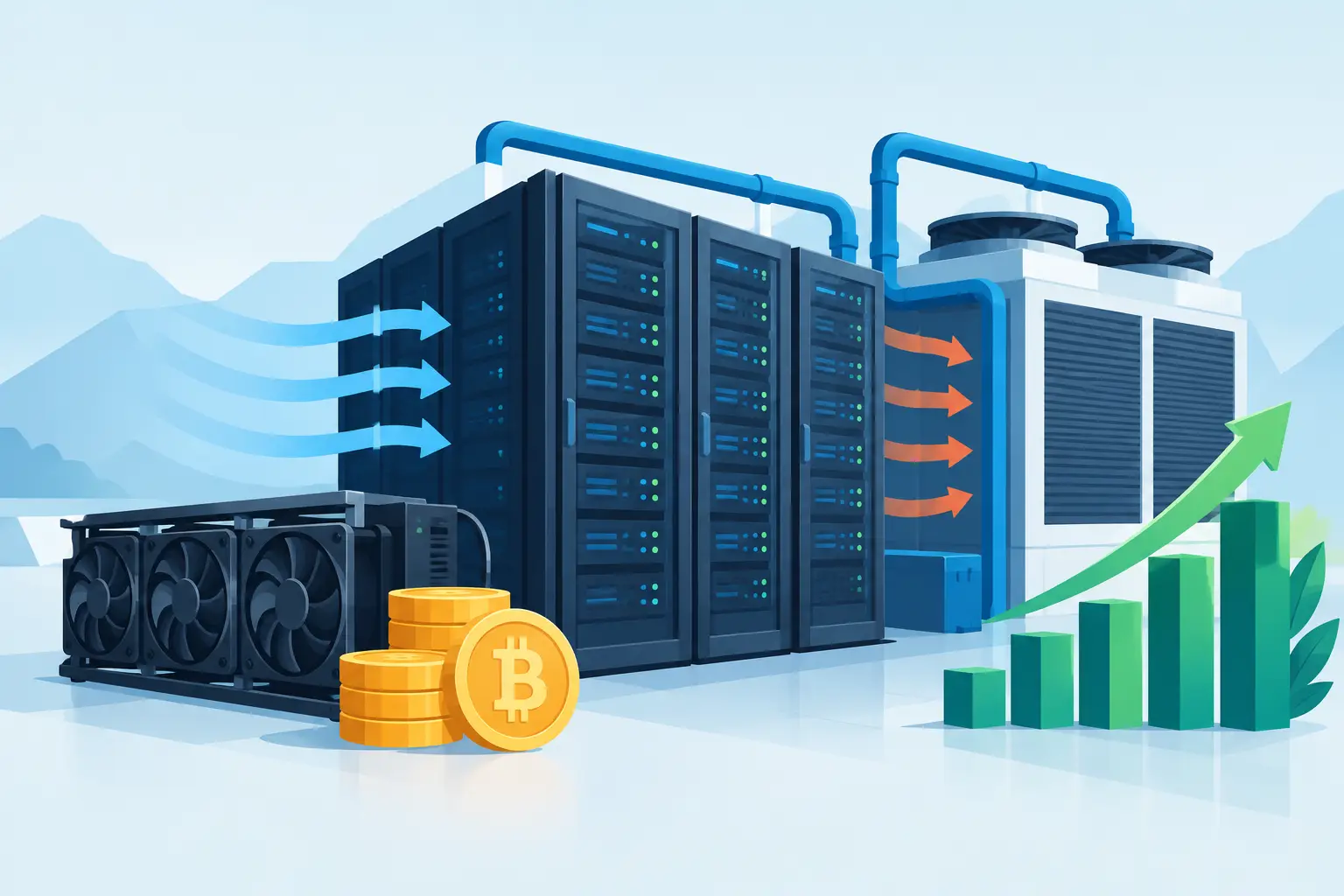
A modern ASIC can turn almost all of the electricity it consumes into heat. For a 3.5 kW miner, that means a 100-machine deployment releases roughly 350 kW of heat continuously. Without disciplined data centre cooling design, that heat quickly becomes lower hashrate, fan failures, thermal throttling, premature component wear and costly downtime.
For mining operators, cooling is not an optional facility feature. It is part of the revenue model. The right approach protects machine availability, controls Opex and gives a fleet room to scale without repeatedly rebuilding the site. The wrong approach can make an attractive electricity rate irrelevant.
Start with the actual thermal load
Cooling capacity should be calculated from the miner fleet, not estimated from room size. Nearly every watt used by an ASIC becomes heat, so a facility with 1 MW of IT load requires the ability to reject approximately 1 MW of heat, plus allowance for power distribution losses, lighting, networking and future capacity.
This is where many small mining sites fall short. They install enough extraction for the initial batch of miners, then add machines until hot air recirculates through the racks. Intake temperatures climb, fans run harder and individual machines begin operating outside their preferred range. A site may still appear online, but it is quietly sacrificing efficiency and hardware life.
A practical design begins with three figures: the current IT load in kW, the expected load after the next expansion stage, and the highest ambient temperature the location is likely to experience. In the UAE, summer conditions make this calculation particularly unforgiving. A cooling strategy that works on a mild day must still protect the fleet during peak heat.
Capacity should also be modular. Rather than installing a single system that becomes a critical point of failure, operators benefit from cooling blocks that can be commissioned as the fleet grows. This reduces unnecessary Capex at launch while keeping expansion predictable.
Airflow is the foundation of data centre cooling design
Air cooling remains the most accessible option for many ASIC deployments. It can be highly effective, but only when the air has a controlled path from intake to exhaust. The objective is simple: deliver the coolest practical air to the miner inlet, then remove hot discharge air before it can mix back into the supply.
Separate cold and hot air
ASIC miners move significant volumes of air. If racks face different directions or hot exhaust spills into the general room, the system starts cooling the same heat more than once. That wastes power and produces uneven inlet temperatures across the fleet.
A contained cold-aisle or hot-aisle layout creates a defined flow path. Miners should be aligned consistently, with sealed gaps around racks, cable penetrations and unused spaces. Extraction should be sized to maintain the intended pressure and prevent hot-air rollback at the final rows.
The detail matters. A poorly sealed opening can become the easiest path for air, bypassing machines that need cooling. Temperature sensors at several points across the intake aisle will reveal whether the design is delivering even conditions or simply creating one cold corner and several hot zones.
Design for resistance, not just volume
High airflow figures alone do not guarantee performance. Filters, louvers, ductwork, bends and evaporative media all create resistance. If fans cannot overcome the system pressure, actual airflow at the miners can be far below the specification.
This is why facility fan selection must account for static pressure as well as cubic metres per hour. Variable-speed fans are valuable because they can respond to ambient conditions and fleet load rather than running at maximum output continuously. The result is better control and lower auxiliary power consumption.
Filtration is another trade-off. Fine filters protect hardware from dust but can restrict airflow if they are not inspected and replaced on schedule. In dusty environments, a maintenance plan for filters is as important as the filter grade itself.
Choose the cooling method around the site economics
There is no single best cooling technology for every mine. The correct choice depends on climate, power price, water availability, fleet density, local maintenance capability and the operator’s growth plans.
Direct outside-air ventilation can offer low-cost heat rejection where ambient conditions are favourable and air quality is manageable. It is often a practical starting point for containerised or warehouse-based deployments. However, high outdoor temperatures, humidity, sand and pollution can increase the need for filtration, supplementary cooling and more frequent servicing.
Evaporative cooling can reduce inlet temperatures with less energy than compressor-based air conditioning, particularly in dry climates. Its trade-off is water use and water treatment. Operators need to assess supply reliability, scaling risk and the cost of maintaining clean media and distribution systems.
Mechanical cooling provides tighter environmental control, but its energy draw can materially affect profitability. It makes sense where thermal conditions, equipment density or customer requirements justify it, rather than as the default answer for every ASIC room. The focus should be on the total power overhead required to keep miners within their operating limits.
For high-density fleets, hydro-cooling changes the equation. Water or a dedicated coolant loop carries heat away far more efficiently than air, allowing greater power density and potentially lower fan-related energy use. Hydro-cooled ASICs can reduce noise and make more compact deployments possible, but they demand properly engineered manifolds, pumps, heat exchangers, leak detection and water-quality management. This is infrastructure, not a simple add-on.
Build resilience into every cooling path
A cooling failure can become a hardware incident within minutes, especially at full load. Resilience is therefore not about promising perfect conditions. It is about identifying failure modes and ensuring the fleet can respond safely.
N+1 capacity is a common approach: install one additional critical fan, pump, cooling unit or electrical feed beyond the number required for normal operation. If one component fails, the system retains sufficient capacity while maintenance is carried out. For larger sites, cooling zones should also be independent where possible, so a fault affects a defined section rather than the entire operation.
Monitoring needs to go beyond a single thermostat on the wall. Operators should track inlet and exhaust temperatures, humidity, differential pressure, fan status, pump flow, water temperature, power draw and individual miner telemetry. Alerts must reach a team able to act, not sit unnoticed in a dashboard.
Automation can protect equipment when conditions deteriorate. Staged responses may include increasing extraction speed, reducing miner frequency, shutting down selected rows or temporarily curtailing the entire fleet. A controlled reduction in hashrate is preferable to allowing sustained overheating to damage boards, PSUs or fans.
Measure cooling by its effect on mining returns
Cooling performance should be reviewed alongside hashrate, rejection rates and electricity consumption. A facility may report acceptable room temperatures while specific miners near an exhaust wall are repeatedly throttling. Machine-level data exposes these issues faster than averages do.
Power Usage Effectiveness, or PUE, is useful as a broad measure of facility overhead. It compares total site power with IT equipment power. Lower is generally better, but it should not become a target detached from operating risk. Cutting cooling energy too aggressively can raise intake temperatures and produce a larger loss through reduced ASIC efficiency or downtime.
The better question is commercial: what cooling investment produces the strongest net mining outcome? In some cases, higher-Capex containment or hydro infrastructure pays back through uptime and machine longevity. In others, a simpler air-cooled design with excellent airflow discipline delivers the best result.
Commission before the fleet is under pressure
Cooling should be tested at load before the facility reaches full production. Commissioning should simulate the hottest credible operating conditions, verify airflow direction, confirm control responses and check whether backup equipment starts as expected. Thermal imaging and sensor trend data can identify leakage, recirculation and overloaded zones that are invisible during a walk-through.
This is also the point to document maintenance intervals, alarm thresholds and escalation responsibilities. A well-designed site can still lose money if filters are left blocked, pumps are not serviced or an alert has no accountable response team.
For operators who want mining infrastructure without carrying every facility risk internally, managed hosting can place procurement, deployment, monitoring and maintenance under one accountable operational model. BitHash approaches cooling as part of the full hosting equation: protecting ASIC performance, controlling operating costs and keeping machines productive at scale.
The strongest cooling design is the one that matches the fleet, local conditions and expansion plan before the first miner is switched on. Get that right, and cooling stops being a recurring emergency and becomes a quiet contributor to predictable hashrate.
BitHash Editorial
Verified AnalystBitHash Infrastructure, UAE Colocation & Mining Intelligence Team