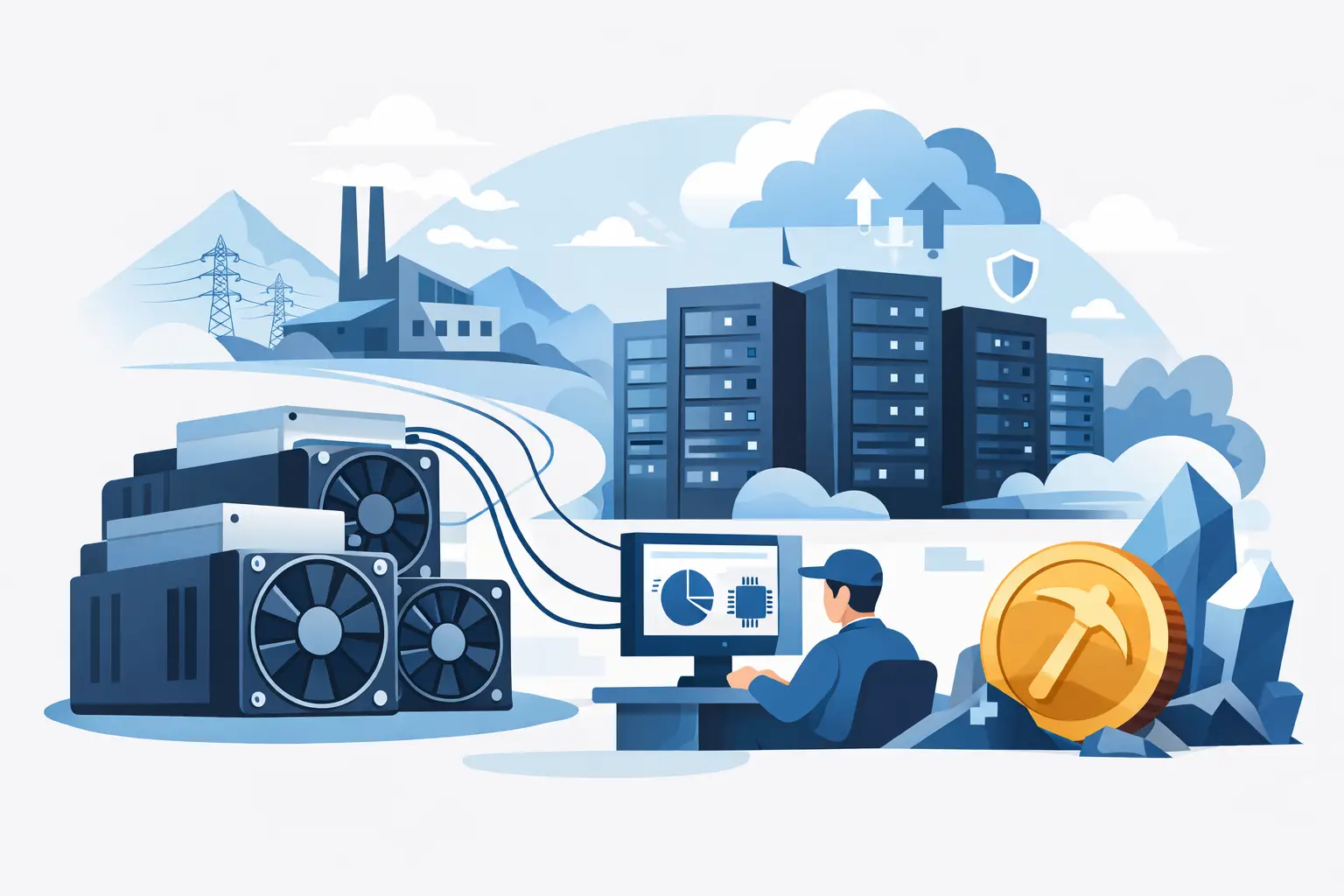
A new ASIC miner can be profitable on paper and still become an operational burden the moment it arrives at your premises. High power draw, heat, noise, network stability and round-the-clock maintenance quickly turn a hardware purchase into an infrastructure project. So, how does mining hosting work? You own the machines while a specialist facility provides the power, space, cooling, monitoring and technical support needed to keep them hashing.
For solo miners, investors building a portfolio and operators managing hundreds of units, hosting replaces the practical difficulty of running equipment yourself with a defined operating arrangement. The aim is simple: get hardware online quickly, protect uptime and make operating costs visible enough to assess mining returns properly.
How Does Mining Hosting Work?
Mining hosting begins with the ASIC hardware. You may purchase miners directly from a hosting provider, supply machines you already own or arrange delivery from a manufacturer or reseller. Before deployment, the provider confirms compatibility, available capacity, electrical requirements and the commercial terms for your chosen site.
Once the machines arrive, technicians inspect them, record their serial numbers and install them in racks or purpose-built containers. Each miner is connected to the facility’s electrical distribution, internet connection and cooling system. The team then configures the mining pool details and wallet settings supplied by the owner, tests hashrate and checks for errors before the equipment goes live.
From that point, the host operates the physical environment while you retain ownership of the miners and receive the mining revenue through your chosen pool arrangement. A strong provider gives you visibility through miner-management software or regular reporting, so you can review hashrate, status, temperature, power use and downtime without being on site.
The division of responsibility should be clear in the contract. The host normally manages facility operations, electricity procurement or billing, security, monitoring and agreed maintenance. The customer owns the machines, controls pool and wallet credentials, and pays the applicable hosting and electricity charges. Details vary, particularly for repair approvals and replacement parts, so never assume a service is included without seeing it in writing.
What a Mining Host Actually Provides
The value of hosting is not merely a shelf with a plug socket. ASICs operate best when the wider infrastructure is designed around their load. A modern high-performance miner can draw several kilowatts continuously. Multiply that by a fleet and the facility needs serious electrical engineering, ventilation, network capacity and operational discipline.
Power is the first consideration. A hosting site supplies electricity through distribution systems built for sustained industrial loads, rather than domestic circuits that were never intended for a 24/7 mining operation. Your agreement may quote an all-in rate per kWh, a power price plus management fee, or another defined structure. The distinction matters because energy is normally the largest ongoing operating expense.
Cooling is equally commercial. Air-cooled ASICs need controlled airflow to move heat away from the machines. In hotter climates, poor ventilation can lead to thermal throttling, more frequent faults and lower effective uptime. Hydro-cooling hosting uses liquid-based systems for compatible miners and can support higher-density deployments, but it requires specialised equipment and may not be the right fit for every portfolio.
A professional facility also provides network connectivity, security and continuous monitoring. Technicians can spot an offline miner, declining hashrate, fan fault or abnormal temperature before a minor issue becomes a lengthy outage. Physical controls matter too: controlled site access, cameras, asset records and documented handling procedures reduce the risk associated with valuable equipment operating far from its owner.
From Payment to Live Hashrate
Deployment speed depends on whether the facility has available capacity, the machine model is in stock and the commercial checks are complete. Where capacity and hardware are ready, a well-organised host can deploy within 24 hours of payment confirmation. For larger fleets, the process may include staged delivery, electrical planning and commissioning milestones.
The practical sequence is straightforward. You select the ASIC model and hosting package, confirm the hardware quantity and site, and agree the electricity rate, term, fees and service scope. The provider receives the miners, performs intake checks, installs them and connects them to the selected mining pool. After testing, you should receive confirmation that the units are online, together with access to monitoring data.
For an investor, the most useful question is not simply, “When will my miners start?” It is, “What evidence will show they are operating as expected?” Ask how the provider reports online status, accepted hashrate, rejected shares, power consumption and maintenance events. Pool-side hashrate and facility-side monitoring can differ slightly over short periods, but persistent gaps deserve an explanation.
Costs That Determine Whether Hosting Makes Sense
Mining hosting simplifies operations, but it does not remove mining economics. Your result still depends on Bitcoin price, network difficulty, block rewards, transaction fees, miner efficiency, pool fees and electricity costs. Hosting makes these inputs easier to manage, not guaranteed.
The cost structure usually includes the ASIC purchase price or Capex, electricity consumption, a hosting or management charge, shipping and possible import costs, pool fees, and repair or replacement-part costs. Some providers combine several of these into a single kWh rate; others itemise them. Neither approach is automatically better. Transparency is what lets you compare offers accurately.
Review the rate alongside the machine’s efficiency, usually expressed in joules per terahash. A more efficient ASIC may cost more upfront but consume less power for the same hashrate. Conversely, a lower-priced older unit can look attractive until electricity and repair requirements are modelled over several months.
It is also worth checking minimum commitments and payment terms. Industrial hosting agreements may require a minimum number of machines, a fixed contract duration or advance electricity deposits. These terms can support stable infrastructure planning, but they affect your flexibility if market conditions change.
Uptime, Maintenance and the Reality of Operations
No hosting facility can honestly promise that every machine will run without interruption. Grid events, pool connectivity issues, firmware faults, failed fans, power supply problems and hashboard errors can occur. What separates a reliable hosting operation is the speed and quality of its response.
Ask how downtime is detected, who performs first-line diagnostics and whether rebooting, cleaning and basic fault checks are included. For more serious issues, confirm the repair process: whether approval is required, how labour is priced, whether spare parts are held locally and how long a typical repair takes. A low hosting rate loses its appeal if machines wait weeks for a simple replacement component.
For sizeable fleets, reporting should support operational decisions rather than merely reassure. You should be able to identify underperforming units, compare actual hashrate with expected output and understand whether losses come from the machine, the pool or the facility. This is where hands-on technical support and clear software access become part of the return profile.
Choosing the Right Hosting Arrangement
The right provider depends on your scale and priorities. A first-time miner may value an all-in package, guided pool setup and direct support. A professional operator may focus on contracted power capacity, PPA structure, hydro-cooling capability, fleet-level reporting and room to scale beyond 150 units.
Before committing, examine the facility’s location only in relation to what it changes: electricity economics, climate, regulatory environment, logistics and access to technical staff. UAE-based hosting can be particularly valuable for investors who want regional support, structured deployment and a clear point of accountability, while global options may suit portfolios seeking different power markets.
BitHash approaches hosting as part of the full mining workflow, from ASIC sourcing and deployment to 24/7 monitoring, maintenance and expansion planning. That single-provider model can reduce handovers between hardware sellers, freight agents, data-centre operators and repair teams.
The best hosting arrangement is one you can audit before and after your miners go live. Understand the price per kWh, know exactly what support covers, keep control of your pool and wallet settings, and monitor performance against realistic assumptions. When those foundations are in place, hosting lets your mining hardware work where the infrastructure is built to keep it working.