How to Secure Mining Hardware for Maximum Uptime
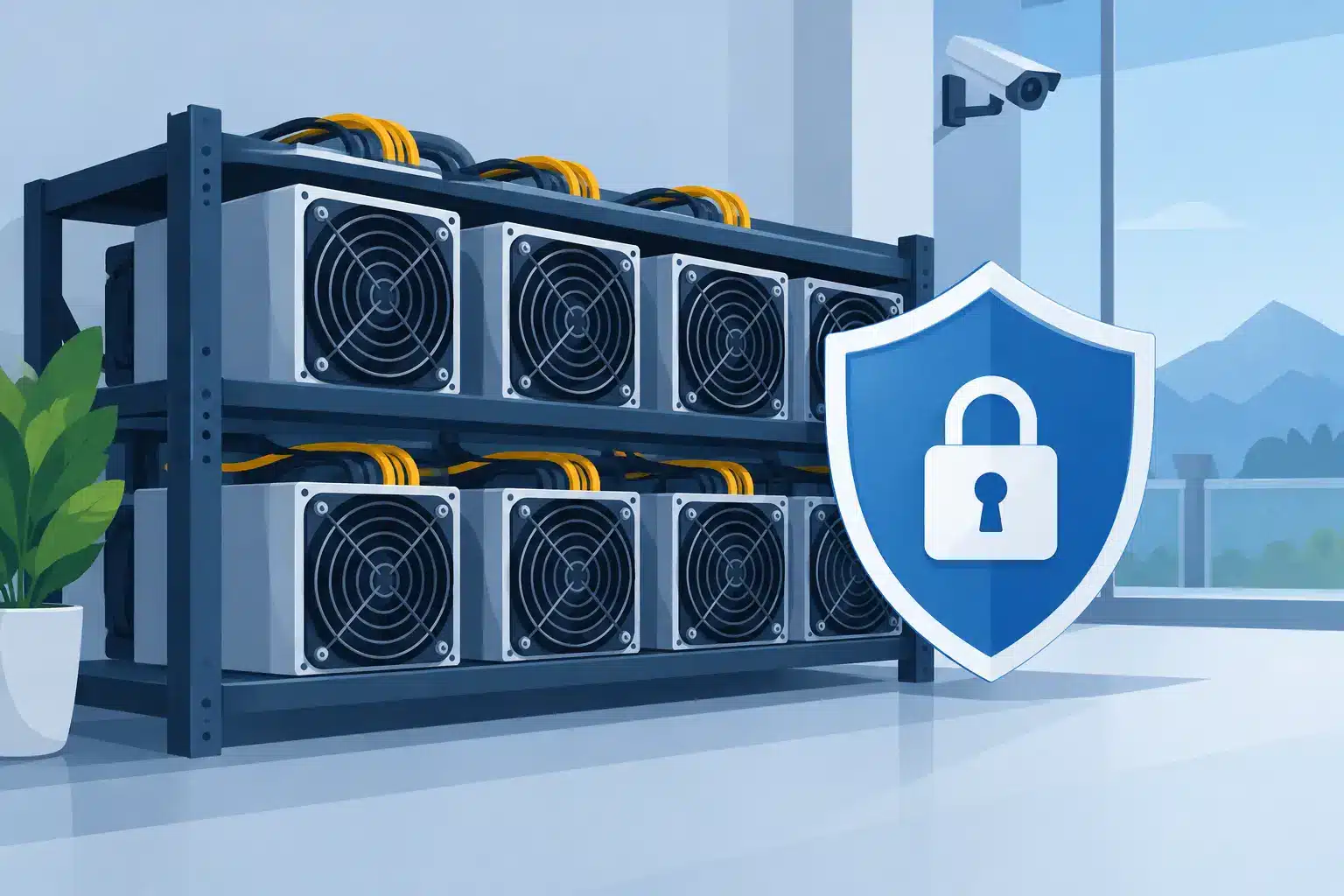
A miner does not need to be stolen to become a costly security incident. One unauthorised firmware change, overheated rack, failed breaker or exposed management interface can take hashrate offline without warning. Knowing how to secure mining hardware means protecting the machine, the facility and the operating process that keeps each ASIC producing.
For a single home miner, the controls may be straightforward. For a portfolio of machines or an industrial fleet, security becomes an uptime discipline. The right approach reduces theft risk, limits avoidable downtime and gives operators a clear path to recover when something does go wrong.
How to secure mining hardware starts with the site
ASIC miners are valuable, portable and designed to operate continuously. That combination makes physical access the first control, not an afterthought. A locked room is a minimum requirement. Professional facilities should add controlled entry, camera coverage, visitor records and a clear chain of custody from delivery to rack installation.
Each machine should be recorded by model, serial number, purchase date, rack position and assigned owner. Photographs at intake are useful, particularly for hosted equipment and larger deployments. This inventory is what allows an operator to identify a missing unit, verify warranty status and avoid confusion when a repair or replacement is required.
Access should follow the least-privilege principle. An electrician may need access to switchgear but not miner-management credentials. A technician may need access to a row of machines but not every customer account. Keep keys, cards and cabinet codes controlled, and revoke access promptly when a contractor or employee leaves.
Security also extends to the delivery point. Confirm who can accept hardware, where it is stored before installation and how serial numbers are checked against shipping documents. A miner that disappears between a loading bay and a rack is not simply a logistics problem. It is an operational loss that delays deployment and disrupts expected returns.
Build power and cooling protection into the design
Most mining interruptions are not sophisticated attacks. They are practical failures involving power, heat, dust or poor installation. Security planning should therefore start with electrical design sized for sustained load rather than optimistic peak figures.
Use properly rated distribution equipment, breakers, cabling and power delivery units. Circuits need clear labels, documented capacity and sufficient headroom. Overloading a circuit to add one more miner can trigger trips, create heat at connection points and place an entire row offline. A qualified electrical team should calculate load at the operating voltage and account for startup behaviour, ambient conditions and redundancy requirements.
Where uptime targets justify it, separate critical systems from miner loads. Networking equipment, monitoring systems, access control and cooling controls should not disappear simply because a mining circuit trips. Backup power for these systems gives operators visibility during an incident and shortens the time to diagnose it.
Cooling is equally central to hardware security. High inlet temperatures, blocked airflow and dust accumulation shorten component life and can cause persistent faults that look like a firmware or pool issue. Maintain clear hot and cold airflow paths, inspect filters, and set alerts for inlet temperature, fan speed and abnormal chip temperatures. In hydro-cooled environments, monitor flow rate, fluid temperature, pressure and leak detection with the same discipline applied to electrical systems.
Fire detection and suppression should suit the facility design and local requirements. The goal is not merely compliance. Early detection protects personnel, equipment and the continuity of the wider operation. Keep combustible packaging away from active racks, maintain clear access routes and test emergency procedures before they are needed.
Lock down the miner network
A profitable ASIC fleet is an attractive target because its settings determine where hashrate is directed and who receives the mining reward. The most common weakness is leaving management interfaces exposed or retaining factory credentials.
Place miners on a segmented network separate from office devices, guest Wi-Fi, CCTV and access-control systems. Use firewalls to restrict management traffic to approved IP addresses and ports. Remote administration should pass through a secure VPN or controlled gateway, never an openly available web interface.
Every miner, router, switch and monitoring platform needs unique, strong credentials. Remove default usernames and passwords at commissioning, use multi-factor authentication wherever the system supports it, and store recovery codes securely. Shared passwords may appear convenient during deployment, but they make it difficult to establish accountability and nearly impossible to remove access cleanly.
Firmware deserves a controlled process. Use updates from verified manufacturer or trusted management-platform sources, check version compatibility, and test changes on a small group of miners before fleet-wide deployment. Unverified firmware can redirect hashrate, reduce efficiency, introduce instability or leave a backdoor that survives a password reset.
Pool configuration should be monitored as closely as temperature and hashrate. Set alerts for changes to wallet addresses, pool URLs, worker names and accepted-share performance. A miner that is running normally but pointed at an unauthorised destination can be more damaging than a miner that is visibly offline.
Make monitoring actionable, not decorative
A dashboard alone does not secure a mining operation. It becomes valuable when someone owns the response to the alerts it creates. Define thresholds for offline miners, hashrate variance, rising reject rates, high temperatures, frequent reboots and unusual power consumption. Then define what happens next.
For example, a single offline unit might generate a remote restart request. Several machines going offline in one rack may indicate a power, network or cooling event and should escalate immediately. A pattern of hashboard errors may require a technician visit before minor instability becomes a costly repair.
24/7 monitoring matters because mining income is measured continuously. However, constant notifications without priorities quickly become noise. Categorise alerts by operational impact, assign escalation contacts and record incidents. Over time, the incident record shows recurring faults, weak components and operating conditions that deserve capital investment.
Remote management tools should provide role-based access and an audit trail. You need to know who changed a pool setting, restarted a miner or modified a configuration, and when they did it. This is particularly relevant for hosted portfolios where transparent oversight protects both the operator and the equipment owner.
Plan for maintenance, spares and recovery
Security is partly about how quickly you return to normal after failure. Keep a documented maintenance schedule for cleaning, fan inspection, cable checks, firmware review and performance testing. The interval depends on the environment: a filtered, professionally managed data centre requires a different routine from a dusty industrial site.
Stocking spare fans, control boards, power supplies and network components can materially reduce downtime, but do not overstock blindly. Base critical spares on fleet size, failure history, model availability and shipping lead times. For a large standardised fleet, holding common parts makes commercial sense. For a small mixed fleet, a dependable repair partner may be more efficient than carrying every component.
Back up configurations for each miner or batch, including pool settings, network assignments and approved firmware versions. Store those records securely and separately from the production network. If a controller fails or a rack must be rebuilt, a tested configuration backup turns hours of manual work into a controlled recovery.
Insurance should match the real deployment model. Check whether cover includes transit, theft, fire, water damage, equipment breakdown and business interruption. Hosting agreements should also make responsibility clear: who controls physical access, who performs repairs, what uptime visibility is provided and how incidents are communicated. Transparent terms are a security control because they remove ambiguity when time matters.
Choose infrastructure that supports the security standard
The cheapest electricity rate is not always the lowest operating cost. A site with weak access controls, limited monitoring, poor cooling or slow maintenance response can lose more in avoidable downtime than it saves on kWh pricing. Evaluate the full operating environment before placing machines.
Ask practical questions: Who is on site when an alert occurs? How are miners tracked from delivery through installation? Is the network segmented? What happens when a power circuit trips? How quickly can a failed unit be diagnosed and repaired? Serious hosting providers can answer these questions clearly, with operational processes rather than vague assurances.
BitHash approaches this as infrastructure management, combining hardware deployment, monitored hosting and technical support so miners can retain visibility without carrying every daily operational burden themselves. The right partner should make security measurable through documented access, live status information and accountable incident handling.
Mining hardware earns only when it is online, correctly configured and operating within safe limits. Treat security as part of your hashrate strategy, review it whenever you scale, and build every new deployment around the question that matters most: if this component fails or this access point is abused, how quickly can the operation keep mining?
Written by BitHash Editorial
BitHash Infrastructure & Mining Research Team