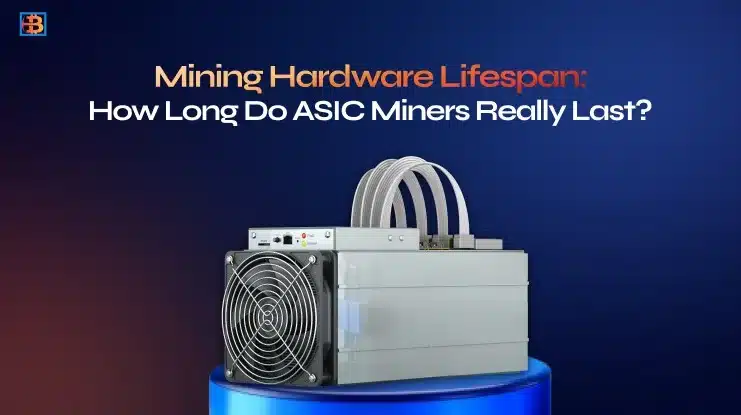
Investing in an ASIC (Application-Specific Integrated Circuit) miner represents a significant commitment for any cryptocurrency enthusiast or professional miner. These specialized machines, designed exclusively for solving the complex mathematical puzzles that secure blockchain networks and release new coins, don’t come cheap.
Yet the question that keeps every investor awake at night isn’t just about initial cost, it’s about longevity. How long will this hardware actually serve you before it becomes obsolete or no longer makes financial sense?
Understanding ASIC miner lifespan requires looking beyond the simple “years it will run” to consider a more complex reality involving technological evolution, energy economics, and market dynamics. A miner might physically operate for half a decade, while its profitable lifespan could be half that time or less. This discrepancy forms the core challenge of ASIC mining investments.
In this comprehensive guide, we’ll demystify exactly what determines how long your mining hardware will last, how to maximize its productive lifespan, and when to recognize that its profitable days are over, even if it’s still technically functional.
Understanding the Dual Lifespan Concept
Every ASIC miner actually has two distinct lifespans operating simultaneously:
Physical Lifespan: The Machine’s Operational Life
This refers to how long the hardware components continue to function before they fail. With proper maintenance and optimal operating conditions, ASIC miners can operate physically for:
- 3-5 years under normal conditions
- 5+ years with exceptional care and an optimal environment
- 2-3 years with poor maintenance or harsh conditions
Economic Lifespan: The Profitability Window
This is the period during which the miner generates more cryptocurrency value than it consumes in electricity and maintenance costs. This window is typically much shorter:
- 12-24 months for most miners under average conditions
- 18-30 months with extremely cheap electricity
- 6-12 months in highly competitive networks or expensive energy markets
The Lifespan Comparison Table
| Aspect | Physical Lifespan | Economic Lifespan |
| Definition | Hardware remains functional | Miner generates net profit |
| Primary Determinants | Build quality, maintenance, and cooling | Electricity cost, mining difficulty, coin price |
| Typical Duration | 3-5 years | 1-3 years |
| Can It Be Extended? | Yes, through careful maintenance | Yes, through efficiency improvements |
| End Point | Hardware failure | Break-even point (costs ≥ earnings) |
Factors That Determine ASIC Miner Longevity
The lifespan of your mining hardware isn’t random or predetermined at the time of purchase. Instead, it’s shaped by several interconnected factors that you can partially influence through smart decisions and proper management. Understanding these factors helps you maximize your return on investment.
1. Technological Obsolescence: The Unstoppable Force
ASIC mining exists in perhaps the most rapid hardware evolution cycle of any industry. This relentless progress dramatically shortens profitable lifespans:
- New generations appear every 12-18 months
- Each generation offers 20-40% better efficiency (joules per terahash)
- Network difficulty adjusts upward as more efficient miners join
- Your older miner’s share of rewards decreases proportionally
Example: A miner producing 100 TH/s at 3,000W becomes economically obsolete when newer models produce 140 TH/s at the same power draw or achieve the same hash rate at 2,100W.
2. Electricity Costs: The Profitability Killer
Electricity represents 70-90% of ongoing mining costs, making it the single most important factor in economic lifespan:
| Electricity Rate | Impact on Economic Lifespan |
| $0.03-0.05/kWh | Maximum lifespan (2.5-3.5+ years possible) |
| $0.06-0.10/kWh | Standard lifespan (1.5-2.5 years typical) |
| $0.11-0.15/kWh | Reduced lifespan (1-2 years maximum) |
| $0.16+/kWh | Minimal or no profitability from the start |
Critical Insight: A miner that’s profitable at $0.07/kWh becomes a money-loser at $0.12/kWh even if nothing else changes.
3. Maintenance & Operating Environment
ASICs operate under extreme thermal stress 24/7/365. Their physical longevity depends heavily on operating conditions:
Optimal Conditions Extend Life:
- Temperature: Maintained at 25-35°C (77-95°F)
- Humidity: Controlled at 40-60% relative humidity
- Cleanliness: Dust-free environment with regular cleaning
- Power Quality: Stable voltage with surge protection
- Ventilation: Proper airflow with sufficient space between units
Shortening Factors:
- Continuous operation above 40°C (104°F)
- Dust accumulation on hash boards and heatsinks
- Voltage fluctuations and power surges
- Poor-quality power supplies
- Stacking miners without adequate airflow
4. Network Factors Beyond Your Control
Two external variables significantly impact profitability:
Mining Difficulty:
- Increases as more computational power joins the network
- Typically rises steadily over time (with occasional adjustments)
- Directly reduces your miner’s share of block rewards
Cryptocurrency Price:
- Rising prices can resurrect “unprofitable” miners
- Falling prices can erase margins overnight
- Volatility makes long-term planning challenging
Maximizing Your Miner’s Lifespan: Practical Strategies
Knowing the challenges is only half the battle. The real skill comes in implementing strategies that extend both the physical and economic life of your mining hardware. These practical approaches can mean the difference between a profitable operation and a money-losing hobby.
Extending Physical Lifespan:
- Thermal Management Excellence
- Implement advanced cooling solutions
- Consider immersion cooling for extreme environments
- Maintain consistent operating temperatures
- Never operate without adequate airflow
- Proactive Maintenance Schedule
- Weekly: Check fan operation and temperatures
- Monthly: Inspect for dust accumulation
- Quarterly: Deep clean with compressed air
- Annually: Consider replacing thermal paste
- Power Quality Assurance
- Use quality uninterruptible power supplies (UPS)
- Implement proper surge protection
- Ensure stable voltage input
- Consider power conditioning equipment
Extending Economic Lifespan:
- Electricity Cost Optimization
- Negotiate industrial/commercial electricity rates
- Explore renewable energy sources (solar, hydro)
- Consider geographic relocation to energy-advantaged regions
- Utilize waste heat for other purposes (greenhouses, heating)
- Efficiency Tweaks and Modifications
- Underclocking: Reduce power consumption with minimal hash rate impact
- Custom Firmware: Install optimized software for better efficiency
- Cooling Upgrades: Improve thermal performance to reduce fan power
- Voltage Optimization: Fine-tune power delivery for your specific unit
- Strategic Operation Timing
- Mine during off-peak electricity hours, where time-of-use rates apply
- Consider shutting down during extended bear markets
- Participate in demand response programs if available
Recognizing End of Life: When to Retire Your Miner
Even with the best care and optimization, every miner eventually reaches a point where continued operation no longer makes financial sense. Recognizing these signs early prevents losses and enables better planning for your next hardware purchase. Clear Signs Your Miner’s Economic Life Is Over:
- Consistent Negative Daily Profit
- More than 30 consecutive days of losses
- Losses continue even after optimizing operations
- Repair Costs Exceed Value
- Major component failure would cost >50% of the miner’s current value
- Frequent minor repairs are accumulating significant expense
- Severe Efficiency Disadvantage
- Your miner uses 2x+ the energy per TH compared to current models
- Newer miners are 3x+ more efficient overall
Planning Your Mining Hardware Strategy
Successful mining isn’t about making one perfect purchase but about developing a sustainable strategy that accounts for the inevitable obsolescence of all hardware. This forward-thinking approach separates professional operations from amateur endeavors.
Smart Acquisition Approach:
- Calculate Total Cost of Ownership: Include electricity, maintenance, and cooling
- Project Realistic ROI Timeline: Assume 18-24 months profitable window
- Consider Used Equipment: Often better value with understanding of remaining life
- Plan for Obsolescence: Have an exit strategy before purchase
The Upgrade Cycle Strategy:
- Monitor Efficiency Metrics: Track joules/TH regularly
- Set Upgrade Triggers: Decide in advance what conditions prompt replacement
- Time Sales Strategically: Sell before complete obsolescence maximizes residual value
- Budget for Regular Upgrades: Treat as ongoing operational expense
Conclusion:
The question “How long do ASIC miners really last?” has a dual answer that every miner must internalize. Physically, with exceptional care and optimal conditions, ASIC miners can operate for 3-5 years or occasionally longer. Economically, however, the window of profitability typically ranges from just 1-3 years under normal conditions, with 18-24 months being the most common timeframe.
The rapid pace of mining technology means standing still equals moving backward. Your mining operation’s success depends less on making a single miner last forever and more on strategically cycling through hardware at optimal intervals.
By understanding the true lifespan of ASIC miners and planning accordingly, you transform from a passive hardware owner into an active mining strategist, maximizing returns throughout the lifecycle of each investment.