A miner can look profitable on a spreadsheet and still become an expensive problem before it produces its first satoshi. Delivery delays, incorrect electrical specifications, weak ventilation, firmware faults and unclear power billing can all erode returns. Turnkey bitcoin mining is designed to remove those operational gaps by putting hardware, infrastructure and day-to-day management under one accountable provider.
For a first-time buyer, that means a route into ASIC mining without building a facility. For an operator scaling from a few machines to a fleet, it means less time coordinating suppliers and more control over uptime, costs and expansion. The value is not simply that someone plugs in a miner. It is that the whole chain is planned to keep capital deployed and hashrate online.
What turnkey bitcoin mining should include
A genuine turnkey offer starts before the ASIC arrives at a site. The provider should help select hardware that fits your budget, risk tolerance, energy price and target deployment date. A high-hashrate miner with a low purchase price is not automatically the right choice if its efficiency is poor, its supply is uncertain or the hosting environment cannot support its heat output.
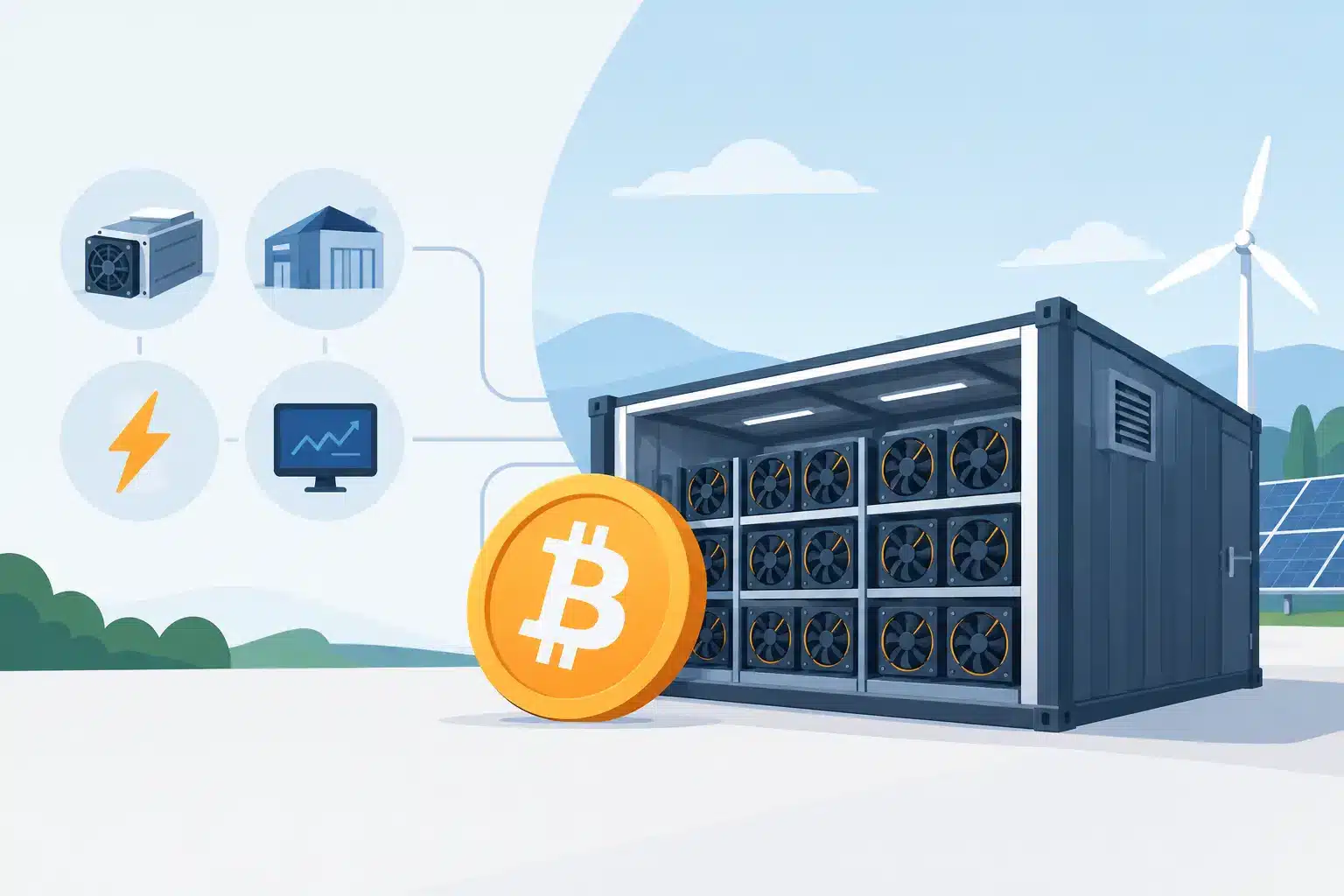
The package then brings together procurement, logistics, installation, power allocation, networking, monitoring and technical support. Instead of buying a machine from one party, arranging transport through another, then searching for a host after delivery, the client has a defined deployment pathway and a single point of responsibility.
In practice, a turnkey arrangement may cover:
- ASIC miner sourcing, model selection and purchase coordination
- Site hosting, rack placement, electrical connection and network configuration
- Electricity pricing, metering and billing terms
- 24/7 monitoring, security, diagnostics and incident response
- Preventive maintenance, repair handling and replacement-part access
- Miner-management software for visibility across hashrate, status and earnings
The exact scope matters. Some providers use the word turnkey when they mean hardware delivery plus a hosting introduction. Others manage the entire operating lifecycle. Before committing capital, ask where responsibility begins and ends, particularly when a machine fails, a site experiences curtailment or network conditions change.
Hardware is only one part of mining performance
ASIC specifications attract attention for good reason. Hashrate, power draw and joules per terahash determine how efficiently a machine converts electricity into computational work. Yet a miner’s rated specification is only useful when it is operating under suitable conditions.
A facility must deliver stable electrical capacity, appropriate cabling, network reliability and airflow or liquid cooling designed for the installed load. Heat is not a side issue. It is one of the main operating constraints in Bitcoin mining. Excessive temperatures can lead to throttling, higher fan demand, component wear and avoidable downtime.
This is where turnkey infrastructure earns its place. Air-cooled machines may suit a standard hosting environment, while high-density deployments can justify hydro-cooling. Hydro systems can support greater rack density and more controlled thermal performance, but they require specialised infrastructure, careful water treatment and technicians who understand the system. It is not automatically the best option for every portfolio. The right choice depends on the miner model, local climate, site design and scale of the deployment.
For investors buying several units, the operational question is simple: what uptime can the site realistically support, and how quickly will faults be identified and resolved? For industrial operators, it becomes more detailed: how is power distributed, what redundancy exists, how are spare units handled and what is the maintenance process at fleet level?
The economics: look beyond the machine price
The initial ASIC invoice is Capex. It is visible, immediate and often the first number buyers compare. Long-term mining economics, however, are driven by Opex: electricity, hosting, maintenance, pool fees, logistics, repairs and the cost of downtime.
Electricity is normally the largest operating expense. A competitive kWh rate means little if the billing method is vague. Ask whether the quoted figure includes all hosting charges, power losses, taxes, management fees and demand-related costs. If the arrangement uses a power purchase agreement, understand the term, volume commitment, pricing mechanism and what happens when energy costs move.
Mining revenue is variable. Bitcoin price, network difficulty, transaction-fee conditions, block luck and pool performance all affect output. No responsible turnkey provider should present a fixed return as though it is guaranteed. A stronger approach is to model several scenarios: conservative, expected and high-performance. Use current network data, then test what happens if difficulty rises, price falls or machines experience a realistic level of downtime.
A useful calculation starts with daily gross revenue, then subtracts daily electricity cost and the hosting fee. Add a maintenance reserve rather than assuming repairs will never occur. The remaining figure is not a promise of profit, but it gives you a more disciplined basis for judging payback periods and portfolio size.
Questions that reveal the quality of a provider
The difference between a sales-led package and an operationally credible one often becomes clear in the questions the provider can answer. Ask for the deployment timeline from payment confirmation to active hashing. A well-prepared operator should explain stock availability, shipping, customs requirements, commissioning and the conditions needed to go live. Fast deployment is valuable, but only when the site capacity and hardware allocation are genuinely confirmed.
Ask how performance is reported. You should be able to see machines online, hashrate, pool configuration, power use where available, fault status and maintenance activity. Transparent reporting reduces disputes and helps sophisticated clients assess performance against their own financial model.
Security also deserves more than a passing mention. Your miners are physical assets with a meaningful resale value. Check how access is controlled, how units are labelled and inventoried, whether facilities are monitored around the clock and how the provider records a machine’s movement from receipt to rack to repair bench.
Finally, examine the support process. A repair service is not useful only because it exists. What matters is diagnosis time, spare-part availability, approval procedures, repair pricing and communication while a unit is offline. At scale, an unclear maintenance workflow can turn a manageable fault rate into a serious loss of hashrate.
When turnkey mining makes commercial sense
Turnkey mining is particularly useful when your capital is intended for Bitcoin exposure and infrastructure ownership is not the primary objective. Building a private mining site can make sense for a large operator with access to reliable power, engineering resources, favourable land or an established industrial footprint. It also creates control over every layer of the operation.
That control comes with a substantial burden. You must secure capacity, design the electrical and cooling systems, manage permits where required, source technicians, protect the site and maintain operations continuously. A single missed assumption in power availability or heat management can delay a project long after the ASICs have been paid for.
Managed turnkey hosting converts much of that complexity into an operating agreement. It can be a practical fit for a solo miner purchasing one or two machines, a high-net-worth investor building a diversified fleet, or a company that wants mining exposure without becoming a data-centre operator. The trade-off is that you depend on the provider’s execution, contract terms and facility standards. Due diligence does not disappear. It becomes more focused.
For larger fleets, the model can also support phased growth. Rather than committing immediately to a dedicated build, an operator can validate hardware performance, operating costs and management processes through hosted capacity, then move towards a custom facility when the economics and scale justify it.
From payment to active hashrate
A disciplined deployment begins with a clear machine and hosting specification. This should state the ASIC model, quantity, expected hashrate range, power requirement, hosting location, electricity terms and any cooling requirements. If the numbers are not documented before payment, they will be harder to verify once the fleet is live.
Next comes allocation and commissioning. Machines are received, inspected, recorded, installed, configured with the chosen mining pool and tested under load. The provider should confirm active hashrate rather than treating physical installation as the end point. BitHash, for example, positions rapid deployment alongside UAE-based operational support, which is relevant when speed needs to be matched by accountable local infrastructure.
Once online, the relationship shifts from deployment to operations. Machines need monitoring, pools may need updating, firmware requires careful management and failed hashboards need a defined repair path. This is why the strongest turnkey model is not a one-off transaction. It is an operating framework that protects machine availability over time.
The right question is not whether turnkey bitcoin mining is easier than doing everything yourself. It is whether the provider can turn operational complexity into measurable performance: clear costs, visible machines, rapid fault response and infrastructure that gives your ASICs the best chance to keep hashing.