
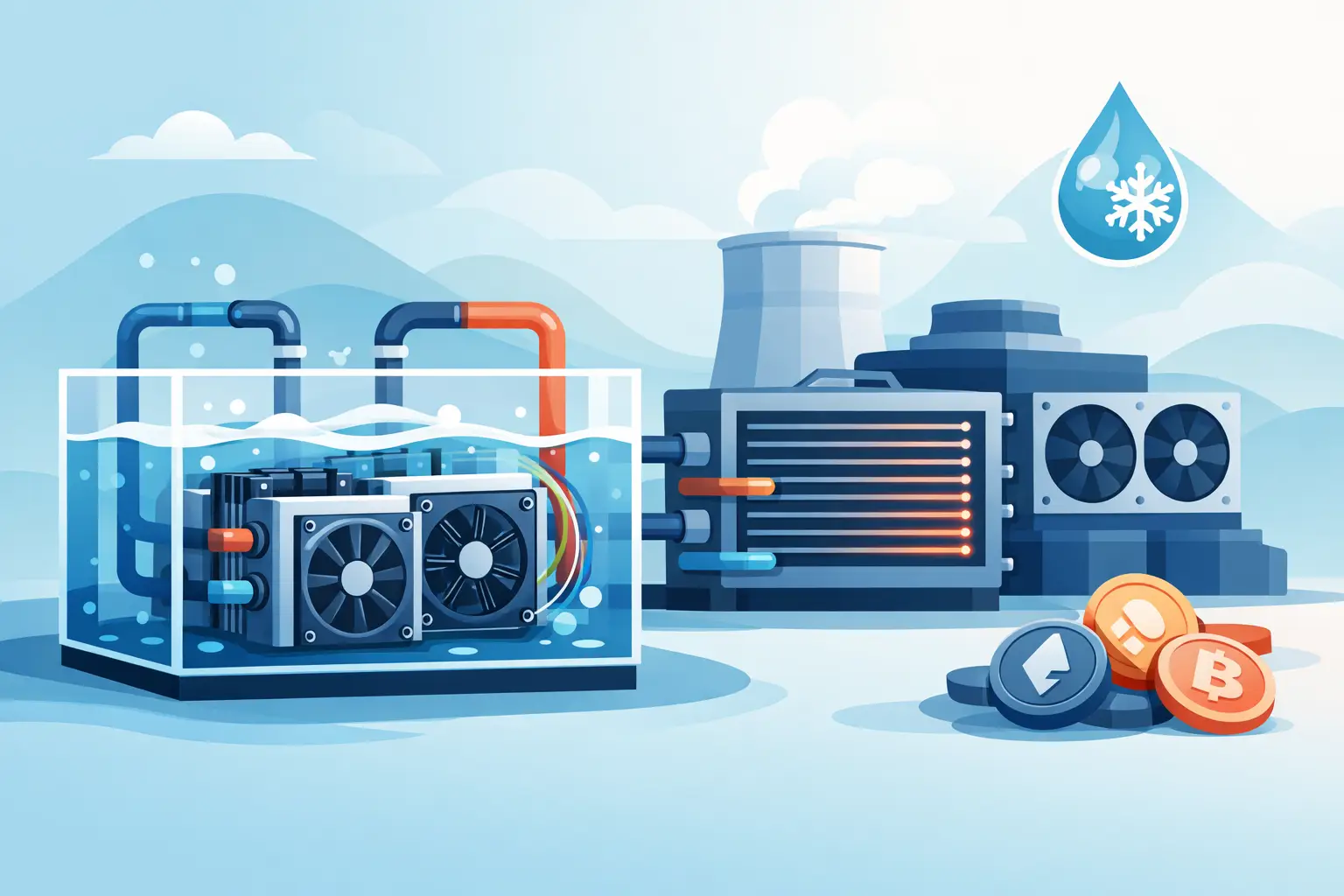
A modern ASIC can turn more than 3 kW of electrical power into heat without pause. Multiply that by a fleet and cooling stops being a background facility task – it becomes one of the main determinants of uptime, operating cost and how much hashrate a site can fit into each megawatt. So, what is hydro cooling mining? It is a mining method that uses a controlled liquid loop to remove heat from purpose-built ASIC miners rather than relying mainly on air and high-speed fans.
For investors, the attraction is straightforward: hydro cooling can support denser deployments, more stable operating temperatures and a quieter, more controlled mining environment. It is not a shortcut to guaranteed profitability, however. The result depends on miner selection, electricity price, facility engineering, coolant temperatures and the operator behind the infrastructure.
What is hydro cooling mining and how does it work?
Hydro cooling mining uses liquid coolant – commonly treated water or a water-glycol mixture – to carry heat away from ASIC chips. Hydro-cooled miners are designed differently from standard air-cooled units. Instead of forcing large volumes of air through heatsinks with multiple fans, they use internal cold plates and coolant channels positioned over the hardware’s hottest components.
The warmed liquid leaves the miner through supply and return connections and enters a wider cooling system. Pumps maintain flow, while a coolant distribution unit, heat exchanger and external heat-rejection equipment remove the captured heat. Depending on the site, this may include dry coolers, cooling towers or chillers.
The key distinction matters. Hydro cooling is not the same as immersion mining. In an immersion system, the whole miner is placed in a dielectric fluid. In a hydro-cooled system, coolant travels through sealed channels and manifolds inside a miner built for that purpose. Standard air-cooled ASICs cannot simply be connected to a hydro loop.
Why mining operators move beyond air cooling
Air cooling remains practical for many operations. It is familiar, easier to deploy in small numbers and generally requires less specialised plumbing. But air is a relatively inefficient medium for moving large amounts of heat. As rack density rises, operators need more fans, more airflow management and more space between equipment to avoid hot spots and recirculated exhaust.
Liquid carries heat far more effectively. That lets a properly engineered hydro facility place more hashrate within the same footprint. Removing onboard fans also reduces miner noise substantially, although pumps, dry coolers and other plant equipment still create sound. For sites near commercial or industrial activity, the lower acoustic profile can be a meaningful operational advantage.
Temperature stability is another major benefit. High inlet temperatures, dust and uneven airflow can push air-cooled miners into thermal throttling or create avoidable component stress. A hydro loop can deliver coolant at a controlled temperature across the fleet, helping miners operate closer to their intended performance profile. This does not eliminate failures, but it gives operators a more predictable thermal environment in which to manage them.
The efficiency opportunity
Hydro cooling can reduce the electricity consumed by miner fans and may lower the wider cooling burden when compared with poorly designed air systems. That can improve the amount of power available for actual hashrate. The gain is site-specific, not automatic.
A hydro site still needs pumps, controls, heat rejection and sometimes water treatment or chillers. If those systems are oversized, badly maintained or run at unnecessarily low temperatures, auxiliary power can erode the expected advantage. The right question is not whether liquid cooling is efficient in theory. It is what the entire facility consumes to produce each unit of hashrate reliably.
For larger fleets, this is where metrics such as PUE, miner efficiency in J/TH, coolant temperature and electrical loss become commercially useful. They show whether the infrastructure is genuinely supporting ROI rather than merely looking advanced on a specification sheet.
The infrastructure behind a hydro-cooled fleet
A hydro-cooled ASIC is only one part of the system. The facility around it must be designed as an integrated thermal and electrical operation. A failure in coolant flow, water quality, power distribution or monitoring can affect far more machines than a single failed fan in an air-cooled container.
At minimum, a professional deployment needs correctly sized piping and manifolds, duty and standby pumps, filtration, leak detection, isolation valves, sensors and controls. The coolant loop should be commissioned and pressure-tested before miners are connected. Flow rate, pressure differential, supply temperature and return temperature should be monitored continuously, ideally with alerts that enable operators to respond before machines overheat.
Heat rejection deserves equal attention. In a hot climate, ambient conditions can make it harder to release heat from the loop, particularly during peak daytime temperatures. That does not rule out hydro mining in the UAE or other warm regions, but it makes engineering discipline essential. Dry cooler sizing, redundancy, water strategy, site layout and expected seasonal temperatures all need to be assessed before capacity is sold or hardware is installed.
Electrical design also remains central. Every miner needs protected distribution, appropriate cabling, metering and capacity planning. A high-density hydro deployment can concentrate significant load into a small area. The cooling system, transformers, switchgear and backup arrangements must be capable of supporting that load without creating a single point of failure.
Hydro cooling versus air cooling: which is right for you?
The choice should start with your operating model, not with the newest miner model. Air-cooled hardware can be the sensible option for an investor with a small portfolio, a temporary deployment or a location where low-complexity installation matters most. It is widely available, easier to service in some markets and does not require a dedicated liquid loop.
Hydro cooling is usually more compelling where scale, density and controlled operations matter. A professional miner expanding to hundreds of units may value the ability to fit more capacity into a purpose-built site, reduce noise and operate under more consistent temperatures. It can also suit dedicated data-centre projects where thermal infrastructure is planned from the outset rather than added after a fleet has already grown.
The trade-off is higher infrastructure complexity and, often, higher upfront capital expenditure. Hydro-cooled miners may cost more, and a site needs specialist commissioning, preventative maintenance and trained technicians. A minor leak in a properly managed loop should be detected and isolated quickly. A poorly managed leak can become a serious equipment and uptime event. The same is true of poor coolant quality: corrosion, scaling or contamination can damage performance over time.
For that reason, hydro cooling tends to reward operators who treat mining as infrastructure, not as a collection of machines plugged into cheap power.
What to check before choosing hydro cooling hosting
A hosting provider should be able to explain more than the headline electricity rate. Ask how coolant temperatures are managed in summer, what redundancy exists for pumps and heat rejection, how leaks are detected, and whether there is continuous on-site or remote monitoring. You also need clarity on maintenance responsibility, repair turnaround, downtime communication and the commercial treatment of curtailment or planned shutdowns.
Check that the provider supports the exact hydro ASIC model you intend to buy. Manifold connections, flow requirements and firmware compatibility vary between machines. Confirm the deployment process as well: hardware procurement, logistics, installation, testing, pool configuration and access to miner-management software should be coordinated rather than handed between multiple parties.
Transparent power pricing is equally important. A low kWh figure means little if it excludes cooling overheads, service charges or other operational costs. Ask for the full commercial picture, including any minimum term, deposit, maintenance fee and the measurement point used for electricity billing. Investors need a forecast they can test against network difficulty, Bitcoin price movements and expected machine performance.
Getting the economics right
Hydro cooling can improve the operating environment around your ASICs, but it cannot change mining fundamentals. Your revenue is still driven by hashrate, network difficulty, pool performance, uptime and the market value of the asset being mined. Your costs still include electricity, hosting, repairs, labour, financing and depreciation.
The financial case is strongest when the cooling design protects uptime and enables capacity that an air-cooled approach could not deliver efficiently. For example, if a hydro facility lets an operator deploy a larger fleet within an available power allocation while keeping thermal conditions stable, the infrastructure may justify its added cost. If the same result can be achieved with well-designed air cooling at a lower total cost, hydro may not be necessary.
Treat the decision as a total-cost-of-ownership calculation over the expected life of the miners. Include acquisition cost, expected fan-power savings, hosting terms, repair exposure, cooling auxiliary load and the value of reduced downtime. A credible provider should be comfortable discussing these variables plainly, because transparent operating assumptions are the foundation of a scalable mining plan.
Hydro cooling is most valuable when it is paired with disciplined facility management. For miners looking to grow without carrying every operational burden themselves, a partner such as BitHash can bring hardware, hosting, monitoring and technical support into one accountable operating model. The real advantage is not liquid flowing through a miner – it is having the engineering, visibility and response capability to keep that miner producing when conditions become demanding.