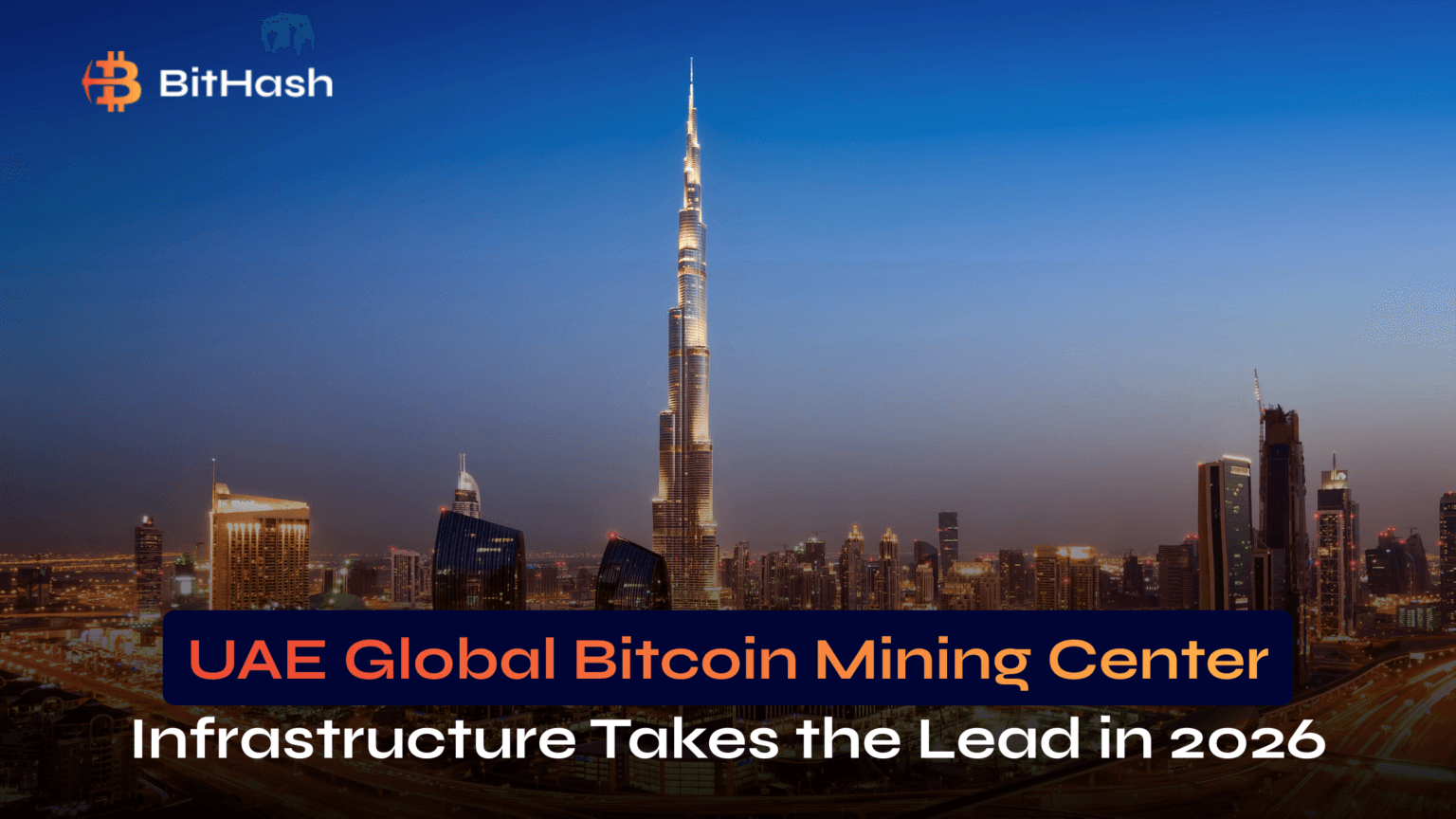
The UAE’s Bitcoin mining will undergo a significant transition in 2026. Structural, capital-intensive operations are being built around infrastructure and regulations that were previously unsystematic and retail-focused assets. Across the Middle East, especially in Abu Dhabi and Dubai, major players are constructing mega-sized facilities to compete on an international scale.
Bitcoin mining has evolved from small places, such as warehouses or garages, to large-scale industrial facilities with megawatt-scale mining capacity. Between now and the end of 2026, the bitcoin mining sector is undergoing a transformation influenced by three primary factors:
- Increasing participation from institutional investors.
- Innovation regarding energy efficiency through the use of hydro cooling and immersion cooling technologies.
- Geographic migration to regions with a stable supply of energy.
The UAE sits at the intersection of all three.
Recent monitoring by blockchain analytics companies such as Arkham Intelligence indicates that state-linked entities in the United Arab Emirates have accumulated substantial amounts of bitcoin-related mining hardware rather than purchasing on public markets. The fact that they purchased their hardware through mining rather than the public market means the UAE is not only hosting mining operations but also establishing its bitcoin reserves through mining. This strengthens the case for Bitcoin mining UAE becoming one of the most closely watched sectors in 2026.
The Institutional Shift Behind UAE Bitcoin mining
Mining is no longer a speculative rush for quick returns. It is becoming part of the national digital strategy. Institutional capital now views hashpower the same way it views energy grids or telecom infrastructure.
In 2026, Institutional crypto mining is defined by measurable efficiency, audited cost structures, and long-term energy contracts. Institutional investors in the sector are not reacting to price hikes; rather, they are examining profit margins across all levels of difficulty throughout the cycle.
The UAE’s clear guidelines help this happen. With clearly defined licensing regulations for digital assets and a regulatory environment that attracts global capital, institutional miners can operate under much clearer terms than in some other countries. With this clarity comes a reduction in counterparty risk and increased confidence to invest capital.
An institutional model for making mining decisions, rather than chasing price ups and downs, is now focused on developing a predictable Bitcoin infrastructure that can withstand downturns.
Mining Difficulty Cycles Create Opportunity
Bitcoin’s self-adjusting difficulty system remains one of its most powerful economic features. Approximately bi-weekly, or every 2 weeks or so, the protocol of a blockchain recalibrates the mining difficulty based on the total hashrate of all miners connected to it at that time.
When less-efficient operators shut down because prices drop, this can often make stabilisation difficult, or even lead to a temporary decline. This results in a short window for efficient miners, during which their production is generally more cost-effective than their costs.
There are three strategic operator dynamics:
- Hashrate expansion during lower difficulty phases increases BTC accumulation
• Infrastructure readiness determines who captures the opportunity first
• Operational efficiency protects margins when difficulty rises again
The UAE’s positioning is very important here. If you can secure power contracts, build your facilities, and deploy your hardware, you will benefit immediately after the business cycle changes. If you still need to build your facility, you will miss the opportunity.
The focus of mining today is not on speculation but on preparing for what lies ahead.
Energy Innovation and the Rise of Hydro mining hosting
Thermal management has become one of the defining factors of profitability. Traditional air-cooled systems struggle at scale, particularly in high-density environments. As mining expands into MW-scale facilities, hydro-based cooling and immersion systems are gaining traction.
Hydro mining hosting offers several advantages:
- Enhanced thermal stability
• Reduced hardware degradation
• Higher sustained efficiency under full load
• Better density in data center environments
For institutional-scale operations, even a few percentage points of uptime improvement significantly impact annual output. That directly influences Crypto mining ROI 2026 projections.
Hydro systems also reduce the stress on ASIC hardware, extending lifespan. In environments with substantial capital expenditures, longer hardware cycles improve overall economics.
This is why many operators are transitioning from air-cooled infrastructure to liquid-based systems. In regions like the UAE, where climate conditions require serious cooling strategies, hydro architecture becomes more than a technical upgrade. It becomes a margin protector.
The Expanding Role of ASIC hosting GCC
As the Gulf region develops as a digital hub, demand for professional hosting is rising. Not every investor wants to manage a facility. Structured colocation models with experienced operators are preferred by many.
The GCC is emerging as an ideal service layer for institutional and semi-institutional miners seeking exposure to mining without the burden of managing electricity logistics or cooling infrastructure.
In this model, professional operators enter into energy agreements, manage downtime, and utilise optimised cooling systems. Clients provide hardware or lease it. This structure lowers entry barriers while maintaining industrial standards.
Bitcoin mining can now be scaled through hosting models. As a result, the operational complexities that early retail miners needed to overcome are eliminated, and only stable infrastructure and capital access can enable the scaling up of Bitcoin mining in the UAE.
Why Geography Matters More in 2026
Mining migration is accelerating toward regions with three characteristics:
- Energy stability
- Regulatory predictability
- Access to capital
The UAE checks all three.
Energy infrastructure in the Emirates is modern and reliable. Grid stability reduces downtime risk. The regulatory environment, while structured, offers clarity for long-term planning. And capital markets remain accessible for both private and public funding rounds.
Compare that to jurisdictions where regulatory frameworks remain unclear, or energy grids are strained. Operators there face uncertainty that directly impacts projected returns.
This geographic shift supports the thesis that Bitcoin mining UAE could expand significantly in 2026.
Chart: Institutional vs Retail Mining Model in 2026
Below is a simplified comparison illustrating how the mining model has evolved.
Aspect | Retail Era | Institutional Era 2026
Scale | Small warehouses | MW-scale facilities
Cooling | Air cooled | Hydro and immersion
Capital Source | Individuals | Funds and sovereign-linked capital
Risk Model | Price speculation | Cost efficiency focus
Primary Goal | Short-term profit | Long-term BTC accumulation
This evolution explains why Institutional crypto mining is becoming dominant and why infrastructure-driven regions stand out.
The Infrastructure Thesis
Increasingly viewed as part of digital infrastructure, Bitcoin Mining in 2026 will continue to support transaction validation, network security, and currency issuance. This way of looking at Mining will alter how investors perceive the Mining opportunity. When Mining is viewed as digital infrastructure, the criteria for assessing the Mining business change accordingly. Operators will now analyze uptime, kWh rate, hardware performance, and cooling systems, rather than just BTC volatility.
This structural methodology for assessing Mining will align with how sovereign and large funds assess investment opportunities. They’re not interested in getting caught up in a hype cycle. They’re focused on long-term production models.
The UAE Advantage in Detail
The UAE offers several structural advantages:
- Stable power infrastructure
- Business-friendly regulatory climate
- Strategic geographic positioning between Asia and Europe
- Access to regional and global capital
These factors create an environment in which Bitcoin mining UAE can scale sustainably.
According to new evidence, mining activities in some states have produced thousands of BTC rather than purchasing them on the market. Retaining mined BTC rather than selling it shows a long-term view, in line with thinking about infrastructure.
Risk and Reality
It is important to stay grounded. Mining still carries risk. Difficulty can rise sharply. Prices of hardware change often. Careful management of energy contracts is critical for success.
The primary difference in 2026 is that success is driven by operational discipline rather than speculative pricing. Operators focused on Crypto mining ROI 2026 are developing scenarios based on different difficulty adjustments rather than predicting that prices will always go up.
Conclusion
UAE Bitcoin mining stands at an inflection point in 2026. Institutional capital is entering. Cooling technology is advancing. Geographic migration favors energy-stable regions.
Mining is no longer a hobbyist endeavor. It is a structured, capital-intensive sector supporting a decentralized monetary network.
Investors who treat mining as long-term Bitcoin infrastructure rather than short-term hype position themselves to strategically accumulate through market cycles.
The opportunity does not lie in chasing price spikes. It lies in building systems that continue producing regardless of sentiment.