
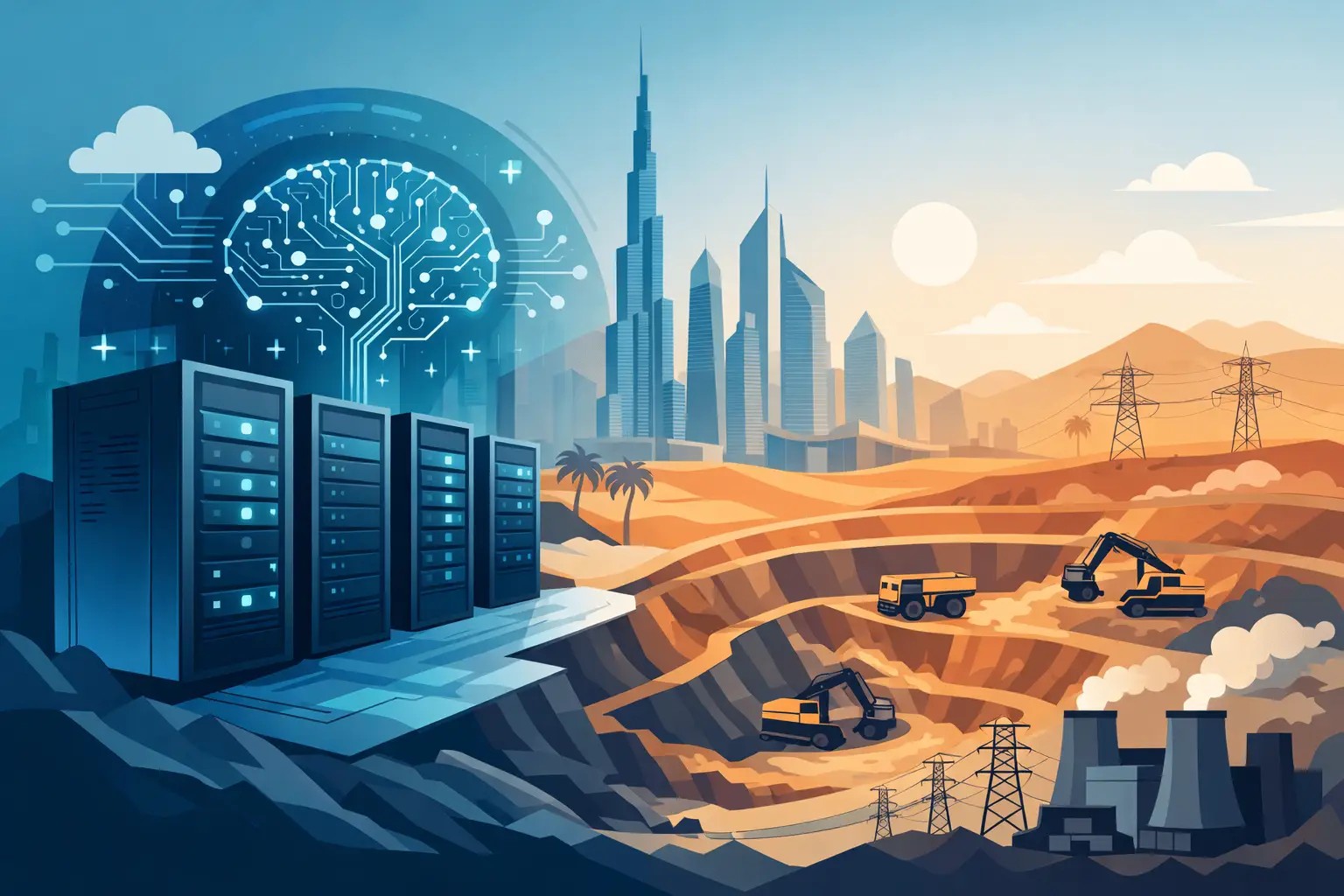
An AI data centre UAE build-out is more than a technology headline. For Bitcoin miners and digital-asset investors, it changes the practical conversation around available power, site capacity, cooling design and long-term hosting economics. AI workloads and ASIC fleets have different operating profiles, but they can compete for the same high-value infrastructure: dependable electricity, grid connections, engineered data halls and skilled on-site operations.
That does not mean mining capacity is disappearing. It means operators need to assess a hosting partner with greater precision. The strongest facilities will be designed around the workload they intend to support, rather than trying to treat AI servers and high-density ASIC miners as interchangeable loads.
Why AI data centre UAE growth matters to miners
The UAE has clear advantages for data-centre investment: major connectivity routes, an ambitious digital economy, access to capital and continued interest in energy and infrastructure development. AI demand adds another layer. Training clusters, inference platforms and enterprise cloud deployments need substantial compute capacity, often with high-density racks and demanding cooling requirements.
For mining operators, the key issue is not whether AI is better than Bitcoin mining. These are different commercial models with different customers, hardware cycles and revenue drivers. The relevant question is whether a prospective hosting site has ring-fenced power, defined capacity and an operating model that can protect mining uptime as demand for data-centre infrastructure grows.
A facility that has committed power capacity, clear electrical distribution and a credible expansion plan can still be an excellent mining location. A provider relying on vague future capacity, however, may struggle when demand rises or when a site must choose between competing workloads.
AI and ASIC mining require different data-centre designs
Both AI servers and ASIC miners turn large amounts of electrical energy into computation and heat. Beyond that broad similarity, the operational requirements diverge sharply.
AI deployments commonly prioritise low-latency networking, dense GPU racks, redundancy, controlled environmental conditions and sophisticated liquid-cooling loops. A short service interruption can affect commercial applications, model training runs or service-level commitments. The infrastructure is often designed around premium rack density and fault tolerance.
ASIC mining is judged differently. Hashrate delivery, energy cost, machine availability and repair turnaround drive results. Miners can be deployed at scale in purpose-built layouts where electrical efficiency, airflow management, dust control, heat removal and rapid maintenance access matter more than ultra-low network latency.
This distinction affects Capex. A mining facility does not automatically need every feature required by a hyperscale AI environment. Paying for over-specified infrastructure can weaken mining economics. Equally, underbuilding cooling, power distribution or monitoring creates downtime that costs more than the apparent saving.
The right design depends on the fleet. Air-cooled ASICs may suit a well-engineered containerised or warehouse-style deployment with disciplined ventilation. Hydro-cooled machines can support higher density and more stable operating conditions, but they require pumps, heat exchangers, fluid management and technicians who understand the system. Neither approach is universally superior. The choice should follow the miner model, local conditions, electricity arrangement and target operating scale.
Power contracts matter more than headlines
When evaluating an AI data centre in the UAE, investors should look past statements about megawatts and ask how that power is actually secured and allocated. A large headline figure means little without clarity on the connection status, energisation timetable, contracted capacity, tariff structure and the provider’s right to use that supply for mining.
For a mining fleet, kWh pricing is only one part of the equation. The commercial model should make clear whether the rate includes power delivery, cooling, security, monitoring, maintenance labour and any management fee. It should also explain how price changes are handled, whether curtailment is possible and what happens if a facility expands faster than its electrical infrastructure.
A serious operator should be ready to discuss the detail. That includes transformer capacity, switchgear, distribution redundancy, planned maintenance windows and the process for restoring machines after an outage. These are not administrative questions. They determine whether advertised hashrate becomes sustained hashrate.
Cooling is becoming a competitive advantage
The UAE climate makes heat management a core operating discipline. As ambient temperatures rise, a site needs more than extraction fans and optimistic capacity estimates. It needs a cooling strategy matched to the equipment and designed for the hottest operating periods, not just favourable seasonal conditions.
Air-cooled miners can perform well when intake air, exhaust paths, filtration and hall pressure are properly managed. Poor airflow design creates recirculation, hotspots and throttling. Those issues reduce efficiency and can shorten hardware life.
Hydro-cooling changes the equation. It can enable denser deployments and reduce exposure to dust and fluctuating ambient temperatures, particularly for newer high-performance ASIC models. Yet it introduces another operating layer: coolant quality, leak prevention, pump redundancy, heat-rejection capacity and a clear maintenance procedure. Investors should view hydro hosting as an engineered system, not simply a premium add-on.
AI infrastructure investment may accelerate regional expertise in high-density cooling. That can benefit mining operators where providers apply the same engineering discipline without forcing mining customers into a costly AI-style specification they do not need.
What to ask before committing a fleet
Before purchasing hardware or moving an existing fleet, operators should get direct answers to a small set of operational questions. A hosting agreement should identify the exact site, available capacity, deployment timeline, electricity price structure, cooling method, monitoring access and maintenance responsibilities.
It should also establish what the customer can see once machines are live. Miner-management software should provide visibility of hashrate, online status, temperatures, pool performance and fault events. Transparency matters most when conditions are not perfect. If a unit goes offline, the customer should know when it was detected, what action is being taken and whether a repair is likely to require parts or replacement hardware.
For larger fleets, ask how the provider handles phased deployment. Installing 150 machines is not the same as commissioning a dedicated multi-megawatt site. The supplier must coordinate procurement, logistics, racking, network configuration, power-up testing and pool connection without losing control of asset records. Serial-number tracking, spare-parts planning and defined service response times become essential as fleets grow.
Capacity should be planned around flexibility
AI demand can make premium data-centre capacity more valuable, but it also reinforces the value of purpose-built mining infrastructure. The best route for a miner may be a shared hosting deployment, a dedicated hall, a hydro-cooled cluster or a custom data-centre project. It depends on fleet size, preferred machine type, appetite for Capex and how much operational control the investor wants.
A solo miner may value a plug-and-mine package with hardware sourcing, hosting and support under one accountable provider. A professional operator may need a tailored PPA structure, dedicated electrical capacity and agreed expansion rights. Institutional clients may prioritise security controls, reporting and contractual certainty over the lowest advertised power rate.
In each case, avoid locking a mining strategy to a single assumption about Bitcoin price, network difficulty or hardware resale value. Capacity planning should allow for machine upgrades, site expansion, repairs and changing market conditions. The facility that is cheapest on day one may be expensive if it cannot support the next generation of ASICs or maintain availability during peak heat.
The opportunity is better infrastructure, not louder claims
The growth of AI data-centre capacity in the UAE raises the standard for everyone operating energy-intensive compute. That is positive for miners when it leads to stronger electrical engineering, better cooling capability, improved security and more professional site operations. It becomes a problem only when providers sell capacity before they can demonstrate how it will be powered, cooled and maintained.
For mining investors, the practical response is straightforward: choose infrastructure on evidence, not on a headline. BitHash approaches deployment as an operational commitment, from ASIC sourcing and installation to monitoring, maintenance and scaling support. The real advantage is not simply getting machines online quickly. It is keeping them productive once the facility is under pressure.
As AI and digital-asset compute expand side by side, ask the provider to show exactly where your fleet will run, how it will be cooled and who acts when a miner stops hashing. Clear answers are the foundation for better uptime and more defensible mining returns.