
The race to build AI infrastructure UAE capacity is changing the operating environment for every high-density compute business. For crypto mining operators, that does not mean ASICs and AI servers are becoming the same asset class. It means the infrastructure beneath them – power, cooling, land, network design and skilled operations – is becoming more valuable, more specialised and more closely planned.
A miner can still buy efficient hardware, secure a competitive electricity rate and target strong returns. But hardware economics alone are not enough. As AI data centres compete for premium capacity, mining operators need to ask a sharper question: is this facility designed to support continuous, high-load compute at the scale and commercial terms my fleet requires?
Why AI infrastructure UAE growth matters to miners
AI workloads are driving demand for GPU clusters that consume significant power and generate concentrated heat. Their requirements differ from Bitcoin mining. AI deployments often prioritise low-latency connectivity, specialist networking, storage performance and highly controlled rack environments. Mining prioritises hashrate, energy efficiency, rapid fleet deployment and consistently high uptime.
The shared dependency is physical infrastructure. Both need reliable incoming power, correctly sized transformers and switchgear, engineered cooling, fire protection, security and teams that can respond when equipment fails. When demand for data-centre capacity rises, these components can take longer to procure and may command a premium. That can affect timelines for new mining deployments, particularly for operators expecting to add hundreds of units at once.
This creates both pressure and opportunity. A professionally operated mining site with contracted power, tested cooling design and clear capacity planning is more valuable than a warehouse filled with machines. Operators that treat hosting as a serious infrastructure decision are better positioned to protect uptime and expand when capacity becomes available.
AI infrastructure UAE is not a substitute for ASIC hosting
There is a common mistake in the market: assuming any facility marketed for AI or high-performance computing is automatically a good location for ASIC miners. It is not.
GPU infrastructure may be engineered around lower rack densities, raised-floor layouts, redundant network paths and premium colocation pricing. Those features can be appropriate for enterprise AI customers but unnecessary for a mining fleet. If they add cost without improving miner uptime or lowering the effective kWh rate, they can weaken the economics of the operation.
Conversely, a mining facility designed only around low-cost airflow may not be suitable for AI workloads. ASIC miners can tolerate a very different operational model from GPU servers, including more direct airflow management and less emphasis on network architecture. The right approach depends on the workload, equipment profile and revenue model.
For miners, the goal is not to rent an AI data centre. It is to use infrastructure that is fit for continuous ASIC operation: sufficient power per unit, practical cooling for local conditions, fast repair access, secure storage for spare parts and transparent electricity management. Premium specifications should be paid for only where they create a measurable operational advantage.
Power capacity becomes a strategic asset
The most important impact of AI growth is likely to be competition for available power and the infrastructure required to deliver it. A quoted electricity price is only one part of the calculation. Operators also need clarity on whether capacity is genuinely allocated, how demand is measured, who carries curtailment risk and whether the site can support future expansion.
For a small portfolio, this may mean confirming that the hosting provider can energise the machines promptly and maintain the agreed operating conditions. For an industrial fleet, it means reviewing the full power path from grid connection through transformers, distribution boards and rack or container-level delivery.
Capacity planning should account for more than the nameplate load of the machines. A fleet of ASICs needs allowance for ventilation, pumps in hydro-cooling systems, monitoring equipment, lighting and site services. The facility should have a clear answer for what happens during an outage, a voltage issue or a sudden increase in ambient temperature.
A low advertised rate without defined power allocation can be expensive in practice. Lost mining hours, repeated shutdowns and delayed expansion can outweigh a small saving on kWh pricing. The better commercial model is transparent: agreed capacity, a clear tariff structure, defined service scope and visibility over the factors that can affect monthly Opex.
Cooling is now a commercial decision, not a technical afterthought
High-density AI clusters have accelerated investment in liquid cooling, heat rejection systems and more precise environmental controls. That trend matters in the UAE because heat management directly affects hardware performance, component life and maintenance frequency.
Air-cooled ASIC hosting remains practical when the facility has been designed properly. Airflow needs to be controlled rather than improvised, intake air needs filtration, and hot air must be removed without recirculating through the fleet. Poor airflow may look manageable during a site visit but reveal itself through higher temperatures, reduced stability and more frequent fan or hashboard failures.
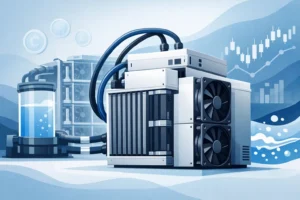
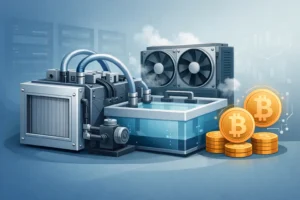
Hydro-cooling can offer a different route for high-density deployments. It can reduce noise, support more compact layouts and provide more predictable thermal conditions when engineered correctly. It also introduces additional considerations: water quality, pumps, heat exchangers, leak detection, maintenance procedures and contingency planning. It is not automatically the cheapest option, but it can be commercially compelling where space, density or operating conditions justify the additional Capex.
The useful question is not whether air or hydro is better. It is whether the cooling system matches the miner model, climate, fleet density and target uptime. A hosting partner should be able to explain that in operational terms, not just present a headline capacity figure.
What to assess before placing a fleet
Before committing hardware to a hosting site influenced by rising AI demand, operators should verify the details that protect their returns. The following checks are particularly relevant when moving beyond a handful of units:
- Energisation timeline: Confirm when machines will be installed, powered and visible in miner-management software. A vague deployment window creates avoidable idle time.
- Power and billing terms: Understand the kWh price, minimum commitment, deposit structure, demand charges where applicable and the treatment of any curtailment or outage.
- Cooling architecture: Ask how heat is managed during peak conditions, what redundancy exists for critical equipment and how temperature alerts are handled.
- Operations coverage: Establish who performs reboots, inspections, board-level fault diagnosis, fan replacement and warranty coordination, and whether this service is included or charged separately.
- Security and asset controls: Check access controls, camera coverage, inventory procedures and how individual machines are tracked within a larger fleet.
- Scale path: If your objective is 150 miners today and 500 later, determine whether the provider has physical space and allocated power to support that plan.
These questions apply whether the facility is in the UAE or overseas. However, local access adds practical value for clients who want a Dubai-based team, direct communication and the option to inspect a deployment rather than manage every issue across time zones.
The case for an integrated operating partner
Mining is often presented as a hardware purchase. In reality, an ASIC is productive only when procurement, shipping, installation, power, cooling, monitoring and maintenance are managed as one operating system. Each handover between suppliers creates a point of delay or uncertainty.
An integrated provider can shorten that chain. Hardware sourcing can be aligned with available hosting capacity. Delivery can be planned around installation teams. Miner-management software can provide fleet visibility from the moment units go live. Maintenance teams can act on alerts before a minor fault becomes days of lost hashrate.
That does not remove market risk. Bitcoin price movements, network difficulty, transaction fees and equipment efficiency will still determine mining profitability. No hosting arrangement can guarantee a return. What professional infrastructure can do is reduce the avoidable operational losses that make an otherwise sound mining strategy underperform.
For newer investors, that means a simpler plug-and-mine route without managing technical contractors independently. For experienced operators, it means consolidating fleet oversight, electricity management and service accountability under terms that can be measured. BitHash’s role is built around that operational discipline: getting miners live quickly, keeping them monitored and giving clients a clear view of what their fleet is doing.
Build for the workload, then protect the economics
AI expansion is raising the standard for digital infrastructure across the region. That is positive for mining operators when it drives better engineering, stronger operational talent and more sophisticated cooling capability. It becomes a problem only when mining clients pay for the wrong type of capacity or accept unclear terms because capacity is scarce.
The strongest mining deployment is not the one with the most impressive data-centre label. It is the one where power is available, cooling is proven, machines are deployed without delay and every operational responsibility has a named owner. As AI demand reshapes the market, that clarity is what keeps a mining fleet commercially focused.