
A better efficiency figure does not automatically mean a better mining investment. With the Antminer S23 Hyd, the real question is whether your power, cooling and operations can keep a high-density hydro fleet running at its intended output. A miner of this class can improve the economics per terahash, but only when the supporting infrastructure is planned with equal care.
For solo miners, investors building a portfolio and operators expanding an industrial site, that changes the buying decision. The machine is only one part of the asset. Electricity pricing, cooling-loop design, uptime, maintenance response and deployment speed decide whether its potential hashrate translates into BTC production.
What the Antminer S23 Hyd is designed to do
The Antminer S23 Hyd is a hydro-cooled Bitcoin ASIC built for operators who want more hashrate from a compact footprint without relying on banks of high-speed air fans. It uses a liquid-cooling circuit to remove heat directly from the miner, enabling dense installations that would be difficult to operate efficiently with air-cooled equipment alone.
Market specifications for this class of S23 Hydro machine are commonly quoted at around 580 TH/s, with efficiency near 9.5 J/TH. At those figures, its electrical load is approximately 5.51 kW. Exact performance, power draw, dimensions and warranty conditions should always be confirmed against the batch-specific manufacturer documentation before funds are committed. ASIC specifications can differ by production run, operating mode and site conditions.
The headline number is the efficiency. Joules per terahash measures how much energy is needed to produce each unit of hashrate. Lower is better. When Bitcoin network difficulty rises or hashprice tightens, a lower J/TH figure gives an operator more room to keep mining profitably than a less efficient generation of hardware.
That does not make the S23 Hyd the right answer for every site. Hydro cooling replaces fan noise and large volumes of hot exhaust air with a different set of engineering requirements. It is a performance tool, not a shortcut around infrastructure.
Antminer S23 Hyd economics begin with the power contract
Using a 5.51 kW load as an example, one miner consumes roughly 132.24 kWh every 24 hours if it operates continuously. At an all-in electricity rate of US$0.06 per kWh, daily power cost would be about US$7.93 per unit. At US$0.08 per kWh, it becomes roughly US$10.58.
Those numbers are only the starting point. Revenue moves with Bitcoin price, network difficulty, transaction-fee conditions, pool fees and the machine’s actual uptime. A serious projection therefore needs a range of outcomes, not one optimistic BTC price and a fixed difficulty assumption.
Ask whether the quoted electricity rate includes transformer losses, cooling consumption, hosting fees, taxes, curtailment provisions and any minimum-volume commitments. A low headline kWh price can look less attractive once the full operating stack is added. Transparent pricing gives an investor a cleaner view of Opex and makes it easier to compare owned-site mining with managed hosting.
The same discipline applies to uptime. A 580 TH/s machine that is offline for three days does not recover those lost mining days simply by returning online. For a fleet, small availability gaps become material. Fast replacement processes, local technical coverage and monitoring that flags abnormal temperatures or hashrate loss early are commercial protections, not optional extras.
Hydro cooling changes the site design
An air-cooled miner can be deployed in a well-designed container or mining hall with adequate ventilation and filtration. A hydro miner needs a controlled thermal system around it. The site must provide suitable coolant flow, pressure, temperature and water quality for the manufacturer’s operating range.
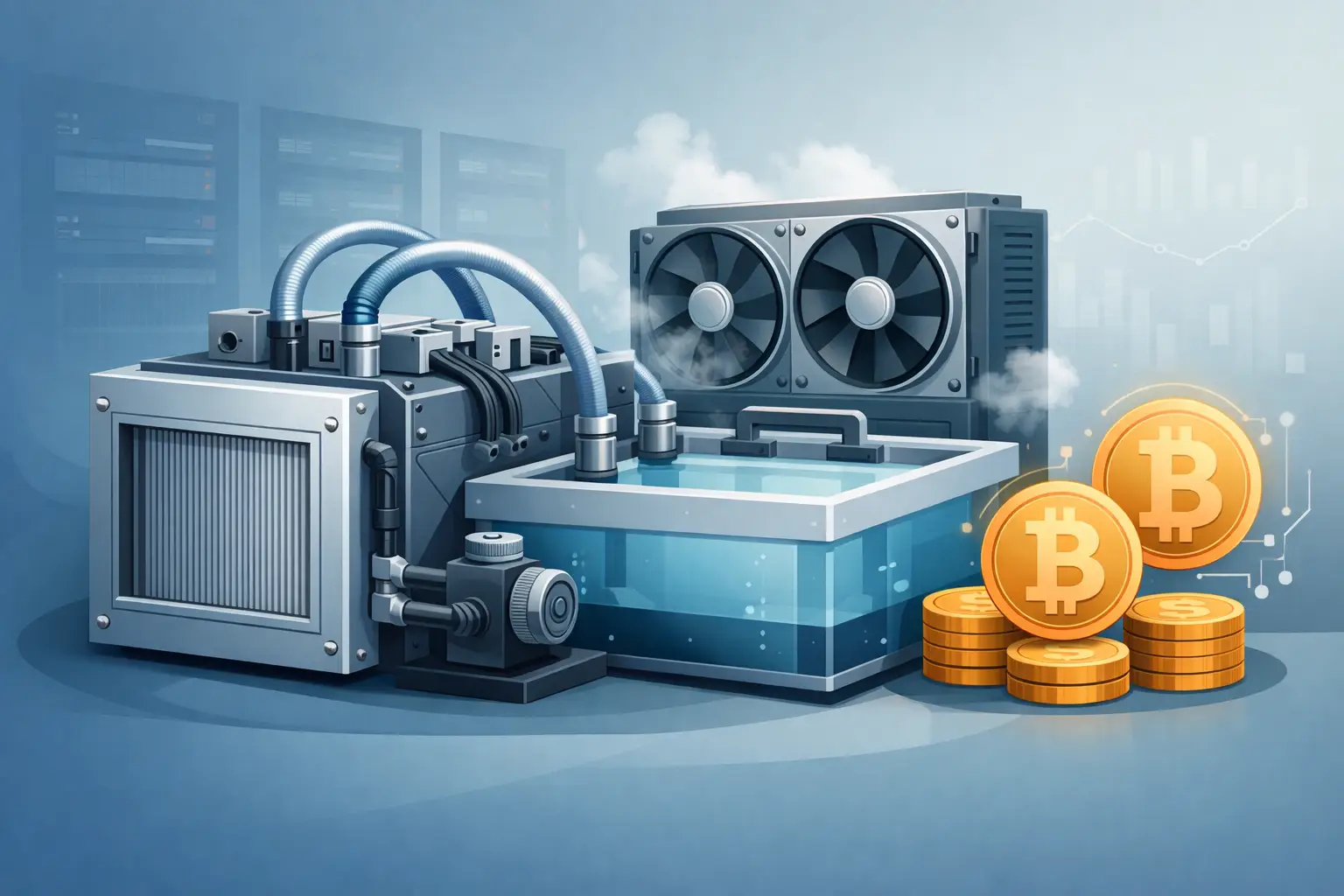
In practice, this normally means a coolant distribution unit, manifolds, compatible hoses and fittings, heat exchangers or dry coolers, circulation pumps, filtration and leak detection. The primary loop is often treated water or a water-glycol mixture, depending on climate and the engineering design. Poor water chemistry can lead to corrosion, scaling or blocked channels, while poor hose management can create avoidable service risk.
Ambient conditions still matter. Hydro cooling moves heat away from the ASIC boards, but the heat must ultimately be rejected outside the building. In hot climates, dry-cooler sizing, approach temperature and seasonal performance deserve close engineering attention. A facility that appears to have enough cooling capacity on paper may struggle at peak summer temperatures if the design margin is too narrow.
Electrical planning needs the same precision. Twenty machines at approximately 5.51 kW represent around 110.2 kW of miner load before pumps, network equipment and cooling auxiliaries are included. A 100-unit deployment moves beyond 551 kW of ASIC load. Switchgear, cabling, protection, transformer capacity and PDU design must be sized for the complete demand, with realistic headroom for continuous operation.
Where the S23 Hyd fits best
The S23 Hyd is most compelling in installations that can support high-density, purpose-built mining. This includes industrial data centres, hydro-ready containers and managed facilities where cooling and power systems are already engineered for liquid-cooled ASICs. It can also suit investors who do not want to build this infrastructure themselves but want exposure to latest-generation hardware through a hosting arrangement.
For a beginner with one or two machines, direct self-hosting may be unnecessarily complex unless a hydro loop already exists. The hardware may be efficient, yet commissioning a dedicated cooling system for a very small number of miners can distort the total Capex. A hosted deployment can make more sense when it spreads infrastructure costs across a larger installed fleet.
For a professional operator replacing older equipment, the calculation is different. Retiring less efficient miners can free power capacity for materially more hashrate, while hydro cooling can reduce the floor area needed for the same production target. The trade-off is a greater dependence on disciplined facility operations. Pumps, valves and heat rejection equipment become part of the mining uptime equation.
What to verify before placing an order
Do not evaluate an Antminer S23 Hyd from hashrate alone. Confirm the manufacturer warranty terms, declared power consumption and permitted variance, delivery schedule, included accessories and whether the selected batch has a specified operating mode. It is also worth establishing the process for dead-on-arrival units, repair turnaround, spare parts and firmware support before deployment rather than after an issue occurs.
For hosting, request the operational details that affect returns: the all-in power rate, contracted uptime terms, cooling charges where applicable, pool configuration, monitoring access, maintenance scope and the procedure for authorising repairs. If the provider manages the equipment, you should still be able to see hashrate, worker status, power data and fault history without waiting for a manual update.
Security matters too. ASICs are compact, transportable assets with high value per square metre. A credible site combines controlled access, CCTV, asset records, network segmentation and 24/7 operational oversight. These controls protect the hardware and reduce the disruption caused by preventable incidents.
Deployment should be measured in operating days
The best purchase price is not always the best commercial outcome. A delayed unit earns no BTC, and a machine delivered to an unprepared site can sit idle while cooling connections, electrical works or network configuration are completed. Before payment, align the hardware arrival date with confirmed rack or container capacity, live power, tested coolant circuits and pool credentials.
This is where an end-to-end infrastructure partner can reduce friction. BitHash can coordinate ASIC sourcing, hydro-ready hosting, deployment, monitoring and ongoing maintenance so that the hardware is treated as part of an active mining operation rather than a standalone product.
The Antminer S23 Hyd rewards operators who think beyond the spec sheet. If your site can provide stable low-cost power, correctly engineered heat rejection and fast operational support, it can be a strong platform for scaling efficient Bitcoin hashrate. The right next step is to model the machine against your actual electricity rate and facility capacity, then deploy only when every part of the operating chain is ready to earn.