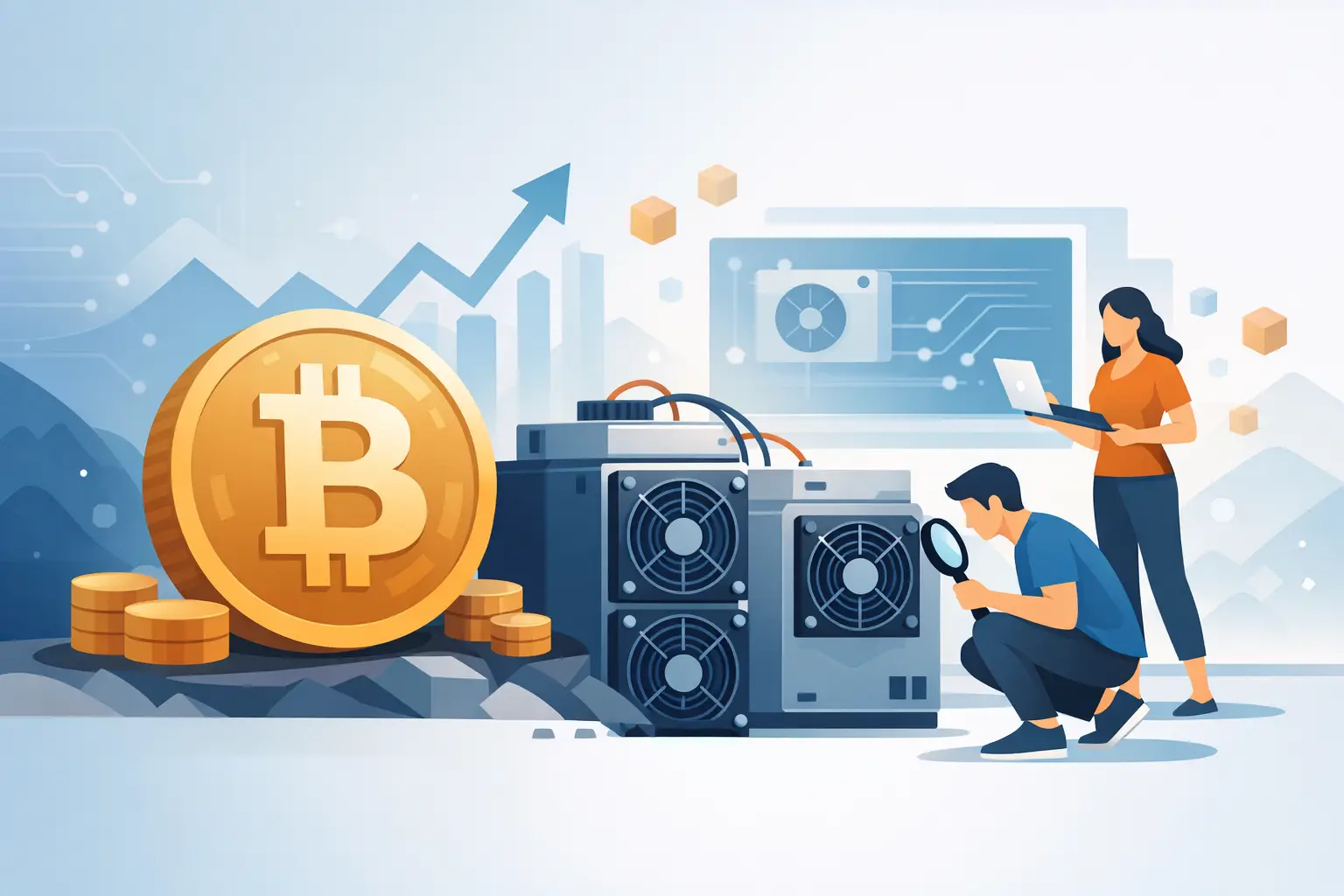
The best Bitcoin miners for beginners are not necessarily the machines with the highest hashrate. They are the units that make commercial sense after electricity, cooling, noise, uptime and support are accounted for. A powerful ASIC in the wrong location can become an expensive heater. The right machine, deployed in a professionally managed environment, can give a new miner a much clearer route from capital outlay to active Bitcoin production.
For most first-time buyers, the practical choice is a current-generation Bitmain Antminer or MicroBT WhatsMiner, paired with hosting rather than a home installation. These machines are built for serious Bitcoin mining. The question is not whether they can mine, but whether your operating set-up can keep them mining efficiently every hour of the day.
What Makes a Bitcoin Miner Beginner-Friendly?
Bitcoin mining hardware is judged by three linked measurements: hashrate, power draw and efficiency. Hashrate, measured in terahashes per second (TH/s), is the amount of computing work a miner contributes. Power draw is the electricity it consumes. Efficiency, generally expressed in joules per terahash (J/TH), shows how much energy the machine needs to produce that work.
For a beginner, efficiency matters more than chasing the biggest headline hashrate. A newer miner with a lower J/TH can protect operating margins when Bitcoin difficulty rises or the Bitcoin price moves against expectations. It also gives you more flexibility when choosing a hosting package and electricity rate.
A beginner-friendly ASIC should also have a mature supply chain for repairs, readily available replacement parts and monitoring support. Mining is a continuous operation, not a one-time purchase. Fans fail, power supplies need attention and firmware settings must be managed carefully. Selecting hardware that can be serviced quickly is part of protecting uptime.
Best Bitcoin Miners for Beginners: The Strong Choices
Bitmain Antminer S21 Pro
The Antminer S21 Pro is a strong starting point for buyers who want modern efficiency without stepping into highly specialised cooling infrastructure. Depending on the batch and configuration, it offers roughly 230 TH/s while operating at around 15 J/TH. That combination puts it firmly in the current generation of competitive Bitcoin ASICs.
Its appeal is simple: it provides meaningful production capacity in a familiar air-cooled format. For an investor starting with one to several miners, this can be easier to deploy and understand than an immersion or hydro-cooled fleet. It is also a sensible platform for future expansion because operators and technicians are widely familiar with the Antminer ecosystem.
The trade-off is power consumption. An S21 Pro still requires several kilowatts of stable electricity and generates substantial heat and noise. It is not a suitable machine for a spare room, garage or office unless you are prepared for industrial ventilation, electrical work and a very loud operating environment.
Bitmain Antminer S21 XP
The Antminer S21 XP is designed for miners prioritising energy efficiency and long-term operating competitiveness. With hashrate around 270 TH/s and efficiency close to 13.5 J/TH, it can produce more work from each unit of power than earlier air-cooled generations.
For a beginner with a larger budget, this is often the more future-focused purchase. Better efficiency does not guarantee profitability, because Bitcoin price, network difficulty, pool fees and electricity pricing remain variable. But it reduces one of the most important ongoing costs: energy consumed per terahash.
The premium purchase price needs to be weighed against that advantage. If you have access to highly competitive hosting electricity, an S21 Pro may offer a more attractive entry Capex. If you are building a portfolio intended to operate through multiple market cycles, the S21 XP’s efficiency can justify paying more upfront.
MicroBT WhatsMiner M60S
The WhatsMiner M60S is a credible alternative for buyers who prefer MicroBT hardware. Models in this family typically deliver around 180 TH/s with efficiency in the high teens J/TH, depending on the exact specification. WhatsMiner units have a reputation for straightforward, durable industrial construction and are used widely across professional mining sites.
It may not match the newest Antminer models on efficiency, but the M60S can be a good fit where acquisition cost, availability or an existing WhatsMiner support arrangement drives the decision. This is an important point for beginners: the best model on paper is not always the best machine you can procure, host and maintain at a workable total cost.
Hydro-Cooled ASICs for Larger First Investments
Hydro-cooled models such as the Antminer S21 Hydro series offer high hashrate in a compact operational footprint, often above 400 TH/s per unit. They are designed for purpose-built liquid-cooling systems rather than conventional air-cooled racks.
These units can be excellent assets in the right facility, particularly where high-density deployment and controlled cooling improve operational performance. They are not, however, a beginner’s home-mining product. Choose hydro cooling only when the hosting provider has proven hydraulic infrastructure, qualified technicians and clear responsibility for maintenance. The hardware is powerful, but the infrastructure around it is non-negotiable.
Why Home Mining Usually Does Not Work for Beginners
A modern ASIC can draw roughly 3,000 to 7,000 watts continuously. That is a constant industrial load, not the occasional demand of a household appliance. Add intense fan noise, heat output and domestic electricity tariffs, and the economics can deteriorate quickly.
Home mining can still suit technically experienced enthusiasts with unusually low power costs and suitable space. Yet most new investors underestimate the operational burden. You may need dedicated circuits, safe electrical installation, extraction systems, filtration, network stability and a plan for hardware faults. A miner that stops because of heat, dust or a tripped circuit earns nothing while it is offline.
Hosting changes the equation. Rather than building a mini data centre yourself, you place the ASIC in an environment designed for continuous operation. The provider handles installation, power distribution, airflow or liquid cooling, security, monitoring and routine intervention. You retain exposure to the machine and its production, without taking on every operational task.
Compare the Numbers That Actually Affect ROI
Before buying, request a simple operating model based on the exact machine and hosting package. Avoid relying on a single daily-profit figure. Mining revenue changes with Bitcoin price, transaction fees, network difficulty, pool performance and downtime.
Your model should include the machine purchase price, shipping and deployment costs, hashrate, wattage, electricity price per kWh, pool fee, hosting fee and an allowance for maintenance. It should also show different scenarios: a higher Bitcoin price, a lower price and a difficulty increase. This is not pessimism. It is how serious miners assess risk before committing Capex.
Pay particular attention to the electricity line. A small difference in kWh pricing can have a material effect over a year because the miner runs continuously. Transparent power billing matters just as much as the ASIC’s advertised efficiency.
It is also worth asking how the provider measures uptime and what happens if a machine needs repair. A fast repair process, access to spare parts and clear reporting can be more valuable than a marginally cheaper headline hosting rate. Mining returns depend on productive hashrate, not just on equipment ownership.
A Sensible First Mining Portfolio
For many beginners, one or two latest-generation air-cooled ASICs is enough to learn the economics without overcommitting. This approach lets you review real operating data: daily output, electricity charges, pool payouts, uptime and support responsiveness. Once you understand the pattern, scaling to five, 10 or more machines becomes a capital-allocation decision rather than a guess.
Avoid building a first portfolio from older, inefficient machines simply because they look cheap. Legacy hardware may produce Bitcoin, but it can be much more exposed to rising difficulty and power costs. Lower entry price does not always mean lower risk.
Equally, do not assume the newest flagship machine is automatically right. If your capital is limited, a balanced choice of efficient hardware and reliable hosting may produce a better outcome than spending every pound on hashrate while leaving no room for deployment, operating costs or contingencies.
The Better First Step: Hardware Plus Operations
Buying an ASIC is the visible part of Bitcoin mining. Keeping it productive is where the value is created. A supplier should be able to explain the machine, the facility, power pricing, deployment timetable, monitoring access and maintenance process in plain commercial terms.
BitHash can source current-generation ASICs and place them into managed infrastructure, giving new miners one accountable route from hardware purchase to live operation. For a first portfolio, that kind of operational clarity is often more useful than trying to assemble equipment, electricity and technical support from separate providers.
Choose the miner that fits your budget and hosting conditions, then give it an environment built to run continuously. That is how a beginner starts mining with fewer surprises and a clearer view of what each terahash is delivering.