
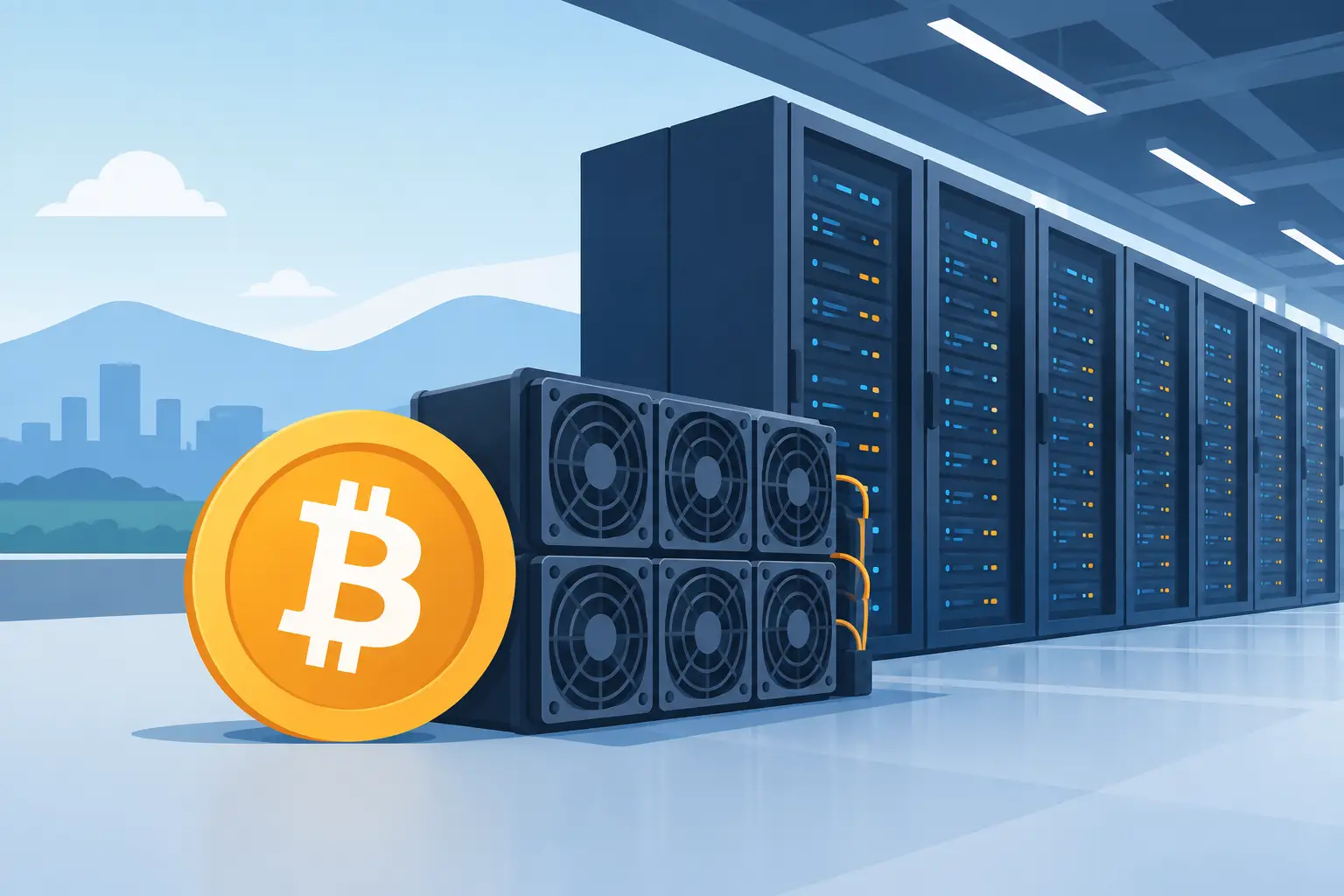
A miner that sits powered off is not an asset producing hashrate. It is capital tied up in a noisy, heat-heavy machine that still depreciates while the network difficulty moves on. Bitcoin colocation is designed to prevent that outcome by placing your ASICs in a purpose-built mining facility, where power, cooling, connectivity, monitoring and on-site operations are managed for you.
For a solo miner, that can mean avoiding the cost and disruption of running equipment at home. For a fleet operator, it can mean getting hundreds of machines online without negotiating utility arrangements, building a site team or maintaining spare-parts inventory across several locations. The model is simple. The commercial and operational detail behind it is not.
What is bitcoin colocation?
Bitcoin colocation is a hosting arrangement in which you own the mining hardware, while a specialist provider supplies the data-centre environment required to operate it. Your ASICs are installed in the provider’s facility and connected to its electrical infrastructure, cooling system, network and monitoring platform.
This differs from cloud mining, where you purchase exposure to mining capacity rather than own and operate specific machines. It also differs from building a private mining site, where you take responsibility for everything from Capex and electrical engineering to security, staffing and repairs.
With colocation, the provider normally handles physical deployment, rack or container space, power delivery, ventilation or liquid cooling, network access, site security and first-line technical support. You retain ownership of the miners and receive the mining output, subject to the hosting agreement and your chosen pool arrangement.
The appeal is operational focus. Instead of trying to become a facilities operator, you can concentrate on the economics of your fleet: machine efficiency, hashrate, Bitcoin price, network difficulty and power cost.
Why miners use colocation instead of self-hosting
ASIC mining is unforgiving of weak infrastructure. A unit can draw several kilowatts continuously, generate significant heat and operate poorly when airflow, voltage quality or ambient conditions are not properly controlled. Scale that from one machine to 150 or 1,500 units and the challenge changes completely.
A professionally operated facility spreads the fixed cost of infrastructure across many customers. That can provide access to industrial-grade switchgear, engineered ventilation, managed network connectivity, 24/7 surveillance and technicians who understand ASIC fault codes, hashboard failures and fan issues. These are expensive capabilities to replicate for a small or mid-sized fleet.
Colocation also shortens the route from purchase to production. Once hardware arrives at a suitable facility, a prepared operator can inspect, install, configure and commission it far faster than an owner building out capacity from scratch. For investors entering at a favourable point in the hardware cycle, deployment speed can materially affect the period in which a machine earns.
There is a trade-off. You give up direct control of the physical environment and rely on the provider’s operational standards. That makes provider selection more important than a headline hosting rate alone.
The costs that determine colocation returns
The first figure most miners ask for is the electricity price per kWh. It matters, but it is not the entire cost of mining. A clear bitcoin colocation proposal should show how the rate is structured and what is included.
Some contracts quote a single all-in tariff covering electricity, space, routine operations and basic support. Others separate energy, hosting and management charges. Either model can work, provided the calculation is transparent. What matters is whether there are minimum commitments, peak-period provisions, curtailment rules, deposits, pass-through utility charges or additional fees for repairs and remote hands.
Machine efficiency is equally important. A newer ASIC consuming fewer joules per terahash can remain competitive at a power price where an older unit no longer produces an acceptable margin. Before committing to a term, model the fleet using conservative assumptions for Bitcoin price, network difficulty, pool fees, downtime and machine degradation. Do not assess returns only on the most optimistic revenue day.
For larger deployments, ask whether the provider has a fixed-rate power agreement, variable utility exposure or a mix of both. A lower advertised rate has less value if the commercial structure is unclear or subject to frequent adjustment. Predictable Opex supports better planning, particularly when a fleet is financed or expected to meet a defined return threshold.
Cooling is not a secondary detail
Heat is a mining cost. It affects machine performance, fan wear, failure rates and the amount of power required to keep equipment within an acceptable operating range. A colocation provider should be able to explain exactly how it handles airflow, filtration, hot-air extraction and seasonal temperature changes.
Air-cooled hosting can be practical and cost-effective when the facility has sufficient ventilation and environmental control. Hydro-cooling may suit high-density deployments and selected ASIC models, particularly where operators want to run at higher performance profiles or reduce the dependence on high-speed fans. It requires specialised infrastructure, compatible hardware and disciplined water-quality management, so it is not automatically the right choice for every fleet.
This is particularly relevant in high-ambient regions. A facility designed for local conditions needs more than a bank of extraction fans. Its electrical and cooling design must account for sustained thermal load, not simply the temperature on a mild day. Ask how the site maintains operating conditions during the hottest periods and what happens if cooling equipment needs service.
What to check before signing a hosting agreement
A serious provider should welcome operational questions. If answers are vague, the risk is not only downtime. It may be delayed repairs, unclear billing or limited visibility when performance drops.
Start with uptime and incident handling. Ask how uptime is measured, whether planned maintenance is excluded, how outages are communicated and what service response applies to offline machines. No facility can credibly promise zero interruptions. The stronger question is whether the operator detects issues early, communicates clearly and restores capacity quickly.
Then examine security and custody. Confirm how units are tagged, inventoried and segregated, who can authorise configuration changes, and how physical access is controlled. For a sizeable fleet, you should be able to reconcile serial numbers, deployment status and repair history without relying on informal updates.
Transparency should extend to software access. A useful miner-management platform shows hashrate, pool connectivity, temperatures, fan status, rejection rates and offline alerts at machine level. It does not replace an operations team, but it gives you evidence that the fleet is performing as expected.
Finally, review the repair process. Ask whether the site keeps common spare parts, how repair quotations are approved, whether replacement units are available and how long a failed machine typically spends out of service. An inexpensive hosting contract can become costly if a simple fault leaves a miner inactive for weeks.
When colocation is the right fit
Colocation is usually strongest for owners who want direct ASIC ownership without taking on the burden of operating a power-intensive site. It suits first-time buyers who need deployment support, investors with a growing portfolio, and established operators expanding faster than their own facilities can accommodate.
It may be less suitable for an operator with secure low-cost power, a capable electrical team and enough scale to justify private infrastructure. In that case, self-hosting can offer greater control and potentially lower long-term unit costs. But it also concentrates technical, regulatory and operational risk on the owner.
The right decision depends on more than the hosting price. Compare the full cost of self-operation against the value of faster deployment, specialist support, physical security and reduced management overhead. A reliable facility can protect production time. A poorly structured agreement can erode the margin it was meant to improve.
For miners seeking a hands-on infrastructure partner, providers such as BitHash can combine hardware sourcing, managed hosting, monitoring and maintenance in one operating model. That single point of accountability is valuable when fleet performance matters more than managing multiple suppliers.
The practical next step is to treat colocation as an operating decision, not a storage decision. Put the proposed facility, power terms, cooling design and repair process under the same scrutiny you apply to the ASIC itself. Your machines may be the source of hashrate, but the site around them determines how consistently that hashrate reaches the pool.