A bitcoin mining investment is not simply a view on Bitcoin’s price. It is an operating investment in machines that convert electricity into hashrate, then hashrate into a variable share of block rewards. The difference matters. A strong BTC market can improve revenue quickly, but poor power terms, delayed deployment or inefficient hardware can still erode the return.
For investors assessing ASIC mining, the practical question is not “Will this miner produce Bitcoin?” It will. The better question is whether the machine can remain competitive, online and economically viable through changing market conditions. That requires disciplined decisions around hardware, energy, hosting and risk management.
What a bitcoin mining investment actually buys
When you purchase an ASIC miner, you are acquiring a specialised computing asset with a defined hashrate, power draw and efficiency rating. Hashrate determines how much computational work the unit contributes. Efficiency, usually measured in joules per terahash (J/TH), shows how much electricity it consumes to produce that work. Lower J/TH figures are generally stronger because they reduce the energy cost per unit of hashrate.
The machine alone is only one part of the investment. It must be shipped, installed, connected to reliable power, cooled, monitored and maintained. It also needs a mining pool connection and a payment arrangement that turns its work into regular Bitcoin payouts. Investors who focus only on the ASIC’s purchase price often underestimate this operating layer.
A current-generation machine may offer stronger efficiency and a longer competitive runway than an older model, but it also requires more upfront Capex. An earlier-generation unit may look inexpensive, yet become unprofitable first if network difficulty rises or electricity pricing moves against it. The right choice depends on your budget, planned operating period and power cost, not on headline hashrate alone.
The variables that drive mining returns
Mining revenue is dynamic. It changes with Bitcoin price, network difficulty, transaction-fee conditions, block subsidy and the total network hashrate. None of these can be fixed by a hosting provider or a hardware seller. What can be controlled is the quality and cost of your operation.
Electricity is the core operating cost
For most ASIC fleets, power is the largest ongoing expense. A miner with a 3.5 kW draw operates continuously, so even a small difference in kWh pricing compounds over a month. Transparent electricity pricing is more useful than an attractively low headline rate that excludes infrastructure, curtailment, service or management charges.
Ask for the full commercial picture: the billed kWh rate, whether it is fixed or variable, the contract term, billing method, deposit requirements and any additional hosting fees. For larger deployments, the underlying power arrangement and its duration matter just as much as the advertised tariff. A competitive rate with uncertain availability is not the same as dependable capacity under a clear agreement.
Uptime protects the economics you modelled
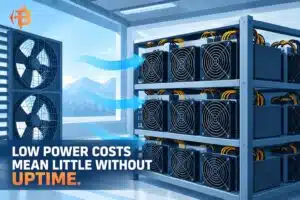
An ASIC cannot mine when it is offline. Downtime can result from power interruptions, unstable internet, excessive heat, failed fans, damaged hashboards or slow on-site support. Over time, the gap between theoretical and realised uptime becomes a material part of return performance.
A serious hosting environment should provide monitored power distribution, effective cooling, physical security and a defined process for alerts and repairs. Investors should also understand how maintenance is approved, how replacement parts are charged and how quickly technicians can act. A promise of high uptime carries more weight when it is backed by operational visibility and clear accountability.
Efficiency creates resilience
Bitcoin mining is cyclical. When revenues are high, many machines can look profitable. The real test comes when difficulty rises, Bitcoin’s price falls or both occur together. More efficient ASICs have greater room to absorb those changes because their electricity cost per terahash is lower.
This does not mean every investor must buy the newest available model. Older units can still have a role where power is particularly competitive or where acquisition cost is low enough to justify a shorter payback horizon. But the investment case should be stress-tested against less favourable conditions, not built around the best month in a profitability calculator.
Model the downside before committing capital
A good mining model starts with conservative assumptions. Use the actual hashrate and power draw specified for the machine, then account for pool fees, hosting charges, expected uptime and the gradual change in network difficulty. Avoid treating a single day’s mining revenue as a forecast for the next year.
Run several scenarios. One can reflect current market conditions, another a lower Bitcoin price, and another a difficulty increase with stable power costs. If the economics only work in the most optimistic case, the investment is speculative in a way that should be recognised upfront.
Payback period should also be handled carefully. It is a useful planning metric, but it is not a guarantee. A miner’s daily output can rise or fall before its initial cost is recovered. Investors building a portfolio of machines may choose to reinvest early payouts, hold the Bitcoin produced, or sell a portion to cover Opex. Each approach changes cash-flow risk and exposure to BTC price movements.
There is also a timing factor. ASIC hardware begins depreciating the moment newer, more efficient models enter the market. Rapid deployment therefore matters. A machine held in transit or waiting for rack space is capital that is not hashing. Confirm the expected path from payment confirmation to installation, energisation and pool connection before completing a purchase.
Own hardware, cloud capacity or a managed fleet?
There is no single route into mining. Direct ASIC ownership gives the investor control over a tangible asset and the ability to decide where it is hosted, when it is sold and how the mined Bitcoin is managed. It also brings the responsibility of selecting equipment and overseeing operational partners.
Cloud mining can provide exposure without the logistics of owning and deploying hardware. It may suit investors who want a simpler entry point or a defined level of hashpower without building a physical fleet. The trade-off is reduced control over the underlying equipment and the need to examine contract terms closely, including payout methodology, duration and operational transparency.
Managed hosting sits between self-operation and cloud exposure. The investor owns the ASICs while a specialist infrastructure partner handles installation, power, cooling, monitoring and maintenance. For many individuals and growing portfolios, this structure removes the burden of running equipment at home or securing a data-centre relationship independently.
The decision should match the investor’s capabilities. A technically experienced operator with access to suitable power may prefer direct control. A first-time miner may place greater value on a plug-and-mine route, dashboards and responsive support. Institutional buyers with larger fleets usually need dedicated capacity, structured power procurement and clear service-level expectations.
Questions to ask before choosing a hosting partner
A hosting provider is not just a place to put machines. It becomes part of the investment’s operating performance. Before committing ASICs, establish who is responsible for each stage: receipt of equipment, installation, configuration, pool setup, monitoring, maintenance, reporting and insurance arrangements.
Ask how you will verify that your machines are online and producing expected hashrate. Miner-management software, serial-number records and accessible performance data create a clearer line of sight between your capital and the live operation. You should also know what happens if a unit underperforms, needs repair or must be moved to another facility.
For investors using UAE-based infrastructure, local technical access can be valuable when speed, communication and on-site accountability are priorities. BitHash combines ASIC sourcing with managed hosting, repair support and fleet oversight, reducing the number of separate providers an investor must coordinate. That consolidation can simplify deployment, but investors should still review machine specifications, commercial terms and risk assumptions for their own portfolio.
Build for flexibility, not perfect forecasts
The strongest mining strategy is rarely based on predicting the exact Bitcoin price six or twelve months ahead. It is built around controllable advantages: efficient hardware, dependable energy, fast deployment, high uptime and transparent operating costs.
Keep enough liquidity to cover hosting and electricity costs during weaker market periods. Avoid concentrating all capital in a single machine generation or one short-term profitability assumption. If you are scaling, consider phased deployment so real operating data can inform the next purchase rather than committing the full budget before your first units are live.
Bitcoin mining rewards preparation more reliably than excitement. Treat the ASIC as an income-producing asset that needs professional infrastructure around it, and you will be in a stronger position to judge whether the opportunity fits your objectives, risk tolerance and time horizon.