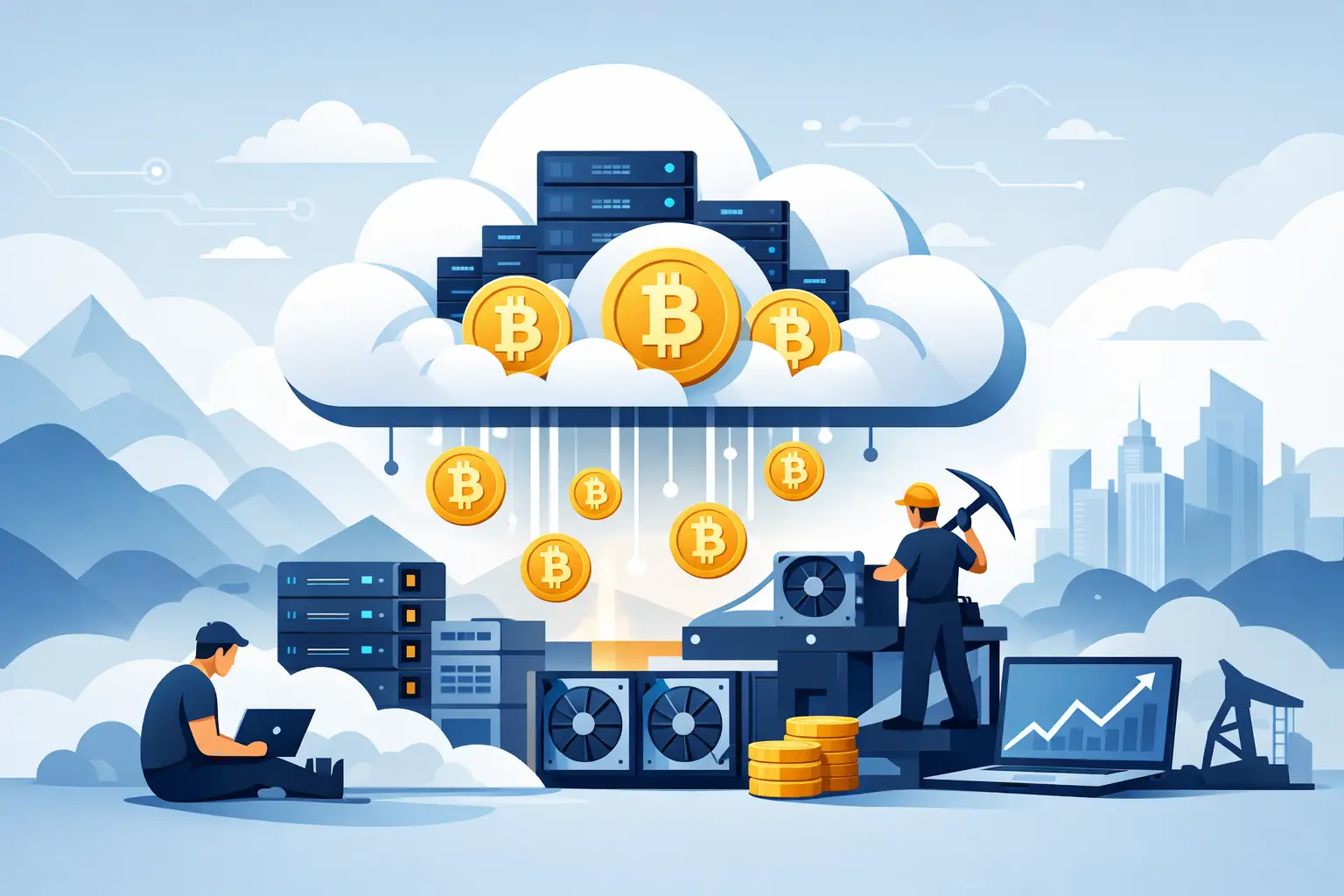
A mining operation does not have to begin with pallets of ASICs, electrical design and a round-the-clock technical team. Cloud mining gives investors a way to buy access to computing power operated elsewhere, turning a complex infrastructure activity into a more accessible route to Bitcoin mining exposure.
That simplicity has value, particularly for investors who want exposure to mining economics without managing heat, noise, repairs, firmware and electricity procurement themselves. It also creates a different set of questions. The quality of the operator, the contract terms, the cost structure and the visibility of the underlying hashrate matter just as much as the advertised daily return.
What cloud mining actually means
Cloud mining is an arrangement in which a customer pays for a defined amount of mining hashrate for a set period, while a provider operates the physical mining equipment and infrastructure. The provider is responsible for the ASIC miners, site operations, power delivery, cooling, monitoring and, depending on the agreement, maintenance and pool management.
In return, the customer receives mining rewards linked to their contracted hashrate, less the fees specified in the contract. For Bitcoin, this is usually measured in terahashes per second, or TH/s. A larger allocation represents a greater share of the operation’s productive capacity, but it does not guarantee a fixed amount of BTC each day.
Mining output moves with several variables: Bitcoin network difficulty, block reward, transaction fees, pool performance, machine uptime and the price of electricity. Any provider presenting cloud mining as fixed, risk-free income should prompt careful scrutiny. Mining is a performance-based activity, not a savings account.
Cloud mining versus hosted ASIC ownership
Cloud mining and managed hosting are often grouped together, but they serve different investment preferences. With cloud mining, the operator generally owns the equipment and sells access to hashrate. With managed hosting, the customer purchases and owns specific ASIC miners while a hosting partner deploys and runs them in its facility.
Cloud mining removes upfront hardware selection, shipping, import arrangements and the need to plan for resale. It can suit an investor seeking a lower-touch entry point or a shorter-term allocation to mining capacity. The trade-off is reduced control. Customers may not own a serialised machine, decide which ASIC model is used, or retain an asset that can later be sold.
Hosted ownership requires more capital and more decisions, but gives the customer direct exposure to hardware value, model selection and long-term fleet strategy. A latest-generation machine with competitive efficiency can remain an operational asset even if mining economics temporarily tighten. The right route depends on whether the priority is operational simplicity, asset ownership, flexibility or scale.
The economics behind a cloud-mining contract
The headline hashrate is only the starting point. Before committing capital, investors should understand precisely how rewards are calculated and which operating costs are deducted. A credible proposal explains the contract duration, contracted hashrate, fee model, payout frequency, minimum withdrawal threshold and the conditions under which service may be paused or terminated.
Electricity is particularly important. In a physical mining operation, electricity cost is usually expressed as a kWh price. In cloud mining, that cost may appear as a daily maintenance charge, an all-in operating fee, or a deduction from mined rewards. These structures can produce very different outcomes, especially when Bitcoin difficulty rises or the BTC price falls.
Efficiency also sits beneath the numbers. Modern ASICs convert power into hashrate more efficiently than older generations. If a provider does not disclose the equipment class, performance assumptions or facility design, it is difficult to judge whether the offered contract is built on competitive infrastructure or ageing hardware with limited margin.
A sensible assessment should model more than one scenario. Estimate rewards under current network conditions, then test what happens if difficulty rises materially, uptime drops, or the BTC price changes. The best case is useful for marketing. The downside case is what protects a capital decision.
What a reliable provider should be able to show
The appeal of cloud mining rests on trust in an operator. Customers are delegating the physical side of mining, so transparency is not an optional extra. It is the foundation of the product.
A serious provider should be able to explain where its infrastructure operates, how power is secured, how miners are cooled, who monitors the site and how faults are handled. UAE-based support, clear operational accountability and access to technical specialists can make a meaningful difference when an investor needs answers quickly.
Look for a defined approach to uptime rather than broad claims. No mining facility can promise perfect availability: planned maintenance, pool issues, power events and hardware failures occur. What matters is whether the operator has 24/7 monitoring, site security, spare-parts capability, repair procedures and a clear process for communicating incidents.
The commercial terms deserve the same level of attention. Read the contract for maintenance fees, power-cost adjustments, payout calculations, withdrawal charges, renewal conditions and early termination clauses. Ask whether the provider can demonstrate real operating capacity, rather than simply selling allocations with no clear connection to live mining infrastructure.
Where cloud mining fits in a mining portfolio
For a first-time miner, cloud mining can be a practical way to understand hashrate economics without immediately committing to ASIC ownership. It allows an investor to see how network difficulty, daily rewards and BTC price movements affect mining results in real time. That experience can inform a later move into hosted hardware.
For an experienced operator, cloud mining can be used more selectively. It may add hashrate while owned machines are being shipped or installed, provide temporary exposure during a capacity expansion, or diversify operational exposure across sites and providers. It is not automatically cheaper than owning and hosting miners. Its value lies in removing Capex and operational complexity where that trade-off makes commercial sense.
For larger investors, the decision becomes more strategic. A fleet of owned ASICs can support a long-term infrastructure plan, while cloud allocations may offer speed and flexibility. The stronger approach is often to match the structure to the objective: use owned machines for durable operating capacity and contracted hashrate for agility where appropriate.
Questions to ask before you commit
Before purchasing a cloud-mining contract, get direct answers to these points:
- What exact hashrate is being sold, for how long, and how is performance measured?
- Which ASIC generation and mining pool support the contracted capacity?
- Are electricity and maintenance costs fixed, variable or deducted from rewards?
- What uptime history, monitoring process and fault-response procedure does the operator have?
- How are payouts calculated, when are they made, and what minimum withdrawal rules apply?
- What happens if mining revenue falls below operating costs or the contract becomes uneconomic?
- Is the provider operating its own facility, and can it evidence its infrastructure and support capability?
These questions are not administrative detail. They determine whether an apparently attractive hashrate price translates into a workable mining position.
Avoiding the common mistakes
The most common error is buying on projected returns alone. Mining calculators are useful planning tools, but they rely on assumptions that change constantly. A return estimate based on today’s difficulty and BTC price should never be treated as a promise for the next quarter.
Another mistake is confusing convenience with absence of risk. Cloud mining removes many operational burdens, but it introduces counterparty risk. If the provider lacks real infrastructure, clear terms or responsive support, the customer has little control over the outcome. Due diligence should cover both the financial offer and the operator behind it.
Finally, avoid allocating capital that depends on a particular payout level. Bitcoin mining can be volatile, and every allocation should sit within a broader investment plan with realistic expectations around liquidity, time horizon and risk tolerance.
For investors who value a hands-on infrastructure partner, BitHash combines ASIC expertise, managed operations and mining support in a model designed to reduce the friction between capital deployment and active hashrate. Whether choosing cloud capacity or owned hardware, the objective remains the same: place mining equipment and operational responsibility with a provider that can explain every part of the journey from power to payout.
The strongest cloud-mining decision is rarely the one with the loudest projected return. It is the one where the hashrate, operating costs, contract terms and real-world infrastructure all stand up to scrutiny.