
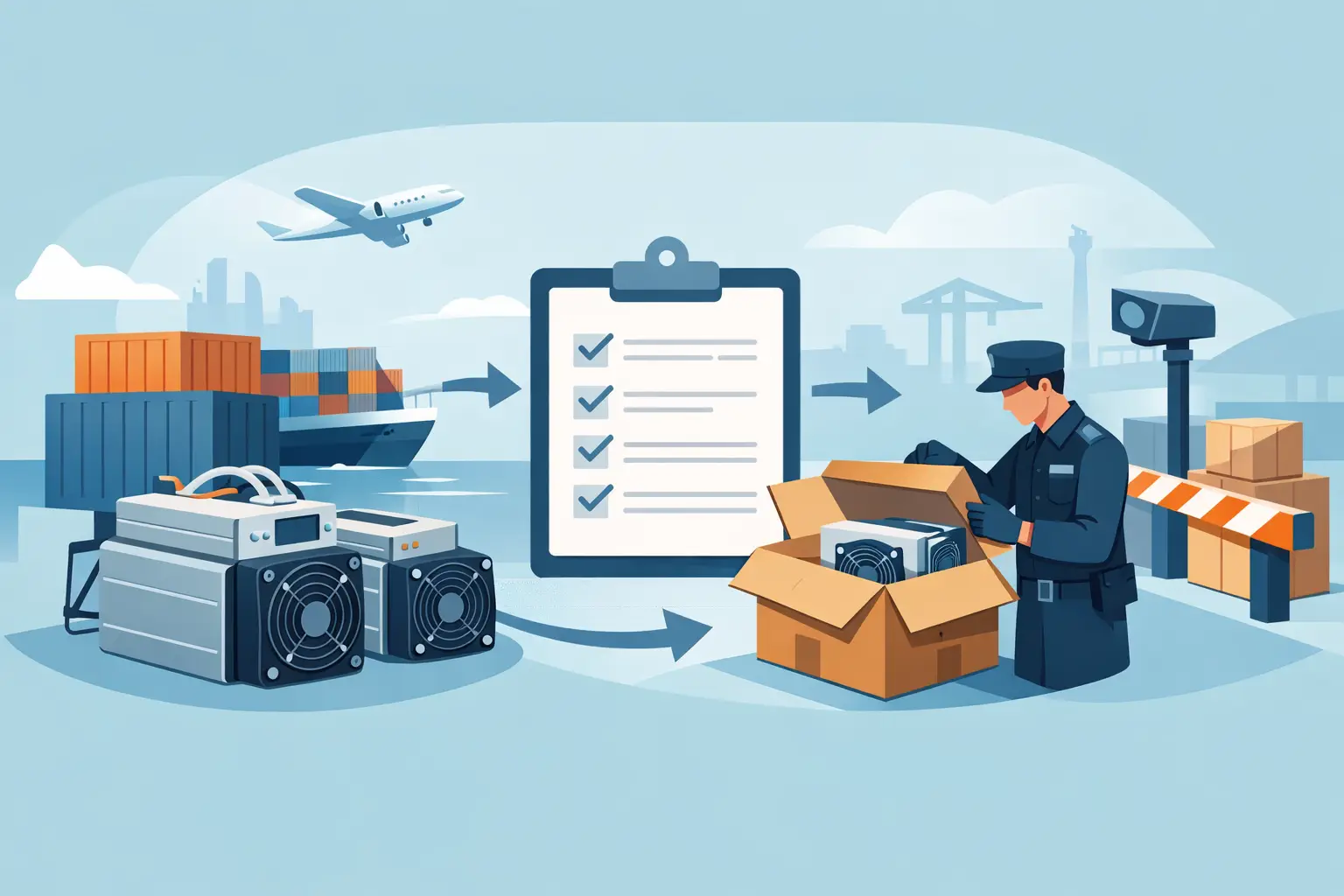
An ASIC miner can look like a simple hardware purchase until it is held at the border, assessed for unexpected duties, or delivered to a site without the power and cooling to run it. Knowing how to import ASIC miners is therefore not just a logistics exercise. It is a Capex decision that affects deployment speed, uptime and your realised mining return.
For a single machine, a poor import process is frustrating. For a fleet of 50, 150 or 500 units, it can tie up significant capital while your hashrate sits idle. The strongest approach is to treat procurement, customs clearance, delivery and commissioning as one connected operation.
How to import ASIC miners: start with the deployment plan
Before requesting a freight quote, confirm where the miners will operate and what that location can support. The model you choose determines the electrical load, plug type, rack layout, airflow requirements and network configuration. A miner that is profitable on paper can become an expensive problem if the hosting site cannot accommodate its voltage, heat output or cooling design.
This matters particularly with latest-generation units. Air-cooled ASICs require carefully managed hot and cold aisles, filtration and exhaust capacity. Hydro-cooled models need compatible manifolds, water treatment, leak detection and trained technicians. Neither is inherently better – the right option depends on your available infrastructure, ambient conditions, power price and scale.
At this stage, establish four commercial figures: machine cost, shipping and insurance cost, landed tax and duty cost, and the ongoing electricity or hosting rate. Use these numbers to model your expected daily operating margin rather than relying solely on a manufacturer’s stated hashrate and efficiency.
Buy from a source that can prove the hardware chain
ASIC mining hardware is a specialist market. Price alone is not a sufficient buying criterion, particularly when a low quote comes with vague delivery terms, an unclear warranty, or no serial-number record.
Ask the supplier to confirm whether the units are new, used, repaired or refurbished; the exact model and firmware; the batch quantity; the stated hashrate tolerance; power consumption; warranty terms; and the dispatch location. For used miners, request operating history where available and evidence of hashboard, fan, PSU and controller condition.
You should also know who is named as exporter on the commercial paperwork. Customs authorities expect the invoice, packing list and transport documents to match. Discrepancies between the seller, declared value, number of cartons and serialised goods can trigger examination or delay.
If the supplier offers a delivered price, clarify the Incoterm rather than assuming everything is covered. EXW, FCA, FOB, CIF, DAP and DDP allocate cost, risk and import responsibility differently. DDP can reduce work for the buyer, but only if the seller has a credible ability to clear goods lawfully in the destination market. For larger purchases, many operators prefer direct visibility over freight and customs arrangements rather than handing control to an unfamiliar seller.
Prepare the documents before the shipment leaves
Most costly import delays begin with documents prepared after the aircraft or vessel has departed. Your customs agent should review the paperwork in advance, especially when you are importing high-value quantities.
A typical ASIC shipment requires:
- A commercial invoice showing seller and buyer details, product description, quantity, unit price, total value, currency and agreed Incoterm
- A packing list with carton count, net and gross weight, dimensions and serial numbers where applicable
- Air waybill or bill of lading issued by the carrier or freight forwarder
- A certificate of origin when required by the destination authority or trade arrangement
- Importer registration, tax registration or local licence documentation required in the country of entry
The product description should be accurate and specific. “Computer equipment” may be technically broad but creates avoidable questions. Describe the goods as cryptocurrency ASIC mining machines, stating the manufacturer, model and intended function. Do not undervalue equipment or use false descriptions to reduce duty. Apart from being unlawful, it can undermine insurance claims and create long-term compliance risk for your business.
Classify the miners and calculate the true landed cost
Customs duty, VAT or equivalent sales tax, clearance charges and local fees vary by jurisdiction. The applicable tariff treatment depends on the correct Harmonised System classification and the rules of the importing country. Do not assume that a classification used in one market will be accepted in another.
Your customs agent should confirm the tariff code before dispatch and explain whether duties apply to the goods value alone or to a broader customs value that includes freight and insurance. In many markets, import VAT is calculated after duty and freight have been added, which can materially change the cash required to release a fleet.
For UAE-bound imports, also distinguish between goods entering the mainland and goods entering a free zone. The treatment, paperwork and timing can differ, particularly if equipment is later moved into the mainland. A local import structure should match the final operating model rather than simply the cheapest initial freight option.
Build a landed-cost schedule for every consignment. It should include the equipment invoice, international freight, cargo insurance, customs duty, VAT where applicable, customs clearance, inspection or storage charges, local delivery and commissioning. This is the number that belongs in your ROI model.
Choose shipping around risk, not just transit time
Air freight is usually faster and can make commercial sense for a small number of high-value miners or when hashprice conditions favour urgent deployment. It is more expensive, and batteries, accessories or certain power components may bring additional carrier requirements.
Sea freight generally suits larger fleets where transport cost per unit matters more than speed. The trade-off is longer transit, more exposure to port congestion and a greater need for moisture protection, shock-resistant packing and cargo insurance. ASIC miners are dense, valuable electronics, so packaging quality is not a minor detail.
Insure the shipment for its replacement value and read the exclusions. Standard carrier liability is often far below the value of a container or pallet of mining hardware. Record the serial numbers, photograph cartons before dispatch where possible, and inspect the shipment at handover. If cartons are crushed, wet or resealed, note it immediately with the carrier before signing acceptance.
Clear compliance checks before payment and dispatch
Crypto mining is legal and commercially established in many jurisdictions, but rules around importing electronics, operating a mining site, converting digital assets and moving funds are not uniform. Check the destination country’s import restrictions, product conformity rules, radio or electromagnetic requirements where relevant, and local licensing requirements for the facility.
Payment also deserves attention. International hardware transactions may be subject to bank compliance reviews, sanctions screening and source-of-funds checks. Keep supplier contracts, invoices, company documents and payment records organised. Clear records make it easier to satisfy banking and customs queries without losing days to back-and-forth requests.
For institutional buyers, add a formal acceptance process. Define the expected model, quantity, serial-number range, hashrate test method, power draw tolerance and defect procedure before funds are released. This turns a vague hardware purchase into a measurable procurement contract.
Plan delivery, testing and go-live as one handover
Customs clearance is not the finish line. The final journey from airport or port to the mining site carries its own risks, especially for heavy pallets, remote facilities and high-security data centres. Confirm vehicle access, unloading equipment, secure staging space and the delivery appointment before the goods arrive.
Once received, reconcile serial numbers against the packing list and inspect units before installation. Power up miners in controlled batches, confirm firmware integrity, test hashboards and fans, monitor rejected shares, and check actual wattage against the manufacturer specification. A staged commissioning process identifies damaged or underperforming units before they are mixed into the wider fleet.
If you are hosting rather than self-operating, ask the provider how it records ownership, allocates machines to your account, monitors uptime and handles repairs. You should receive visibility over hashrate, pool connection, electricity billing, maintenance events and downtime. Transparent operations matter more than a headline hosting rate that excludes essential support.
For operators who want procurement and deployment under one accountable partner, BitHash can coordinate ASIC sourcing, logistics, hosting and ongoing monitoring from the point of purchase through active mining. The practical benefit is fewer handovers between sellers, freight agents and site operators when time-to-hashrate matters.
Avoid the shortcuts that reduce returns
The most common mistake is buying first and planning second. Other avoidable errors include choosing a supplier without a verifiable export history, declaring an unrealistic customs value, shipping without adequate insurance, and sending equipment to a facility that has not confirmed capacity.
There is also a temptation to focus solely on the purchase price. A slightly cheaper miner can cost more over its life if it arrives late, lacks warranty support, consumes more power than expected or sits in a queue awaiting installation. The better calculation is total cost per productive terahash, supported by reliable infrastructure.
A well-run import should feel uneventful: correct documents, known taxes, protected transit, verified hardware and a prepared site waiting at the other end. That is the standard to aim for, because every day a miner is operationally ready but not hashing is a day of potential revenue you cannot recover.