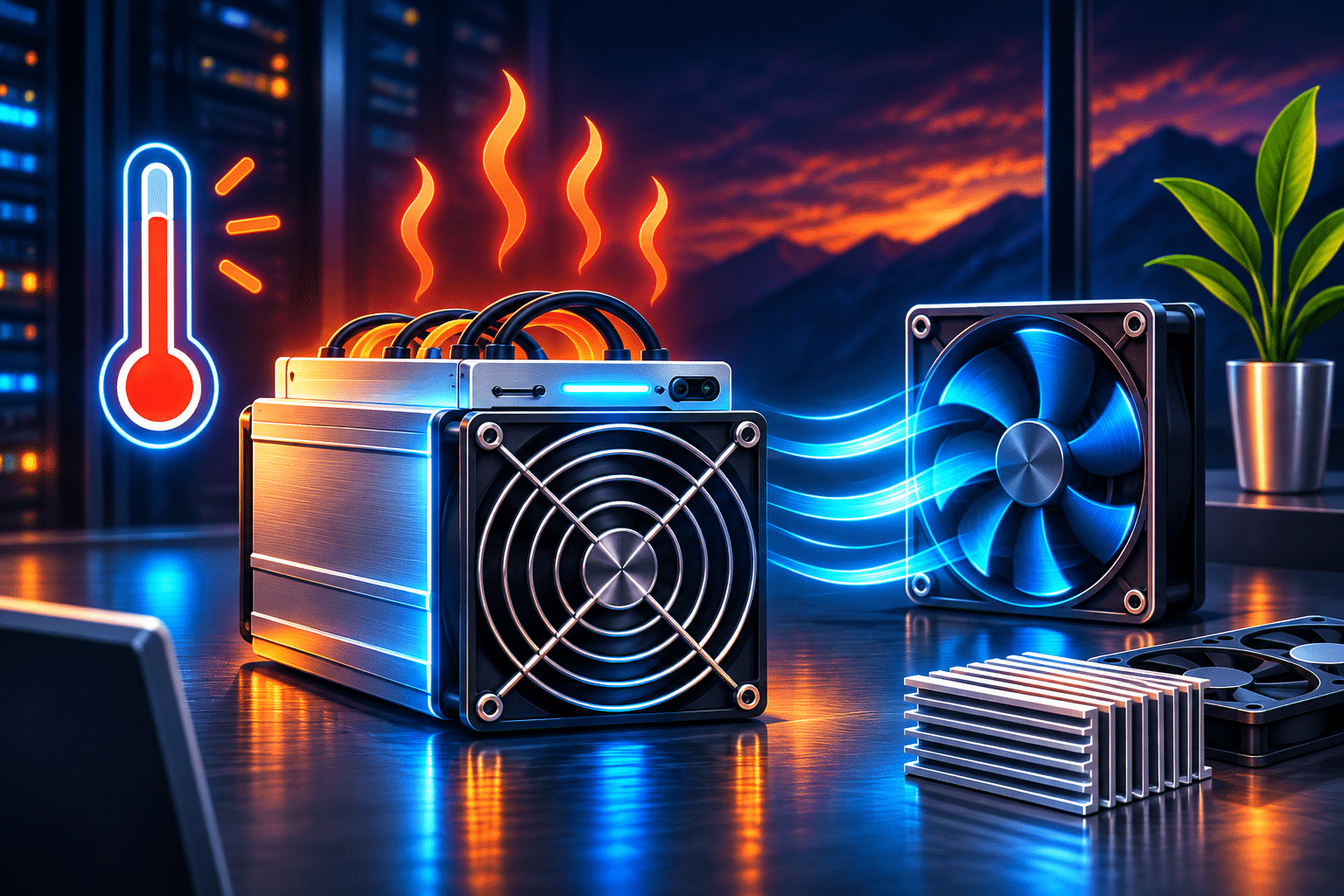
A miner that suddenly loses hashrate on a hot afternoon is not merely having a bad day. It is signalling an operational risk that can turn into repeated downtime, damaged hashboards and avoidable repair cost. Understanding miner overheating causes lets operators protect uptime before temperature becomes an expensive problem.
ASICs convert significant electrical input into heat. That is the commercial reality behind high-performance mining: more compute density demands more disciplined power delivery, airflow and monitoring. The objective is not to make a mining room cold at any cost. It is to keep each machine within its designed operating range while controlling Opex and maintaining predictable output.
The main miner overheating causes
Overheating rarely comes from one dramatic failure. More often, several small weaknesses combine: a high ambient temperature, restricted intake air, dirty fans and a poorly balanced rack layout. Once chip temperatures rise, an ASIC will usually protect itself by reducing frequency, reporting faults or shutting down. Those safeguards prevent worse damage, but every intervention reduces productive mining time.
High ambient temperature
The temperature of air entering the miner sets the starting point for its cooling system. If intake air is already hot, the fans have less capacity to remove heat from the hashboards. This is especially relevant in warm climates, enclosed rooms and facilities where exhausted air recirculates into the cold aisle.
Operators sometimes focus on the room’s average reading. That can be misleading. A sensor near an air-conditioning outlet may show an acceptable temperature while the top rack, rear row or corner nearest the exhaust is much hotter. Measure conditions at the miner intake, at several rack heights and during the hottest part of the day.
Poor airflow and hot-air recirculation
An ASIC needs a clear path for cool air in and hot air out. When miners face each other, sit too close to a wall, or discharge into an enclosed area, they can ingest their own exhaust. The temperature then escalates machine by machine, particularly in dense installations.
Airflow failures also occur when extraction is undersized. Adding more miners without increasing exhaust capacity pushes heat back into the room. A facility may have enough total cooling capacity on paper, yet still suffer hotspots because air is taking the easiest route rather than the route designed for it.
Dust, sand and blocked components
Dust buildup reduces the effectiveness of heatsinks, fan blades, filters and vents. In dry or construction-adjacent environments, fine particles can become a serious maintenance issue quickly. A clogged filter may seem minor, but it forces fans to work harder and reduces the volume of air crossing the hashboards.
The trade-off is straightforward: aggressive filtration keeps contaminants out but can restrict airflow if filters are not serviced on schedule. Filter selection, cleaning intervals and pressure checks should be part of the site operating plan, not an afterthought after machines begin alarming.
Failing fans and fan-control faults
Fans are consumable components operating at high speed for long periods. A noisy, slow or intermittent fan can leave one section of a miner inadequately cooled even when the other fans appear normal. Fan-related alarms deserve prompt investigation, as continued operation can create uneven temperatures across boards.
The issue is not always the fan itself. Loose connectors, damaged cables, firmware faults or an incorrect replacement part can prevent the controller from reading fan speed properly. Use compatible, approved parts and confirm that the miner recognises the replacement before returning it to full load.
Power-quality problems and electrical heat
Not every temperature alert starts with cooling. Loose electrical connections, undersized cabling, overloaded circuits and unstable supply voltage can generate excess heat at plugs, breakers, power distribution units and power supplies. These conditions create fire risk as well as miner downtime.
Check for discolouration, hot connectors, burnt smells and repeated breaker trips. Thermal inspection is particularly valuable at fleet scale because it can reveal high-resistance connections before they fail. Any electrical repair should be handled by qualified personnel under an appropriate site safety process.
Overclocking and unsuitable performance settings
Pushing frequency or voltage beyond a miner’s intended profile increases power draw and heat output. It may improve hashrate briefly, but the additional revenue can be outweighed by efficiency losses, accelerated component wear and more frequent shutdowns. This is a commercial decision, not simply a technical setting.
The right profile depends on electricity price, cooling headroom, model condition and Bitcoin price. During periods of high ambient temperature, an underclocked or efficiency-focused profile may produce better net results than chasing maximum theoretical hashrate and triggering thermal throttling.
How overheating affects mining returns
Heat damages profitability in stages. First, fans consume more power as they increase speed. Next, the miner may lower performance to protect chips, which reduces hashrate without necessarily reducing all associated overhead. If the issue continues, boards can drop out, the machine can enter fault protection, or parts may require repair.
A single shutdown is visible. More damaging are intermittent temperature events that create unstable output across a fleet. If ten machines each lose a modest amount of production every day, the combined lost opportunity can exceed the cost of proper extraction, preventative servicing or a better rack design.
For hosted miners, ask for visibility rather than relying on a broad uptime claim. Useful operational reporting includes individual miner status, online hashrate, temperature alerts, maintenance events, power consumption and clear handling procedures for offline units. Transparency makes it easier to distinguish a one-off hardware fault from a site-wide cooling constraint.
A practical response when an ASIC runs hot
Start by protecting the machine. If chip temperatures exceed the manufacturer’s threshold, or the miner is repeatedly entering thermal protection, reduce load or shut it down according to the operating procedure. Continuing to restart a hot unit without finding the cause can turn a manageable issue into board damage.
Then inspect the environment before replacing hardware. Confirm the intake temperature, ensure the exhaust has a clear route away from the machines, and check whether adjacent units are also running hot. If multiple miners show similar behaviour, the cause is probably facility-level airflow, extraction or ambient heat rather than a single defective ASIC.
For an individual unit, inspect fans, vents, cables and connectors. Remove dust using a controlled cleaning method suitable for electronic equipment, and avoid forcing contaminants deeper into the chassis. Review logs for fan-speed errors, missing hashboards, temperature sensor warnings and sudden changes after a firmware update or configuration adjustment.
Do not ignore humidity either. Very high humidity can create condensation risk when cooling is too aggressive, while extremely dry environments increase static and dust concerns. The target conditions should follow the equipment manufacturer’s specifications and the facility’s engineering design, rather than a generic room-temperature rule.
Build prevention into the operating model
The strongest overheating strategy is designed into the deployment. Separate cold and hot air paths, size extraction for peak load, leave service clearance around racks and avoid adding capacity until the facility can remove the additional heat. A well-planned layout is cheaper than repeatedly solving hotspots after commissioning.
Monitoring should be continuous, with alerts that identify changes before a shutdown occurs. Track inlet temperature, chip temperature, fan speed, hashrate, power draw and offline events at machine level. Trend data matters: a miner whose temperature rises gradually over two weeks may be signalling dust buildup or a weakening fan long before it trips an alarm.
Preventative maintenance also needs a defined cadence. Cleaning, filter inspection, fan checks, electrical inspections and firmware management should be scheduled around site conditions, not only when fault tickets appear. A desert-adjacent site may require more frequent dust control than a clean, purpose-built data centre. A dense fleet with high load may need more frequent thermal checks than a small pilot installation.
For investors who do not want to build and manage this operational layer themselves, managed hosting can turn cooling, monitoring and maintenance into a defined service responsibility. BitHash approaches infrastructure as the system around the miner, not just the machine: deployment, power arrangements, security, technical response and ongoing operational visibility all affect realised returns.
When air cooling is no longer enough
Air cooling remains effective for many ASIC deployments when facility design and maintenance are sound. However, very high-density operations, challenging climates and performance-focused hardware may justify hydro-cooling or immersion-based approaches. These systems can provide more consistent thermal control and reduce dependence on enormous volumes of filtered air.
They also introduce new considerations: higher initial Capex, specialised infrastructure, fluid management, compatible hardware and trained maintenance teams. The best choice depends on fleet size, available power, climate, expansion plans and the value placed on density and noise reduction. Cooling technology should be selected as part of the full data-centre economics, not as a reaction to one hot rack.
Heat is not an unavoidable tax on mining performance. It is an operational variable that can be measured, engineered and managed. Treat every temperature alarm as useful evidence, act before throttling becomes routine, and give each ASIC the power and airflow conditions it needs to keep producing.
BitHash
Verified AnalystBitHash Infrastructure, UAE Colocation & Mining Intelligence Team