A silent ASIC in a professional facility can earn around the clock while you focus on your portfolio, rather than dealing with heat, noise, wiring and fault alerts at home. But are hosted miners profitable? The honest answer is yes, they can be – provided the machine, power contract and operating environment work together. Hosting does not create profit on its own. It protects the conditions that give a competitive ASIC its best chance to produce it.
For an investor, hosted mining is a direct operational business. Your capital buys hashrate, then that hashrate must convert into Bitcoin at a rate that exceeds every ongoing cost. The strongest hosting arrangements make this process clearer and more controllable. The weakest hide costs, tolerate avoidable downtime and leave the owner with a machine that is technically online but commercially underperforming.
Are hosted miners profitable after all costs?
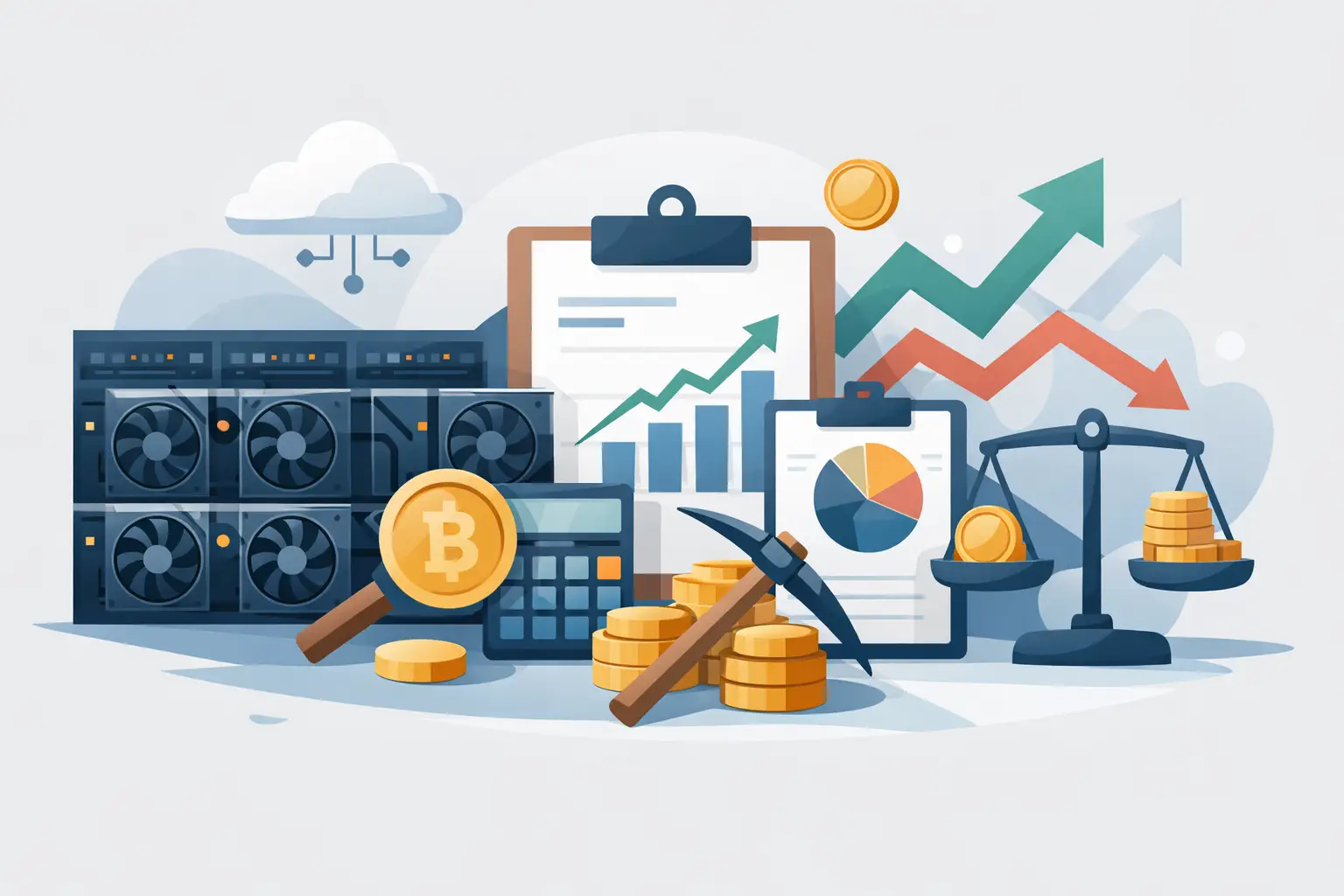
A hosted miner is profitable when its daily Bitcoin revenue exceeds its daily operating costs, and when the remaining cash flow can recover the purchase cost of the miner within an acceptable period. That sounds simple, yet each part of the calculation moves.
At a basic level:
Daily profit = daily mining revenue – electricity cost – hosting charges – pool fee – maintenance allowance
Daily mining revenue is driven by your ASIC’s hashrate and efficiency, the Bitcoin price, network difficulty, transaction-fee conditions and the block reward. Electricity cost is driven by the miner’s power draw in kW, its operating hours and the all-in price per kWh. A useful hosting quote states exactly what is included in that all-in rate, rather than relying on a headline number that excludes facility, management or service charges.
Consider a simplified example. A 200 TH/s ASIC consuming 3.5 kW operates at an all-in power cost of $0.06 per kWh. Its electricity cost is 3.5 × 24 × $0.06, or $5.04 per day. If the machine earns $9.00 per day before operating expenses, the gross margin is $3.96 before pool fees and any additional agreed services. If revenue falls to $6.00 as difficulty rises or Bitcoin’s price declines, that margin narrows quickly.
This is why a profitability calculator should be treated as a scenario tool, not a promise. Run a base case, a conservative case and an upside case before buying. The question is not whether a miner looks profitable on one favourable day. It is whether it remains viable when conditions become less generous.
Hosting changes the cost of operating, not the market
Mining at home can appear cheaper because there is no separate hosting invoice. In reality, home mining often carries costs that are easy to miss: higher residential electricity tariffs, ventilation upgrades, electrical work, noise restrictions, internet interruptions, heat management and the time required to respond when a machine goes offline.
A purpose-built mining facility replaces those fragmented responsibilities with a known operating structure. Industrial power arrangements, engineered airflow or hydro-cooling, physical security, network redundancy and on-site technicians are not cosmetic additions. They can materially affect uptime, hardware condition and the number of billable mining hours your ASIC achieves.
That said, hosting is not automatically the lowest-cost answer for every miner. If you have access to reliably priced power, suitable space, electrical capacity and the technical confidence to run machines safely, self-hosting may suit you. For most portfolio investors, however, the relevant comparison is not a hosting fee versus zero cost. It is professional hosting versus the full cost and risk of doing the job properly yourself.
The variables that decide your mining return
Electricity pricing and contract clarity
Electricity is usually the largest operating expense in ASIC mining. A difference of one or two cents per kWh can turn an acceptable margin into a weak one, particularly during periods of rising network difficulty. Ask whether the quoted rate includes energy, facility overhead, cooling, monitoring and applicable service charges.
Also understand how the price can change. Is it fixed for a defined term, indexed to a tariff, linked to a power purchase agreement, or subject to a minimum consumption commitment? A low introductory rate has limited value if the terms are unclear once your machines are deployed.
ASIC efficiency and purchase price
The newest machine is not always the most profitable purchase, and the cheapest used machine is not always a bargain. What matters is the relationship between hashrate, energy consumption, price and expected useful operating life.
Efficiency is commonly measured in joules per terahash. Lower J/TH means the ASIC requires less energy to produce each unit of hashrate. In a competitive market, efficient hardware tends to hold up better when revenue compresses. Older models can still work well with very low electricity pricing, but they carry a smaller margin of safety and may become uncompetitive earlier.
Your Capex matters just as much. An expensive next-generation unit may generate stronger daily margin yet take longer to repay if bought at the peak of a hardware cycle. Compare anticipated cash flow against the delivered machine price, not only against the advertised hashrate.
Uptime, curtailment and response time
A miner that is offline earns nothing while its costs and capital exposure continue. Even modest uptime losses can have a meaningful effect across a fleet. A reliable host monitors performance continuously, identifies failed hashboards or network issues quickly, and has an established process for repair, replacement and redeployment.
Ask operational questions before committing machines: how is uptime measured, what events are excluded, who authorises repairs, how are repair costs approved, and how quickly are faults escalated? Facilities may also curtail operations during exceptional power events. This can be commercially sensible, but it should be transparent in the agreement and reflected in your projections.
Pool fees, firmware and fleet visibility
Pool fees are relatively small, but they are part of the economics. More important is whether you can see the operational data behind your returns. You should be able to review hashrate, worker status, rejected shares, power consumption where available, payouts and downtime history.
For multi-unit portfolios, miner-management software is more than a dashboard. It helps detect underperformance early. A machine running below its expected hashrate for several days may be losing more value than the repair cost required to return it to full output.
How to assess a hosted-mining offer before you pay
Do not make the decision from a calculator screenshot alone. Request a written commercial breakdown and test it against conservative revenue assumptions. The due diligence should cover the hardware, the facility and the contract as one investment case.
Before deployment, you need clear answers on four areas:
- the ASIC model, nominal hashrate, power draw, warranty status and delivery timeline;
- the all-in electricity rate, billing currency, deposit requirement and any variable pricing mechanism;
- facility security, cooling design, monitoring, maintenance process and realistic uptime reporting; and
- ownership, access to wallet or pool configuration, withdrawal arrangements and exit or relocation terms.
For larger fleets, ask about rack density, electrical capacity, phased deployment and the host’s ability to scale without diluting service levels. A facility that can host ten machines well is not automatically prepared to commission 150 machines on schedule.
The UAE can be attractive for miners who value professional infrastructure, responsive regional support and a clear route from procurement to active operation. BitHash’s role in this model is to bring hardware sourcing, deployment, hosting and ongoing operational support under one accountable team, reducing the gaps where projects commonly lose time and revenue.
Profitability is a moving target, so manage it actively
Once the machines are live, profitability should be reviewed regularly rather than checked only when payouts arrive. Track revenue per TH, effective electricity cost, realised uptime, pool performance and each unit’s actual hashrate. Compare these figures with your original model and investigate material variance quickly.
There will be periods when holding mined Bitcoin makes more sense than selling immediately, and periods when converting a portion of production to cover Opex is the more disciplined choice. That is an investment decision separate from whether the machine itself is operating efficiently. Keep the two decisions distinct so that a view on Bitcoin price does not mask an unprofitable operating position.
Hosted miners are most compelling when they give you competitive power, dependable uptime and transparent control without the burden of running a data centre yourself. Start with conservative assumptions, choose infrastructure that can prove its performance, and treat every ASIC as an asset that must earn its place in your portfolio every day.