
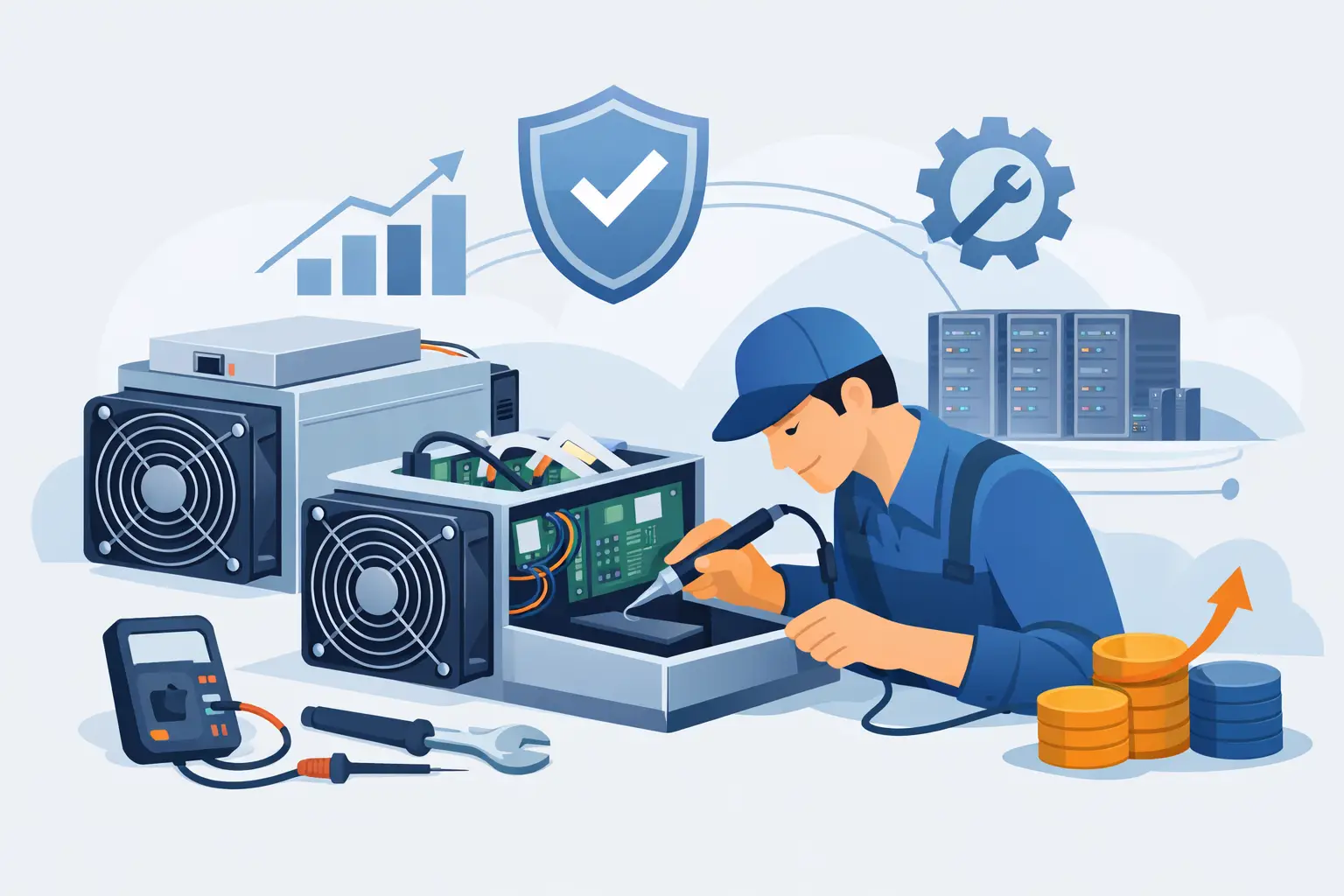
A miner that drops offline at 03:00 is not simply a faulty machine. It is lost hashrate, a weaker daily mining yield and, if the fault is repeated across a fleet, a direct hit to operational ROI. Effective ASIC miner repair is therefore not about swapping parts at random. It is a disciplined process of identifying the failed component, preventing the issue from returning and getting productive capacity back online with minimum delay.
For a solo miner, one offline unit may represent a sizeable proportion of the portfolio. For a site operating hundreds of machines, even a modest failure rate can consume technician time, spare-part budgets and available rack capacity. The right repair decision depends on the machine’s age, fault type, expected output, warranty position and the cost of keeping it offline.
Why ASIC failures need a commercial response
ASIC miners work under sustained electrical and thermal load. Hashboards process continuously, fans move large volumes of air, power supplies operate close to demanding load profiles, and network connections must remain stable. This is precisely what makes them productive, but it also means small operational defects can become major failures when ignored.
A damaged fan, for example, may appear to be a minor maintenance issue. Left unresolved, reduced airflow can raise board temperatures, cause frequency throttling and accelerate component wear. A loose power connection can create heat at the connector, while inconsistent input power may trigger repeated restarts or damage a power supply unit.
The objective is not merely to make the miner switch on. It is to restore stable hashrate at a temperature, error rate and power draw that make commercial sense. A machine returning online only to cycle through faults every few days is still an operational liability.
The most common fault patterns
Many repairs begin with a symptom rather than a confirmed diagnosis. Low hashrate can be caused by one missing hashboard, poor chip performance, unsuitable firmware settings, overheating or a weak power supply. A miner that will not boot could have a controller-board issue, a damaged PSU, a network problem or an incorrect configuration.
The most frequent patterns include contaminated heatsinks and fans, failed fan assemblies, degraded or failed PSUs, hashboard chip errors, broken temperature sensors, damaged connectors and control-board faults. Humidity, dust, poor airflow, unstable electricity and rushed installation can all increase the likelihood of these issues.
Error logs are valuable, but they are not a repair verdict on their own. A reported board fault may originate in the board, its cable, the PSU or the environment around the machine. This is why experienced diagnostics test the system methodically rather than replacing the first component that looks suspicious.
ASIC miner repair starts with safe diagnostics
Before a unit is opened, isolate it from power and allow it to cool. ASIC PSUs and internal components are not suitable for casual live testing. Operators should use qualified technicians, appropriate test equipment and established electrical safety procedures, particularly when working at scale.
A useful first inspection checks the obvious but meaningful points: fan operation, cable seating, connector condition, accumulated dust, signs of heat damage, physical board damage and the status lights or display output. The miner’s management interface and kernel log should then be reviewed for missing boards, temperature readings, fan speed, voltage warnings and chip-related faults.
This sequence matters because it separates configuration and environmental problems from hardware failure. A machine that is overheating because of blocked airflow does not necessarily need a board-level repair. Equally, resetting a miner repeatedly without investigating a persistent board error can make diagnosis harder and extend downtime.
Test the whole operating context
A reliable diagnosis looks beyond the unit. Check the incoming power quality, breaker capacity, cabling, rack airflow, ambient temperature and network stability. If several miners in the same row develop similar faults, the common cause is often infrastructure rather than individual machine failure.
In hot operating environments, cooling design becomes central to repair prevention. Air-cooled miners need correctly managed intake and exhaust paths. Hydro-cooled systems require close control of fluid quality, flow, temperature and connections. In both cases, a machine can be technically sound yet underperform if the cooling system is not doing its job.
For hosted fleets, centralised monitoring is particularly valuable. A gradual rise in rejected shares, board temperatures or restart frequency can flag a developing issue before it becomes a full outage. Predictive maintenance is less glamorous than emergency repair, but it protects availability far more effectively.
Repair, replace or retire the miner?
Not every fault deserves the same response. Replacing a fan or PSU is often quick and commercially sensible, especially on a machine with competitive efficiency and a strong remaining operating life. Repairing a hashboard can be worthwhile when the unit remains profitable and the board can be restored with quality parts and proper testing.
However, component-level board repair is more specialised. It may involve fault tracing across chips, signal paths, voltage domains and temperature circuits. It should be carried out by technicians with the correct fixtures, tools and access to tested replacement components. A cheap repair that creates unstable hashrate, repeated failures or a safety risk is not a saving.
Replacement becomes more attractive when a miner is older, less efficient than current-generation hardware, outside warranty and affected by an expensive board failure. The calculation should include more than the repair invoice. Compare expected post-repair hashrate and watts per terahash against electricity pricing, projected uptime, shipping time, warranty coverage and the revenue that will be missed while the machine is unavailable.
Retiring or redeploying a unit can also be the right choice. A machine that is no longer competitive at one kWh rate may still operate acceptably in a lower-cost location, while a newer model takes its place in premium capacity. Treat hardware allocation as a portfolio decision, not simply a technical one.
A repair workflow that protects fleet uptime
The most effective operations separate triage from deep repair. First, identify whether the unit can be restored through configuration, cleaning, cooling correction or a straightforward part replacement. Then quarantine machines requiring advanced diagnostics so they do not occupy productive rack space or create repeat technician call-outs.
For larger fleets, maintain accurate records for each serial number: installation date, hashrate baseline, repair history, firmware version, parts replaced and recurring error codes. This reveals whether a particular batch, rack, PSU type or environmental zone is creating a disproportionate number of failures.
A practical operation should also hold appropriate spares. The ideal inventory depends on fleet size and model mix, but commonly replaced items such as fans, cables, control boards and PSUs should not require a long procurement cycle. Standardising on selected miner models can reduce spare-part complexity and speed up technician training.
When a repaired unit returns to service, it should be burn-tested before full deployment. Confirm all boards are detected, hashrate is stable, fan behaviour is normal, temperatures are balanced and power draw aligns with the expected profile. A clean test period is more valuable than a fast but uncertain return to the rack.
Preventing the next repair bill
Maintenance schedules should be based on operating conditions rather than a calendar copied from another site. Dust-heavy sites may require more frequent filter, fan and heatsink inspection. Higher ambient temperatures call for tighter thermal monitoring. Sites with inconsistent grid conditions need greater attention to power protection and electrical distribution.
Good housekeeping has a direct financial impact. Keep intake paths clear, manage cable routing, use correctly rated connections and ensure hot exhaust air is not recirculating into miner intakes. Avoid overclocking simply to chase headline hashrate unless the cooling, power capacity and hardware economics support it. Higher frequency can increase output, but it also raises thermal stress, consumption and failure risk.
Firmware management deserves the same discipline. Approved firmware can improve monitoring and efficiency controls, but unverified versions may create stability, security or warranty issues. Test changes on a limited group of miners before applying them across a fleet, and keep a clear rollback plan.
For operators who do not want an in-house repair bench, the quality of the service partner matters. Ask how faults are diagnosed, whether repairs are tested under load, which parts are used, how turnaround is managed and whether recurring infrastructure causes are reported back to the client. BitHash approaches repair and maintenance as part of the wider mining operation, linking technical intervention with monitoring, hosting conditions and the commercial need to keep equipment earning.
A well-run repair programme does more than revive failed hardware. It gives operators cleaner data on fleet health, more predictable Opex and the confidence to scale without letting small faults quietly erode returns. The next time a miner drops offline, treat it as a signal to protect the whole operation, not just a machine to reset.