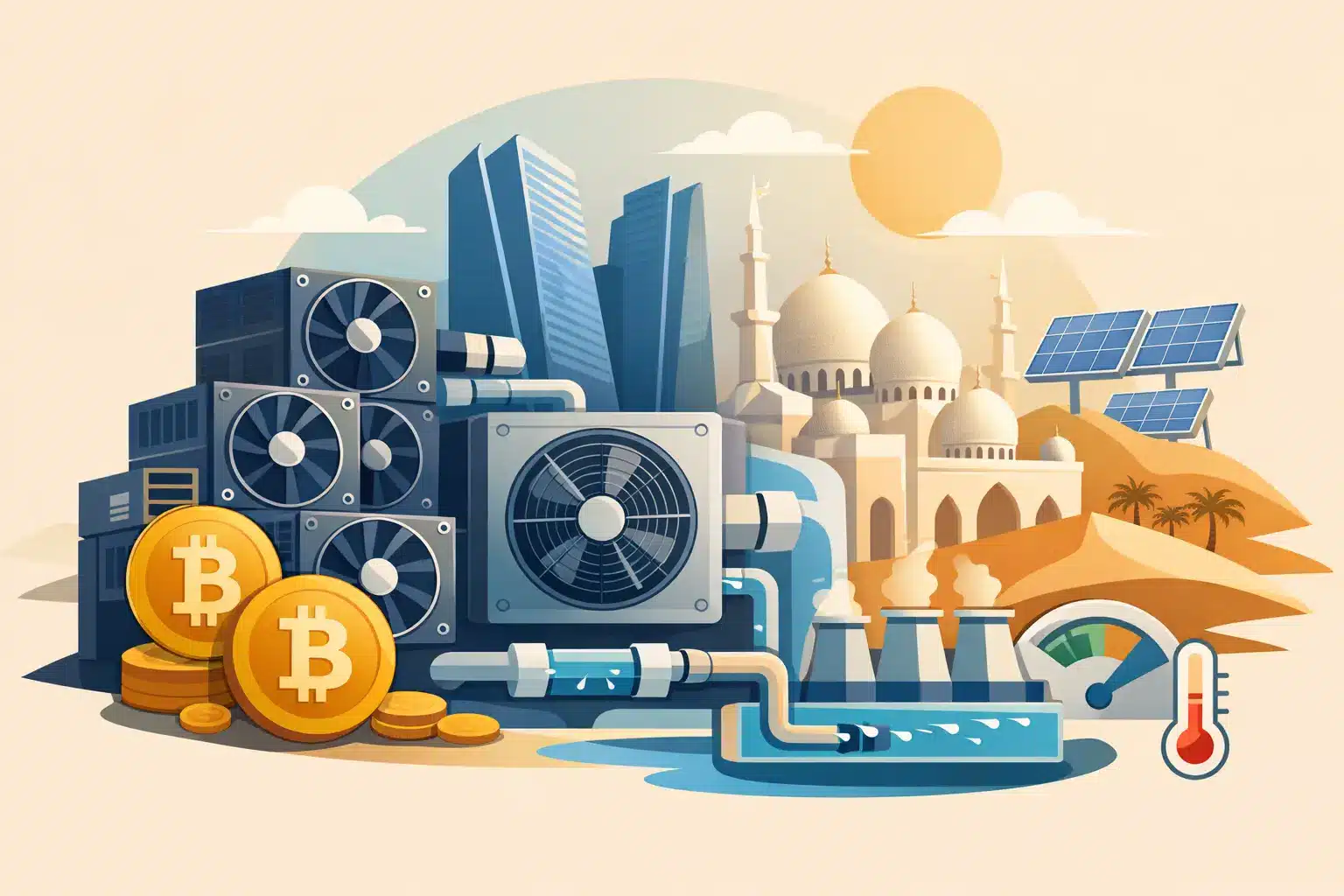
A profitable ASIC can become an expensive idle asset the moment power, cooling or maintenance are treated as an afterthought. Bitcoin hosting Dubai is designed to remove that operational gap by placing miners in a managed environment where electricity, ventilation, security and technical response are handled as one system.
For an investor with a handful of machines, hosting can replace a noisy, heat-heavy home setup with professional oversight. For a fleet operator, it can reduce the time spent coordinating suppliers, electricians, technicians and monitoring tools across multiple locations. The value is not simply a rack space and a plug socket. It is the ability to keep hashrate online, understand operating costs and scale without rebuilding the operation every time the fleet grows.
Why Dubai hosting is an operational decision
Dubai is a commercial hub with established logistics routes, strong infrastructure and direct access to a growing digital-asset ecosystem. That makes it a practical base for miners who want local access to their equipment and a provider that can manage the full deployment cycle, from ASIC sourcing through to active operation.
Yet location alone does not produce better mining results. Bitcoin mining is an energy and uptime business. The real questions are whether the facility can support the electrical load, manage heat effectively, protect the machines and respond quickly when something fails. A low advertised rate has little value if it comes with frequent curtailment, unclear fees or prolonged downtime.
Dubai’s climate also makes thermal design non-negotiable. High ambient temperatures put pressure on air-cooled ASICs, especially at dense rack configurations. A capable host must plan airflow, filtration, exhaust paths and preventive maintenance around the actual hardware being deployed. For higher-density operations, hydro-cooling may offer a more controlled route to stable performance, although it requires compatible equipment, specialised infrastructure and a larger upfront commitment.
What a Bitcoin hosting Dubai package should include
The best hosting arrangement begins with clear commercial terms and ends with accountable daily operations. Before moving capital, miners should establish exactly what is included in the quoted cost per kWh and where additional charges may apply.
Electricity is the main operating expense for most ASIC fleets, but it should not be assessed in isolation. Ask whether the power figure includes distribution losses, management fees, VAT where applicable, maintenance and any minimum-consumption requirements. If rates change with market conditions or consumption bands, that mechanism should be documented rather than left to a sales conversation.
Physical security matters just as much. ASICs are compact, valuable assets that are difficult to replace quickly when supply is constrained. A facility should have controlled access, continuous surveillance, inventory processes and a clear chain of custody from delivery to installation. You should know how each unit is labelled, where serial numbers are recorded and how equipment can be inspected or collected if required.
Monitoring is the third core component. Effective miner-management software gives clients visibility of hashrate, uptime, temperature, fan performance and pool connectivity. It also gives technicians the information needed to identify a failing board, unstable power supply or network issue before it becomes a lengthy outage. A dashboard is useful, but it is not a substitute for people who are actively reviewing alerts and able to act on them.
Start with the machine, not the marketing
A hosting decision cannot be separated from ASIC selection. Different models have different power draw, heat output, efficiency and repair profiles. The machine that looks attractive on a headline hashrate figure may not suit the available power price, rack density or your preferred risk level.
Calculate expected performance using realistic assumptions. Use the unit’s stated wattage, but allow for pool fees, potential downtime and the fact that network difficulty and Bitcoin price move independently. Revenue is paid in Bitcoin, while many operating expenses are paid in fiat currency. That creates a different risk profile from simply buying and holding BTC.
For example, a newer-generation ASIC may offer stronger efficiency in joules per terahash, helping it remain competitive as difficulty rises. However, it usually carries higher Capex and may take longer to pay back if market conditions soften. Older units can be cheaper to acquire, but their margins are more sensitive to electricity pricing and they may become uneconomic sooner. There is no universally correct machine choice. The right answer depends on capital available, expected hosting term and the level of volatility you can absorb.
Due diligence before you deploy
A provider should be able to explain its process without relying on vague promises of guaranteed returns. Mining output cannot be guaranteed. What can be assessed is the quality of infrastructure, the transparency of the contract and the provider’s ability to keep equipment operating.
Before committing, confirm these practical points:
- the contracted power allocation, kW per unit and whether capacity can expand;
- the complete electricity and hosting price structure, including any deposit or exit terms;
- expected deployment timing after payment, delivery and site acceptance;
- service-level expectations for monitoring, reboots, repairs and replacement parts;
- the procedure for failed machines, warranty claims and customer approval of repair costs;
- access to live reporting for hashrate, status and account billing;
- equipment ownership, insurance responsibilities and the process for withdrawal or relocation.
These details prevent avoidable disputes later. They also reveal whether a host is equipped for long-term operations or simply reselling capacity. A professional operator will be comfortable discussing limitations, including lead times for specific ASIC models, the availability of spare parts and the cases in which a repair is not commercially worthwhile.
Air cooling versus hydro cooling
Most entry-level and mid-sized hosted fleets use air-cooled ASICs. They are familiar, widely available and generally simpler to service. With correct facility design, they can deliver reliable production at scale. Their limitation is that performance and component wear are closely tied to air quality and temperature control.
Hydro-cooled systems circulate liquid to remove heat more efficiently. This can support higher-density deployment and reduce dependence on high-volume fan operation. It is particularly relevant where operators are pursuing larger fleets, advanced thermal management or purpose-built data-centre projects.
Hydro cooling is not automatically the better commercial choice. The equipment, plumbing, heat-exchange systems and maintenance process are more specialised. Smaller investors may gain more from well-managed air-cooled hosting than from paying for infrastructure they do not need. The decision should follow a technical and financial assessment, not a trend.
Scaling without losing control
The first few miners are often the easiest part of a mining portfolio. Complexity rises when a fleet grows from ten units to one hundred or more. Procurement becomes more time-sensitive, firmware consistency matters, failure rates become visible and manual spreadsheets stop being useful.
A scalable host should be able to add machines without disrupting the existing fleet. That means planned capacity, standardised commissioning, documented network configuration and a repair workflow that does not leave machines offline while minor faults wait for attention. It also means a single point of accountability when hardware, hosting and maintenance are combined.
BitHash supports this model by bringing ASIC sourcing, UAE-based hosting, monitoring and technical operations into one managed service path. For clients, the practical benefit is fewer handovers between parties and clearer ownership of issues when they arise.
Treat hosting as part of your mining strategy
Hosting does not eliminate market risk. Bitcoin price, network difficulty, transaction-fee conditions and machine resale values will still affect returns. What managed hosting can do is reduce the operational uncertainty that turns a sound mining thesis into an underperforming fleet.
The strongest approach is to match hardware, energy cost, cooling method and hosting term to a defined investment objective. If the numbers work only under perfect uptime and an optimistic Bitcoin price, the plan needs more margin. If the provider can show clear costs, accountable support and a realistic route to expansion, your mining operation has a far better foundation to keep producing when conditions become demanding.