Bitmain ASIC Miners: What Drives Real Returns

A Bitmain miner may be the most visible part of a Bitcoin mining investment, but it is not the investment on its own. The machine produces hashrate; the operation around it determines whether that hashrate is converted into consistent mining output or lost to heat, downtime, poor power terms and delayed repairs. For a single ASIC or a fleet of hundreds, buying the right model is only the starting point.
Why Bitmain remains central to ASIC mining
Bitmain is one of the best-known manufacturers in the ASIC market, particularly through its Antminer range. Its machines are built for proof-of-work networks where specialist hardware has replaced general-purpose computers. For Bitcoin miners, the decision is usually not whether an ASIC is necessary. It is which ASIC offers the most suitable balance of hashrate, efficiency, purchase price and operating requirements.
Newer Antminer generations typically improve efficiency, expressed in joules per terahash (J/TH). A lower figure means less energy is required to produce each unit of hashrate. That matters because electricity is normally the largest ongoing cost in mining. A machine with a lower upfront price can still be the weaker commercial choice if it consumes materially more power over its operating life.
However, the newest unit is not automatically the best unit for every buyer. Availability, delivery timing, site capacity, cooling configuration and the electricity rate all change the calculation. A high-performance hydro-cooled model may be an excellent fit for a purpose-built facility, while an air-cooled machine may be the more practical choice for a smaller hosted deployment.
Start with mining economics, not the headline hashrate
Hashrate attracts attention because it is easy to compare. If one machine produces 200 TH/s and another produces 100 TH/s, the larger number appears to offer a clear advantage. But mining returns are driven by the relationship between output and total operating cost, not by hashrate alone.
Before committing capital, assess the machine across four connected variables: its hashrate, power draw, purchase cost and expected operating environment. Bitcoin network difficulty and market price will move throughout the life of the machine, so no responsible provider should frame a profitability estimate as guaranteed income. Instead, the objective is to build a position that remains competitive across different market conditions.
Power draw should be measured against an actual, transparent kWh price. Ask whether the quoted rate includes infrastructure charges, service fees, taxes, power loss allowances and any minimum commitments. A low headline electricity rate that excludes material operating charges can distort a comparison quickly.
The purchase price also needs context. A discounted older machine may produce cash flow in favourable conditions, but it may have less protection when difficulty rises or Bitcoin price falls. Latest-generation hardware generally offers stronger efficiency, although the Capex commitment is higher. The right choice depends on whether the priority is lower entry cost, long-term fleet efficiency or a balanced portfolio of both.
Bitmain hardware needs the right operating conditions
An ASIC is designed to work continuously at high load. It produces significant heat, draws substantial power and depends on stable environmental conditions. That is why mining should be treated as infrastructure, not as a simple hardware purchase.
Air-cooled miners need controlled airflow, clean intake conditions and enough space to prevent hot air from circulating back into the machines. Poor containment can cause elevated temperatures, fan stress, throttling and avoidable failure rates. Noise is another practical issue. Air-cooled ASICs are not suitable for most homes, offices or lightly ventilated commercial spaces.
Hydro-cooled models address thermal density differently. They circulate coolant through the hardware, allowing higher-density deployments and more controlled thermal performance. The trade-off is that they require purpose-built cooling loops, compatible racks, water treatment and experienced site operations. Hydro-cooling is not simply an add-on; it is an infrastructure decision that should be made before equipment is ordered.
Power quality is equally important. Machines need properly engineered distribution, protections, cabling and capacity planning. A site that is technically able to energise a fleet is not necessarily capable of running it efficiently at full load over time. Professional hosting facilities plan for redundancy, monitoring, access control, fire protection and maintenance workflows alongside the raw megawatt capacity.
Hosting can protect uptime and reduce operating friction
For many investors, managed hosting is the practical route to mining exposure. Rather than managing delivery, customs processes, electrical installation, ventilation, security and repairs independently, the owner places the hardware in a facility built for continuous operation.
The value is not limited to convenience. Hosting can shorten the path from purchase to active mining, especially where the provider controls both equipment procurement and site deployment. It also gives operators a clearer accountability chain when a machine needs attention. If hashrate drops, the response should involve monitoring, diagnosis, repair coordination and a documented update, not a vague support ticket with no operational owner.
When comparing hosting proposals, focus on the detail behind the headline. Understand the electricity tariff, contract duration, billing method, planned maintenance arrangements, uptime approach and repair process. Confirm whether the site can support the specific Bitmain model under consideration, particularly if it is a hydro-cooled unit or has unusual voltage and rack requirements.
Location can add value where it improves logistics, support or power access. For example, UAE-based infrastructure can offer a useful operational base for investors who want direct regional access to their equipment and support team. Yet the stronger question is always whether the facility has the energy, cooling and operational discipline required for the intended fleet.
Fleet visibility is an operational advantage
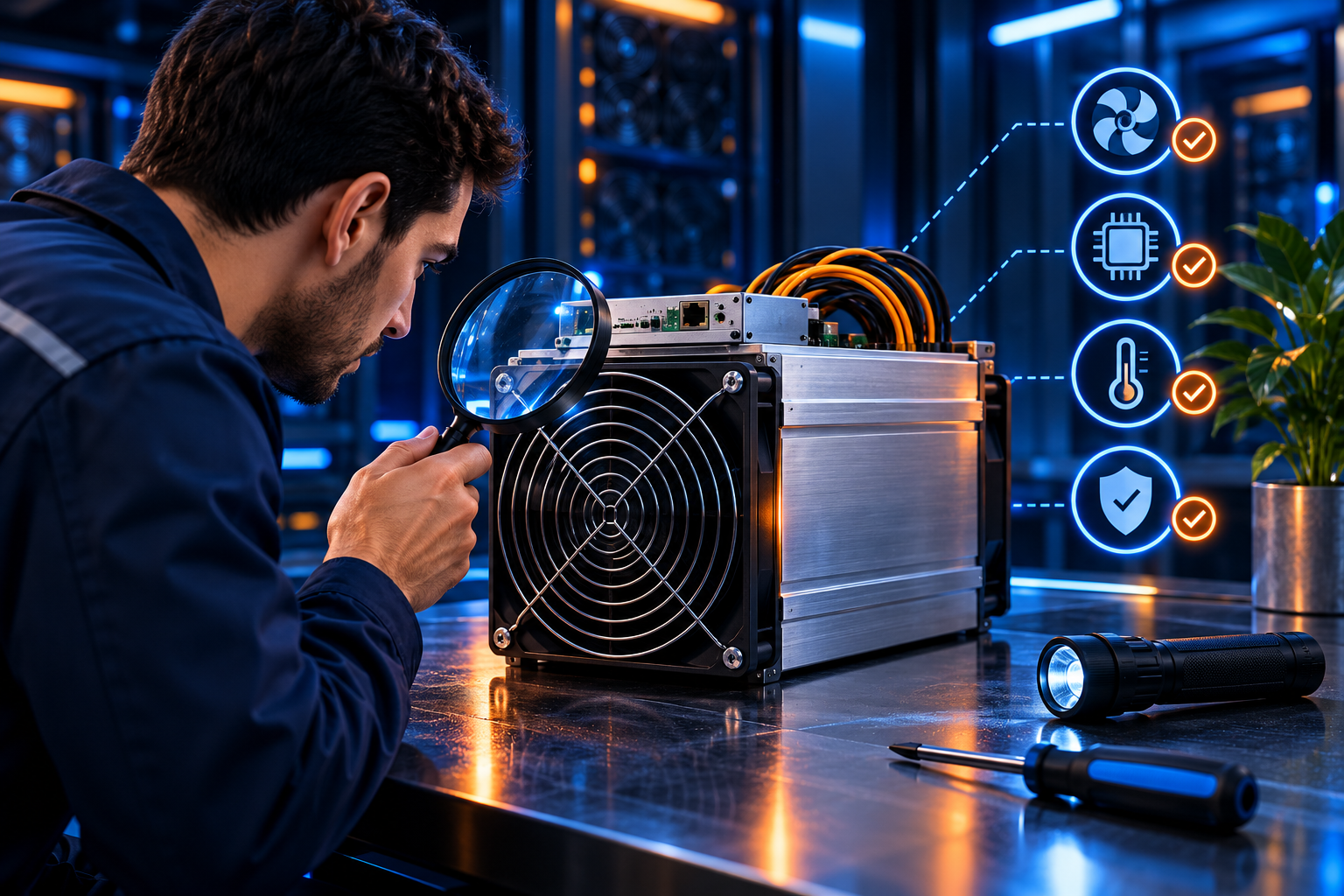
A miner that is powered on is not necessarily performing correctly. Hashboards can degrade, fans can fail, temperatures can drift and firmware issues can affect output. At scale, these small events compound. A fleet of 200 machines can lose meaningful hashrate before a manual check identifies the cause.
Miner-management software provides a working view of the operation: online status, pool connectivity, hashrate, temperature, fault alerts and performance trends. It helps operators identify underperforming units and prioritise interventions. For larger portfolios, it also supports better financial oversight by connecting expected output with actual machine performance.
The quality of the response matters as much as the quality of the dashboard. Monitoring without on-site technicians, spare parts access or an organised repair path does not solve downtime. A serious operating model has escalation procedures, stock management and a clear decision process for repair versus replacement.
Plan for repairs before the first failure
ASIC miners are industrial electronics operating under sustained stress. Repairs are part of the commercial reality, not an exceptional event. Hashboard faults, control-board issues, power supply failures and cooling-related problems can all occur over a machine’s life.
The key question is how quickly a problem is detected, diagnosed and returned to service. A transparent repair process should explain the fault, expected turnaround, costs and testing completed before redeployment. It should also avoid unnecessary repairs where a configuration issue, pool setting or minor component fault is the real cause of reduced performance.
For fleet owners, maintaining operational records is worthwhile. Track serial numbers, installation dates, repair history, warranty status and recurring error patterns. This creates better visibility over Opex and can reveal whether a particular batch, site condition or operating configuration needs attention.
Build the operation around your investment horizon
A first-time buyer may want one or two efficient machines hosted under a simple all-in arrangement. The goal is straightforward: go live quickly, see performance clearly and avoid becoming a facilities manager. A professional operator may need bulk procurement, staged deployment, custom power capacity, dedicated technical reporting and an expansion plan tied to a PPA or long-term energy strategy.
Both approaches can work, but neither should be forced into the other’s model. Small portfolios benefit from simplicity and responsive support. Larger fleets benefit from standardisation, site engineering and granular operational data. BitHash works across that range, combining ASIC sourcing with hosting, monitoring, maintenance and infrastructure support so the mining operation can scale without creating unnecessary administrative burden.
The most useful way to assess a Bitmain miner is to look beyond its specification sheet. Choose hardware that fits the power price, cooling design, capital plan and support model available to you. When those elements are aligned, hashrate becomes more than a headline figure: it becomes an asset that can keep working when the market gets less forgiving.
Written by BitHash
BitHash Infrastructure & Mining Research Team