Why Do ASIC Hashboards Fail? Causes and Fixes
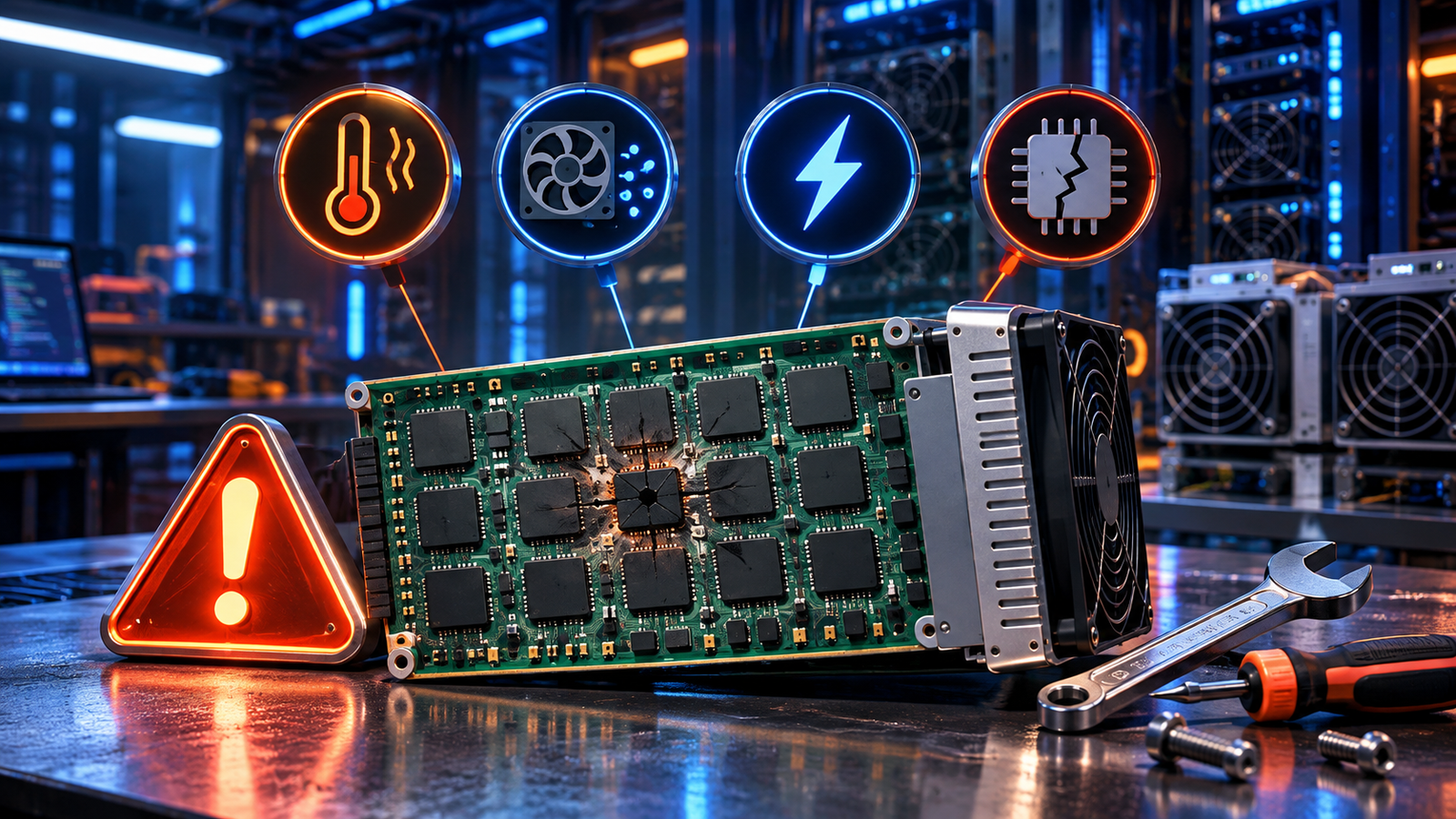
A miner can look completely normal from the outside – fans spinning, control board online, network connected – while one failed hashboard quietly removes a third of its earning capacity. For an individual operator, that is an immediate hit to daily output. For a fleet, repeated board faults turn into lost hashrate, repair bills and a difficult question: why do ASIC hashboards fail when the machine is designed to run continuously?
The short answer is that a hashboard operates under sustained electrical and thermal stress. It contains hundreds of specialised chips working at high frequency, with very little tolerance for excess heat, unstable power or poor contact between components. A failure is rarely random. Most can be traced back to operating conditions, ageing parts, handling errors or a repair that addressed the symptom rather than the cause.
What a hashboard is actually coping with
A hashboard is the computing engine inside an ASIC miner. It carries the ASIC chips, voltage-regulation circuits, capacitors, sensors and data pathways that allow the machine to produce hashrate. In a three-board miner, each board should contribute a broadly similar share of the total performance.
This is demanding hardware, not general-purpose computing equipment. ASIC chips draw substantial current and generate heat constantly. The board relies on stable voltage, clean airflow and reliable communication with the control board. If one part of that system drifts outside its operating range, the miner may report missing chips, zero hashrate from one board, frequent restarts, low hashrate or hardware errors.
The important operational point is that a hashboard fault is not always caused by the board itself. A weak power supply unit, damaged cable, incorrect firmware settings, obstructed airflow or a failing fan can create conditions that damage a healthy board or make it appear faulty. Accurate diagnosis protects both uptime and repair spend.
Why do ASIC hashboards fail in real operations?
Excess heat and uneven cooling
Heat is the most common long-term threat. High chip temperatures accelerate component wear, degrade solder joints and push voltage regulators beyond their safe operating margin. In air-cooled miners, the problem is not simply a high room temperature. Hot air recirculation, blocked filters, poor rack spacing, failed fans and dust accumulation can leave some sections of a board much hotter than the temperature reported at the intake.
Uneven cooling is particularly damaging. A miner may remain online while chips at the far end of a board run consistently hotter than the rest. Over time, this can lead to intermittent faults that become increasingly difficult to reproduce on a repair bench.
Hydro-cooled ASICs reduce several air-cooling risks, but they demand equally disciplined operation. Incorrect coolant flow, pump issues, poor water quality, contamination or leaks can cause rapid damage. The trade-off is clear: hydro systems can support higher-density, lower-noise deployments, but they require purpose-built infrastructure and active monitoring rather than casual maintenance.
Poor power quality and electrical events
ASICs need stable power. Voltage fluctuations, loose connections, overloaded circuits and poorly specified electrical distribution can stress the PSU and the hashboard voltage domains it feeds. A sudden outage is not always catastrophic, but repeated abrupt power loss and unstable restart cycles can shorten component life.
Surge protection, correctly rated cabling, properly engineered PDUs and realistic circuit loading matter more than they appear to during initial deployment. A miner that is underpowered or supplied through a poor connection may intermittently lose a board, generate chip errors or fail to initialise at all.
This is why hosting economics should never be assessed on kWh pricing alone. A cheaper power arrangement that compromises quality, protection or operational oversight can cost more through downtime and avoidable repairs.
Dust, humidity and contamination
Dust is not cosmetic. It restricts airflow, insulates heat-producing components and can hold moisture against sensitive areas. In harsher sites, airborne particles can include conductive or corrosive contaminants that create leakage paths and damage connectors.
Humidity creates a different risk. Condensation during transport, storage or abrupt temperature changes can cause short circuits or corrosion. Miners moved from a cool environment into a hot, humid facility should not be energised immediately. They need time to acclimatise, and operators should inspect boards and connectors before commissioning.
In desert environments, dust management and filtration are central to uptime. In humid regions, corrosion control and environmental stability deserve the same attention. There is no universal cooling or maintenance strategy – the site conditions determine the right design.
Component ageing and manufacturing variance
Even in an excellent facility, electronics age. Capacitors lose performance, thermal pads harden, solder joints fatigue and fans gradually lose their ability to move air. ASIC fleets also contain natural manufacturing variation. Two miners with the same model, batch and operating settings may not age at the same rate.
Overclocking, aggressive frequency settings or pushing machines beyond their intended thermal envelope speeds that process up. Higher hashrate can improve revenue when market conditions are favourable, but it also increases power draw and heat. The additional output must justify the greater failure risk, energy consumption and potential warranty implications.
Poor handling, transport and incorrect repairs
Hashboards are vulnerable during shipping and maintenance. Vibration, impact, electrostatic discharge and bent connectors can produce faults that only appear once the machine returns to load. A board may pass a brief visual inspection yet fail after several hours of mining.
Repair quality matters just as much. Replacing a failed chip without identifying the original cause can produce a repeat fault. For example, a chip damaged by inadequate cooling may be replaced while the defective fan, poor thermal interface or airflow restriction remains in place. The board returns to service, then fails again.
Professional repair should include fault isolation, chip-level testing where required, inspection of surrounding components, thermal checks and a loaded burn-in test. It should also consider the complete miner: PSU, cables, fans, control board, firmware and operating environment.
Recognising a failing board before it goes offline
A complete hashboard failure is obvious. Early degradation is often not. Operators should pay attention when a miner shows a persistent hashrate gap against its expected specification, an uneven board contribution, recurring hardware error codes, unstable chip counts or repeated restarts under load.
Temperature trends are especially valuable. A single high reading may reflect a temporary condition. A gradual rise in board or chip temperature at the same ambient conditions is a maintenance signal. Similarly, a rising fan speed can indicate that the miner is compensating for reduced airflow before an alarm threshold is reached.
Fleet monitoring turns these signs into actionable data. Comparing miners of the same model, tracking average board performance and setting alerts for persistent deviations lets an operator remove a weakening unit before it becomes a more expensive fault. For larger deployments, this is where miner-management software and 24/7 operational oversight directly protect ROI.
Preventing hashboard failure without over-maintaining
The objective is not to dismantle every miner constantly. It is to control the conditions that cause predictable damage and respond early when the data changes. A disciplined preventive plan should cover four areas:
- Keep intake air, filtration, exhaust paths and rack spacing clean enough to maintain consistent cooling.
- Use properly designed electrical distribution, protected circuits and securely terminated cables sized for continuous load.
- Monitor hashrate, chip status, temperatures, fan behaviour and restart events at machine and fleet level.
- Use trained technicians and tested replacement parts, then burn in repaired miners before returning them to full production.
The schedule depends on the site. A clean, well-controlled data centre may need less frequent physical intervention than a dusty containerised operation. Conversely, a location with extreme ambient temperatures may require more conservative power settings or stronger cooling capacity during peak conditions. Preventive maintenance should follow operating evidence, not a generic calendar alone.
When repair is the right commercial decision
Not every failed board should be repaired immediately. The calculation depends on the ASIC model, expected remaining useful life, repair cost, shipping time, current BTC price, network difficulty and the revenue lost while the unit is offline. Repairing a current-generation machine with strong efficiency is often sensible. Spending heavily on an older, inefficient miner may not be.
There is also a capacity question. If a fleet has spare machines available, a failed unit can be swapped out quickly and repaired without sacrificing site output. Smaller operators may prefer managed support that handles diagnosis, repair and redeployment as one workflow, rather than leaving expensive hardware idle while faults are investigated.
BitHash approaches maintenance as an uptime discipline, not simply a repair service. Hardware quality, facility design, power management and monitoring all affect the same result: how consistently your machines convert energy into hashrate.
A hashboard rarely fails because of one dramatic event alone. More often, it has spent weeks absorbing heat, dust, unstable power or overlooked warning signs. Treat those signals as operational data, and maintenance becomes a practical way to protect mining returns rather than an unwelcome interruption.
Written by BitHash
BitHash Infrastructure & Mining Research Team