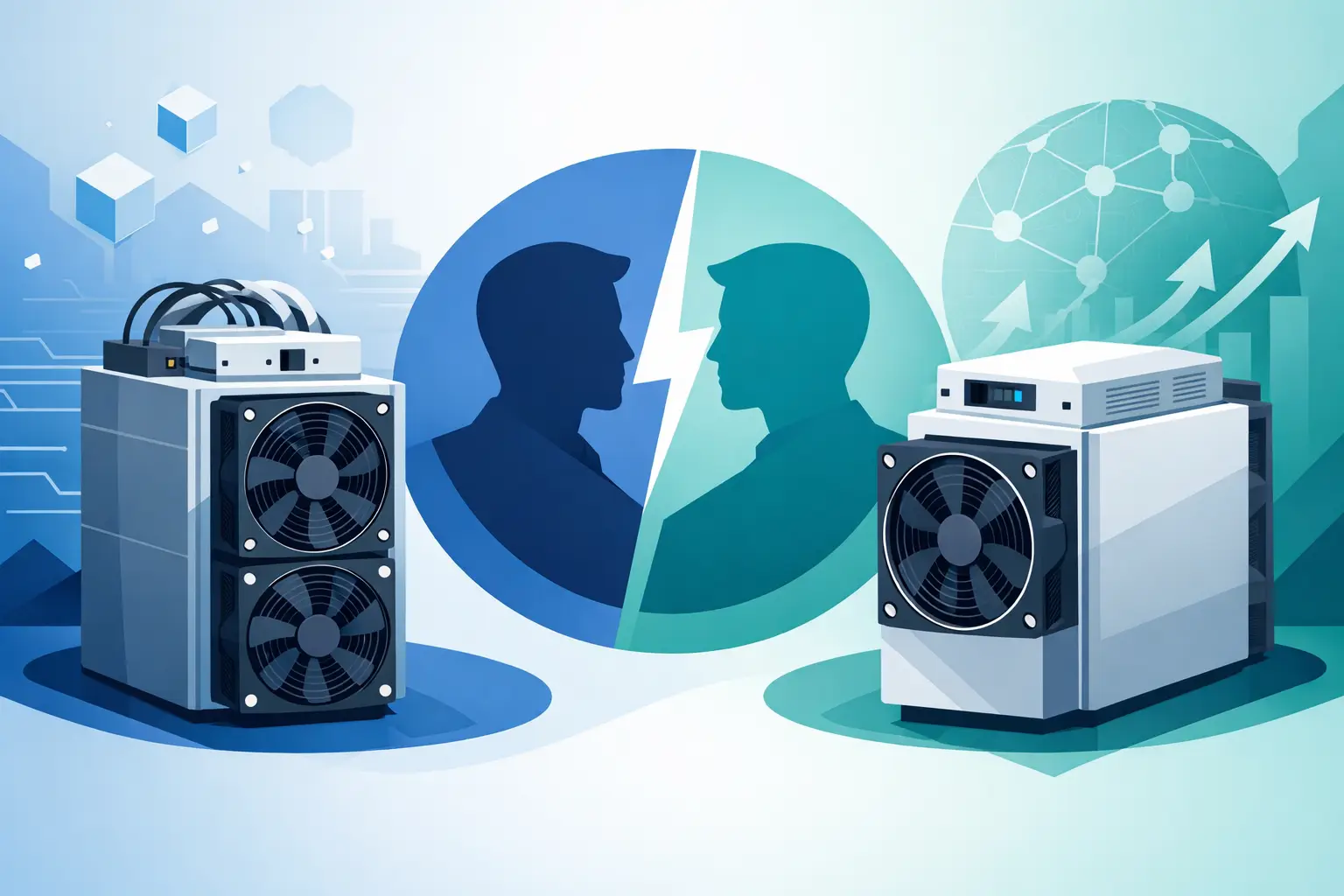
A miner that looks stronger on a specification sheet can become the more expensive choice once it reaches a live site. A few joules per terahash, a different airflow requirement, or a slower repair route can materially change operating margin across a full fleet. That is why Bitmain versus MicroBT miners is not simply a brand preference. It is a Capex, Opex and infrastructure decision.
Both manufacturers build high-performance SHA-256 ASICs for Bitcoin mining. Bitmain sells the Antminer range, while MicroBT produces WhatsMiner units. Both brands have proven their place in professional mining deployments, with air-cooled and liquid-cooled options across recent generations. The right decision depends on the specific model, your electricity price, the cooling design of the site and how quickly you need to scale.
Bitmain Versus MicroBT Miners: The Core Difference
The useful comparison is model against model, not logo against logo. Every new generation shifts hashrate, energy efficiency and operating characteristics. An older flagship may be outperformed by a newer mid-range model from the competing manufacturer, so headline brand claims are not enough.
Bitmain’s Antminer portfolio is broad. It commonly gives operators more configuration options, including high-hashrate air-cooled units, hydro models and immersion-ready machines. That breadth can be valuable where a business runs several site types or wants to standardise on a platform as it expands.
MicroBT’s WhatsMiner range is often selected for its straightforward industrial design and strong reputation among operators who value dependable, repeatable fleet operation. Many large-scale miners favour WhatsMiner models where the available model fits their power and cooling envelope well. The best choice is usually the machine with the lowest total cost per productive terahash at your facility, rather than the one carrying the highest headline hashrate.
Start With Efficiency, Not Purchase Price
ASIC efficiency is measured in joules per terahash, written as J/TH. Lower is better. A machine operating at 15 J/TH consumes less electricity per unit of hashrate than one operating at 20 J/TH. At a site with a competitive kWh price, that difference compounds every hour the machines are online.
However, efficiency needs context. A more efficient miner often costs more to acquire. If the premium is substantial, the lower power consumption may take longer to repay it, particularly if electricity is inexpensive or the intended holding period is short. Conversely, at higher electricity prices, a modest efficiency gap can determine whether a miner remains viable when network difficulty rises.
Use your actual electricity agreement, not a generic online profitability figure. Factor in the site’s all-in kWh rate, including any management fees, electrical losses and cooling overhead. Then model several Bitcoin price and network-difficulty scenarios. The question is not which miner earns the most today. It is which miner protects margin when conditions are less favourable.
Hashrate matters too, especially for operators constrained by rack space, deployment labour or management capacity. A higher-hashrate unit can concentrate more output into fewer machines. Yet that same unit may draw more power and release more heat per machine, placing greater demands on breakers, cables, PDUs and ventilation. A fleet does not become simpler just because it contains fewer miners.
Cooling Can Decide the Winner
Air-cooled ASICs remain the most accessible route for many investors. They are generally easier to deploy, easier to inspect and compatible with a wide range of established mining facilities. Both Antminer and WhatsMiner air-cooled units can perform well, provided inlet temperatures, dust management and airflow are controlled.
The limitation is heat. High-density air-cooled fleets require disciplined hot-aisle and cold-aisle design, reliable extraction, filtration and adequate make-up air. In warm climates, cooling infrastructure can become a material operating constraint rather than a background detail. A miner’s stated efficiency does not include every watt consumed by the wider facility.
Hydro-cooled miners make more sense where the site is designed for them from the outset. They can support higher density, reduce airborne dust exposure and offer more controlled thermal conditions. The trade-off is clear: pumps, heat exchangers, manifolds, water treatment and leak detection must all be properly engineered and maintained. Buying a hydro ASIC without confirming compatible hosting capacity is an avoidable mistake.
When comparing Bitmain versus MicroBT miners for a hydro deployment, verify the exact operating requirements for the selected model. Check water flow, inlet temperature range, pressure requirements, connections and expected power draw. A hydro hosting site should match the machine, rather than forcing the machine into an unsuitable loop.
Reliability Is an Operations Question
No ASIC manufacturer can remove the realities of continuous, high-load operation. Fans wear, hashboards fail, power supplies experience faults and environmental conditions affect component life. What separates a profitable operation from an expensive interruption is the speed and quality of the response.
For this reason, procurement should include more than delivered hardware price. Ask about warranty terms, spare-part availability, repair capability, diagnostic processes and turnaround time. A slightly cheaper machine can lose its price advantage quickly if it sits offline while replacement parts are sourced.
Fleet standardisation has value here. Running one primary model, or at least one primary manufacturer per site, can simplify spare holdings, technician training and monitoring rules. It also makes performance benchmarking easier. On the other hand, a mixed fleet can reduce dependence on a single supply channel and allow operators to buy the strongest economics available at the time. There is no universal answer. A 10-machine portfolio and a 1,000-machine data centre should not make procurement decisions in the same way.
Software, Monitoring and Day-to-Day Control
Modern mining operations need visibility beyond pool hashrate. Operators should monitor individual miner status, board temperatures, fan performance, rejected shares, power draw and downtime causes. The brand of ASIC matters less if the operation lacks a clear process for identifying and resolving underperformance.
Before selecting Antminers or WhatsMiners, confirm that your chosen management software and hosting provider support the firmware, monitoring and alerts you require. This is particularly relevant for larger portfolios, where a small percentage of inactive machines can quietly erode revenue. Automated alerts and clear ticket ownership are practical safeguards, not administrative extras.
For hosted customers, this is where a full-service provider adds real value. Hardware sourcing, commissioning, network configuration, 24/7 monitoring and repair coordination need to operate as one workflow. BitHash can support that path from ASIC selection through to active hosted deployment, reducing the handovers that often delay a new fleet.
Choose by Deployment Scenario
A first-time miner with a small number of units should prioritise an efficient, current-generation machine that the selected host already supports well. The aim is predictable operation and transparent running costs, not chasing a specification that cannot be properly cooled or serviced.
An investor building a larger portfolio should compare delivered cost per terahash, J/TH, all-in hosting price and expected time to go live. Availability can be commercially important. A technically attractive miner that cannot be deployed for weeks may underperform a slightly less efficient alternative that starts producing promptly.
Industrial operators should go deeper. Assess power-density limits, container or building layout, cooling topology, transformer capacity, redundancy, repair strategy and future expansion plans. At this scale, a difference in cable design or water-loop capacity can outweigh a small difference in ASIC purchase price.
The Numbers to Confirm Before You Buy
For each shortlisted Antminer and WhatsMiner model, obtain the current manufacturer specification sheet and confirm the delivered unit configuration. Compare nominal hashrate, power draw, J/TH, cooling type, voltage requirements, dimensions, weight, warranty and delivery timeline. Then build the investment case using site-specific electricity and hosting costs.
Do not assume a quoted hashrate is a guaranteed financial outcome. Network difficulty, pool performance, curtailment, planned maintenance and machine availability all affect realised production. A realistic uptime assumption is more useful than an optimistic revenue projection.
The strongest miner is the one that fits the whole operating system around it: power, cooling, monitoring, maintenance and capital plan. Select that fit carefully, and your hardware choice becomes a controlled step towards scalable Bitcoin mining rather than a costly operational gamble.