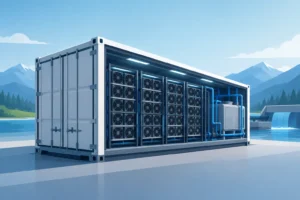
An ASIC miner only earns when it is hashing. That sounds obvious, yet the difference between an attractive mining projection and real-world output is often decided by the crypto mining data centre around the machine. Power instability, heat, network loss, delayed repairs and unclear operating costs can each reduce the hashrate that reaches the pool.
For an individual miner, a professional facility removes the burden of running high-load equipment at home. For a fleet operator, it becomes the operating foundation for Capex worth hundreds of thousands or millions. The objective is not simply to fit more miners into a room. It is to convert installed hardware into secure, measurable and continuously available hashrate.
What a crypto mining data centre actually does
A crypto mining data centre is purpose-built infrastructure for proof-of-work hardware, particularly ASIC miners. Unlike a conventional server facility, it must handle exceptionally high, continuous power draw, substantial heat rejection and equipment that is designed to operate at full load around the clock.
The core job is straightforward: deliver stable electricity at an agreed kWh rate, keep miners within their operating temperature range, maintain reliable connectivity and respond quickly when equipment needs attention. Everything else supports those outcomes, from racking and cabling to access control and miner-management software.
That distinction matters when assessing a hosting proposal. A warehouse with sockets and extraction fans may accommodate a small number of machines, but it is not necessarily engineered to sustain an industrial mining load. A proper facility considers electrical distribution, redundancy, airflow paths, fire protection, monitoring, physical security and maintenance access before the first ASIC is energised.
Power is the commercial foundation
Electricity is usually the largest operating cost in ASIC mining. The relevant number is not just the advertised energy tariff. Operators need to understand the complete pricing model: the kWh rate, minimum commitments, any management charge, curtailment conditions, taxes where applicable and whether the price can change during the contract term.
Power quality matters as much as price. Voltage variation, overloaded circuits and poorly sized distribution equipment can cause miner faults, reduced efficiency or avoidable downtime. At scale, the site needs correctly specified transformers, switchgear, protection systems and distribution boards, with capacity planned for the actual fleet rather than a best-case estimate.
There is also a practical capacity question. A provider may have space for machines but limited energised capacity. Before buying a fleet, confirm the number of megawatts available now, the power allocation assigned to your account and the timeline for future expansion. A fast hardware delivery has limited value if the machines wait weeks for a live slot.
Cooling determines performance and equipment life
Every watt consumed by an ASIC eventually becomes heat. An air-cooled fleet therefore needs a disciplined airflow strategy, not just more fans. Hot exhaust air must leave the mining area without recirculating into machine intakes. Intake filtration needs regular inspection, particularly in environments where dust can rapidly affect heatsinks and fan performance.
Ambient conditions affect the design. In warmer regions, a facility must be built for seasonal peaks, not average temperatures. This may involve high-volume ventilation, containment, filtration, evaporative support where appropriate or immersion and hydro-cooling for higher-density deployments.
Hydro-cooling can offer greater rack density and more controlled thermal conditions, particularly for compatible next-generation ASICs. It also introduces additional engineering requirements: coolant distribution, leak detection, pump redundancy, water treatment and trained technicians. It is not automatically the best choice for every portfolio. For a small fleet, well-managed air cooling may be the more economical route; for an expanding industrial operation, hydro infrastructure can justify its higher initial complexity.
Uptime comes from operational discipline
The most effective mining facilities do not wait for clients to report a problem. They continuously monitor hashrate, temperature, fan behaviour, pool connectivity, power consumption and machine status. A sharp decline in one miner’s output can indicate a failing hashboard, damaged cable, network issue or thermal event. Early detection protects production and helps prevent a minor fault becoming a longer repair.
Monitoring should be paired with clear processes. Who receives alerts? How quickly is a technician dispatched? Can the operator reboot, reconfigure or move a miner without approval? What happens when a unit requires a replacement fan, power supply or hashboard repair? These are operational details, but they directly affect realised returns.
For fleet owners, reporting should make performance easy to audit. At minimum, it should show active units, offline units, total hashrate, energy use, maintenance actions and the status of any repair. Transparency is especially valuable when equipment is hosted in another country. It gives the owner a factual view of operations rather than a monthly estimate.
Security protects more than the hardware
ASIC miners are compact, valuable and relatively easy to move. A serious site needs controlled entry, visitor procedures, CCTV coverage, secure storage and an accurate inventory process. Equipment should be labelled and tracked from receipt through installation, repair and redeployment.
Cybersecurity also deserves attention. Miner-management platforms and network access must be controlled to prevent unauthorised wallet changes, firmware tampering or configuration errors. Separating management networks, restricting permissions and recording material changes help protect both the machines and the revenue they produce.
Insurance, contractual responsibility and incident procedures should be understood before deployment. No infrastructure operator can promise that every possible event is impossible. What matters is whether risks are actively reduced, documented and handled through a defined response process.
Building for scale without overbuilding
A data centre designed for 20 miners does not simply become a 2,000-miner operation by adding shelves. At higher loads, electrical architecture, heat management, spares stock, staffing and logistics all change. Expansion should be modular, so additional capacity can be commissioned without disrupting an active fleet.
This is where turnkey development can make commercial sense. Instead of coordinating ASIC procurement, electrical contractors, cooling specialists, network providers and on-site technicians separately, an operator can use one accountable infrastructure partner. BitHash supports this approach from machine sourcing and deployment through to managed hosting, maintenance and custom facility development.
Still, scale should follow an economic plan. A larger fleet can improve purchasing power and reduce overhead per machine, but it also increases exposure to Bitcoin price movements, network difficulty, equipment obsolescence and power commitments. Sensible growth uses current profitability data, a conservative downside case and a realistic view of how quickly additional capacity can be filled.
Questions to ask before committing your miners
A hosting contract should make the operating model clear before machines leave the supplier. Ask how electricity is priced and billed, what uptime reporting is provided, which maintenance tasks are included and what repair work costs. Confirm whether your miners are installed in a dedicated area or a shared hall, how they are identified, and whether you can inspect them through scheduled visits or remote evidence.
It is equally useful to ask about deployment speed. A provider that can install and activate machines quickly after payment confirmation reduces the period in which expensive hardware sits idle. However, speed should never replace verification. Check that the facility has available power, suitable cooling capacity and technicians ready to support the model you are purchasing.
The right crypto mining data centre makes mining feel operationally simple without pretending that mining is risk-free. It gives you stable infrastructure, clear data and accountable support, so your attention can stay on fleet strategy, hashrate economics and the next decision that grows your operation.