
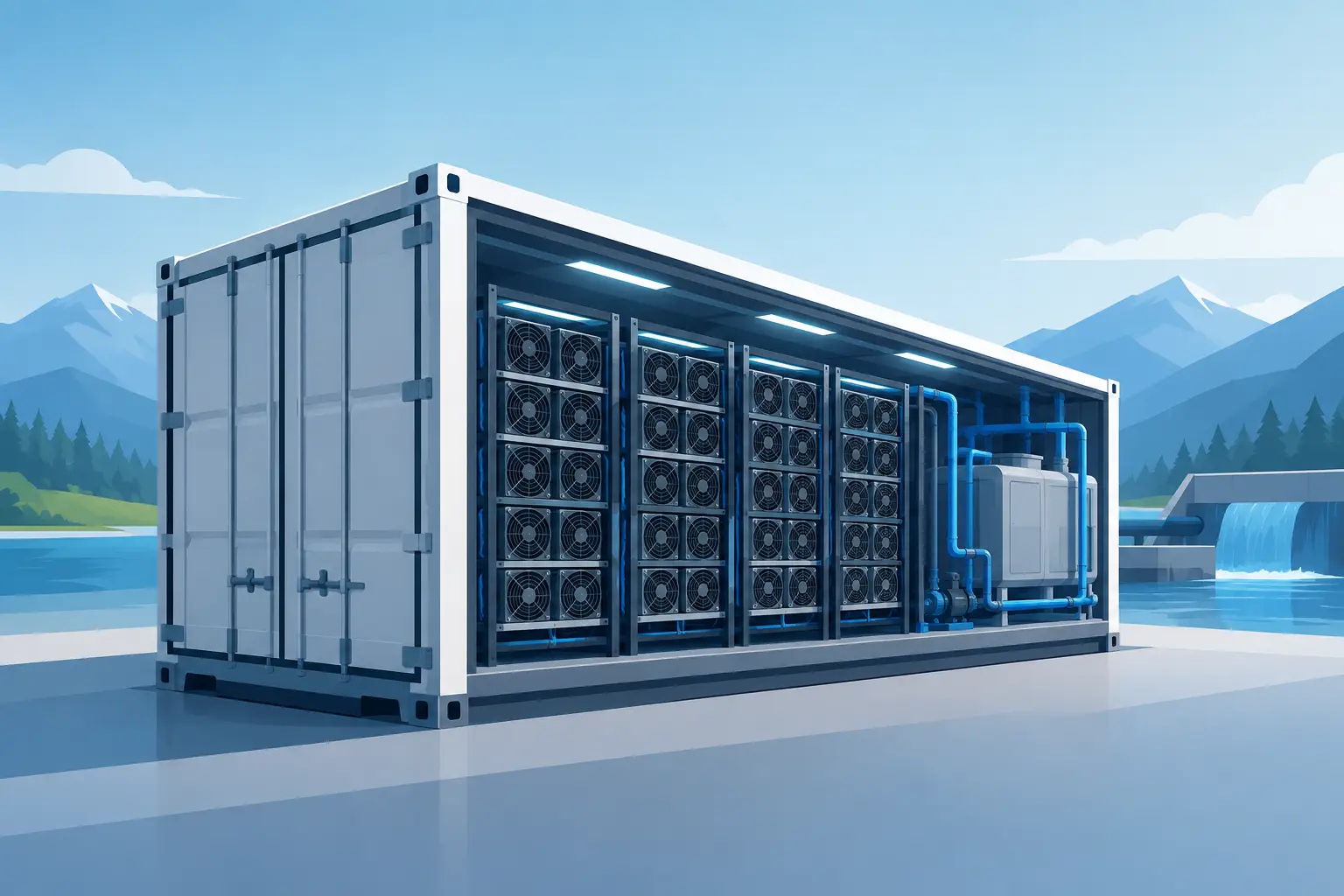
A hydro mining container is not simply a shipping container filled with ASICs and water pipes. It is a purpose-built mining module designed to remove heat from compatible hydro-cooled miners efficiently, keep operating conditions stable, and support far greater rack density than a conventional air-cooled deployment.
For operators managing serious hashrate, cooling is no longer a facilities detail. It directly affects uptime, machine performance, maintenance workload and the ability to expand without rebuilding the site around every new generation of hardware. A properly specified hydro container turns cooling from a constraint into part of the operating advantage.
What Is a Hydro Mining Container?
A hydro mining container houses ASIC miners fitted with liquid-cooling systems. Rather than relying on high-speed fans to force air through heat sinks, a coolant loop carries heat away from the miner’s cold plates. That heat is then transferred through pumps, manifolds, heat exchangers and external heat-rejection equipment, such as dry coolers or cooling towers.
The container provides the controlled environment around this process. It typically includes electrical distribution, network infrastructure, monitoring equipment, pipework, filtration, leak detection and physical security, alongside the miner racks themselves. The result is a compact, deployable mining facility that can be delivered, connected and commissioned much faster than a permanent build.
Hydro cooling should not be confused with immersion mining. In an immersion system, miners are placed in dielectric fluid. A hydro system normally uses miners manufactured specifically with liquid-cooling plates and coolant connections. An air-cooled ASIC cannot simply be connected to a water loop. Hardware compatibility is the first question in any hydro deployment.
Why Hydro-Cooled ASIC Fleets Are Gaining Ground
The performance case starts with heat. Latest-generation ASICs produce substantial thermal loads, especially when operators run large fleets in hot climates or pursue high-density layouts. Air cooling can work extremely well when the building, ventilation and climate support it. But as heat density rises, air systems demand more fan power, larger airflow paths and more space between machines.
Hydro cooling transfers heat more directly. That can reduce the dependence on enormous volumes of filtered air and allows more miners to operate within the same footprint. It may also reduce noise at the container itself because hydro ASICs do not rely on the same level of onboard fan operation as air-cooled units.
For an investor, the practical benefit is operational consistency. Lower and more stable chip temperatures can help maintain expected hashrate, reduce thermal throttling and limit avoidable shutdowns. It does not make mining risk-free, nor does it guarantee a particular BTC yield. Network difficulty, Bitcoin price, pool performance, curtailment terms and electricity rates still determine the financial outcome. It does, however, give the operation a stronger foundation for keeping equipment online.
Density changes the economics of the site
A container’s value is not measured only by how many miners fit inside it. The key calculation is how much usable hashrate can be supported per square metre, per megawatt and per operational team member.
A hydro setup can be particularly attractive where land is limited, build time matters or a site needs to scale in repeatable modules. Instead of designing a new mining hall for every expansion phase, operators can add containerised capacity around available electrical infrastructure and heat-rejection capacity.
This modularity is useful for portfolios at different stages. A professional fleet may deploy several units against a dedicated power agreement. A growing operator may begin with one container, validate its electrical and cooling assumptions, then add capacity as capital and power availability increase.
The Infrastructure Behind a Reliable Hydro Mining Container
The visible container is only one part of the system. Reliable output depends on how well the mining module integrates with the site.
Inside, the electrical system must be designed for continuous high loads. This includes correctly sized switchgear, transformers where required, protection equipment, busbars or PDUs, cable routing and earthing. Mining loads are unforgiving: a weak connection, undersized component or poorly balanced phase can create heat, faults and downtime before the cooling loop is even considered.
The liquid side requires equally careful engineering. A typical design uses a closed coolant loop serving the ASICs, with pumps moving fluid through supply and return manifolds. Heat is transferred to a secondary loop or rejected externally through dry coolers, cooling towers or other site-specific equipment. Pressure, flow rate, temperature differential and coolant quality all need active monitoring.
Water chemistry matters. Untreated water can introduce corrosion, scaling or biological growth, each of which can impair flow and damage expensive hardware. The appropriate fluid, filtration regime and maintenance schedule depend on the OEM requirements, climate and system design. Operators should ask exactly what coolant is used, how it is tested and who is responsible for corrective action if readings move outside tolerance.
Heat rejection is the real design test
Every megawatt consumed by ASICs becomes almost the same amount of heat that must be removed. A container may look capable of holding a given number of miners, but that rating is meaningful only if the external cooling system can reject the full thermal load under local peak ambient conditions.
This is especially relevant in high-temperature regions. Dry coolers can be effective and reduce water usage, but their capacity changes with ambient temperature. Cooling towers can provide stronger heat rejection in some conditions, yet introduce water treatment, consumption and maintenance considerations. There is no universal winner. The right choice depends on the local climate, water strategy, power price, planning conditions and target operating profile.
A credible provider will specify capacity at the site’s actual design temperatures rather than quoting ideal laboratory conditions. Ask whether the container’s rated megawatt load is continuous, what happens during extreme heat, and whether miners will be curtailed or downclocked if the thermal limit is approached.
When a Hydro Container Makes Commercial Sense
Hydro cooling is most compelling when density, thermal stability and scalable deployment justify the additional infrastructure. For a small number of machines, a well-run air-cooled hosting arrangement may be simpler and more economical. The pumps, heat exchangers, external coolers and specialist maintenance of hydro systems introduce Capex and operational complexity that should be earned by the scale of the deployment.
For larger fleets, the calculation changes. Higher-density ASIC hardware can reduce the space required for a given hashrate, while containerised delivery can shorten the route from equipment purchase to active mining. This can be valuable where delay means missed production, particularly after hardware delivery or during a favourable mining economics window.
The right comparison is not hydro versus air in isolation. Compare total deployed cost, electrical efficiency, expected uptime, site construction cost, staffing requirements, maintenance exposure and expansion timeline. A lower purchase price is not necessarily the lower cost of ownership if it creates years of higher operational friction.
Questions to Ask Before You Commit
Before ordering a hydro mining container, establish the operating assumptions in writing. The following questions separate a designed solution from a generic container offer:
- Which ASIC models are supported, and are they approved for the proposed coolant and operating pressures?
- What MW load can the system sustain at local summer design temperatures?
- Is the quoted cooling capacity continuous, and what derating or curtailment policy applies during peak heat?
- Who owns maintenance for pumps, filters, coolers, sensors and leak-detection systems?
- What monitoring data will the customer receive for hashrate, temperatures, flow, pressure, power draw and alarms?
- What redundancy exists for pumps, electrical distribution and network connectivity?
These answers have commercial value. They reveal how quickly faults can be identified, whether performance reporting is transparent and how much unplanned downtime the operator could face.
Operating for Uptime, Not Just Deployment
A container can go live quickly, but sustained performance comes from disciplined operations. Miners need remote monitoring at both fleet and machine level, with alerts for temperature drift, falling flow rates, hashboard errors, power anomalies and connectivity loss. The faster an issue is isolated, the less hashrate is lost.
Preventive maintenance should be planned around the entire cooling chain, not just ASIC repairs. Filters require inspection, pumps need performance checks, connections need visual review and fluid quality needs testing. Spare parts strategy also matters. Waiting days for a critical pump controller or manifold component can turn a minor fault into a costly outage.
At BitHash, the strongest deployment model combines compatible ASIC sourcing, electrical planning, hydro hosting expertise, miner-management visibility and responsive maintenance under one accountable operating team. That reduces handovers between hardware sellers, site contractors and hosting providers, which is often where avoidable delays appear.
A hydro mining container is worth considering when it supports a clear operational plan: compatible hardware, confirmed power, realistic heat rejection and a maintenance partner ready to act. Get those fundamentals right, and high-density mining capacity becomes far easier to deploy and manage over the long term.