An ASIC that sits offline is not an investment waiting patiently for better market conditions. It is a high-power asset producing no hashrate while fixed costs, hardware depreciation and missed mining opportunities continue. That is why hosting for ASIC miners should be assessed as an operating decision, not simply a place to plug in a machine.
For a solo miner, hosting can remove the noise, heat and electrical limitations of running equipment at home. For a fleet operator, it can determine whether a mining portfolio performs predictably enough to scale. The right facility combines commercially viable electricity, suitable cooling, physical security and accountable technical support. Miss one of these, and an attractive headline rate can become an expensive operational problem.
What ASIC hosting actually covers
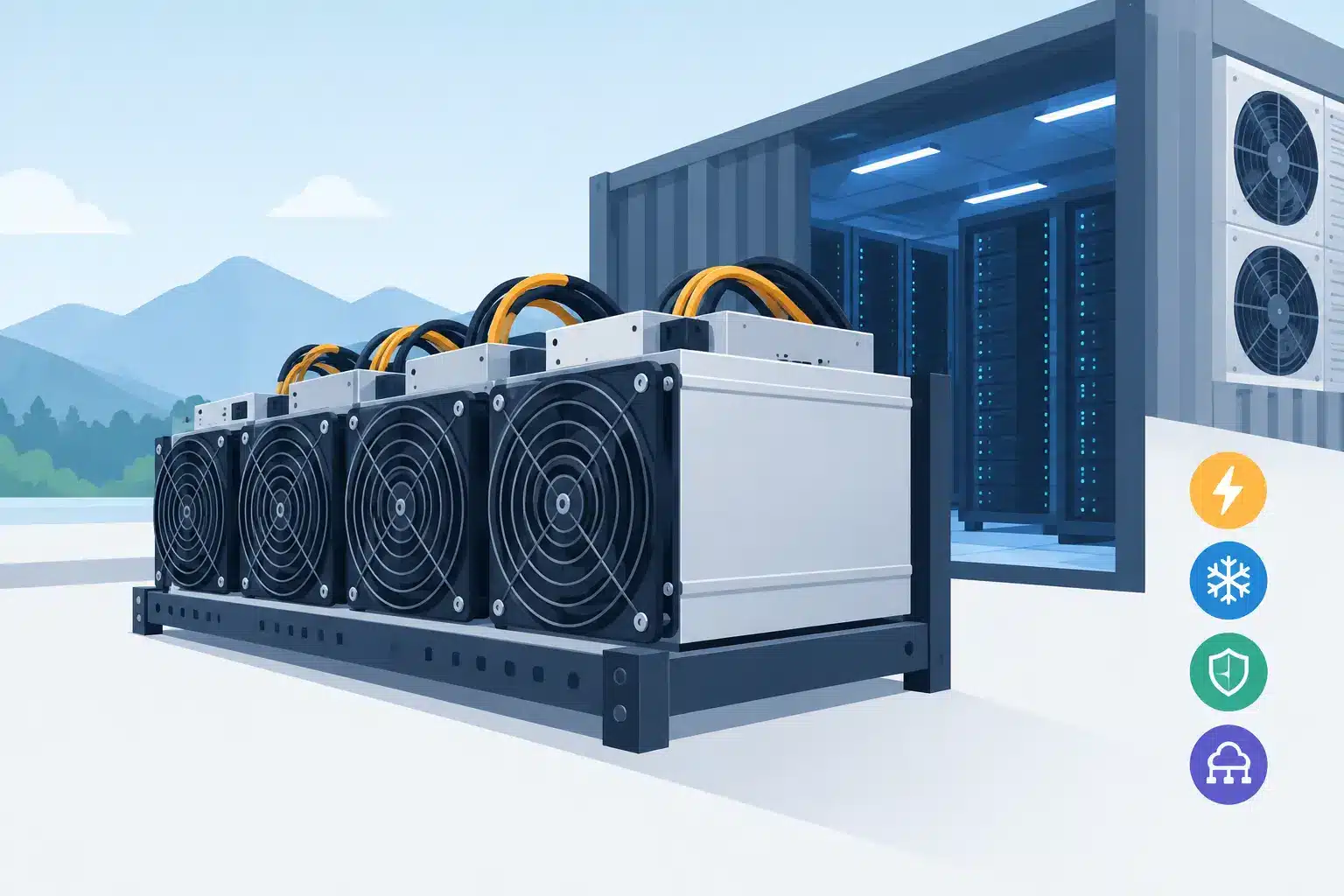
Managed ASIC hosting is the infrastructure and day-to-day operation behind your mining hardware. The provider receives or sources the miners, installs them in a purpose-built facility, connects them to power and network infrastructure, monitors their performance and handles agreed maintenance work.
The strongest hosting arrangements also reduce the hand-offs that cause delays. Instead of buying machines from one party, arranging international logistics through another, and then finding rack space and an electrician independently, the owner works with one accountable operator. This matters when markets move quickly and each day before deployment affects realised output.
Hosting is not the same as cloud mining. With ASIC hosting, you own specific machines and retain visibility over their model, hashrate and condition. Cloud mining generally provides contractual exposure to mining output without physical ownership of the hardware. Neither route is automatically better, but they solve different problems. Owners who want direct control over a hardware portfolio will usually favour hosting.
The economics behind hosting for ASIC miners
The advertised hosting rate is only the starting point. A serious comparison should consider the total operating cost per miner, the expected uptime and the terms that govern both. Low kWh pricing is valuable, but only if the facility can sustain its quoted capacity without frequent curtailment, unstable power or prolonged repair queues.
Start with the miner’s power draw and expected monthly consumption. A 3.5 kW unit running continuously consumes roughly 2,520 kWh over a 30-day month. A small difference in electricity pricing therefore compounds across each machine and every billing cycle. At fleet scale, the calculation becomes central to Opex planning.
Then consider efficiency. A newer ASIC may consume less energy per terahash than an older model, making it more resilient when Bitcoin difficulty rises or network economics tighten. Hosting cannot turn an inefficient machine into a profitable one, but good infrastructure helps the miner deliver the hashrate it was designed to produce.
Uptime has similar weight. A facility reporting 98% uptime sounds strong until it is viewed over a year: that allows more than seven days of lost production. The practical figure depends on how uptime is measured, whether planned maintenance is excluded, and whether the commitment applies to facility power, network connectivity or an individual miner. Ask for clarity rather than accepting a percentage in isolation.
Power quality, cooling and the cost of heat
ASICs place continuous strain on electrical and cooling systems. A provider needs more than available megawatts. It needs properly designed distribution, protection systems, cabling, ventilation and monitoring that can support sustained load safely.
Power quality is particularly important for protecting expensive hardware. Voltage instability, overloaded circuits and poor electrical design can lead to avoidable downtime and component failures. Where a provider operates under a structured power arrangement, such as a PPA, the customer should understand how the agreement affects price certainty, capacity allocation and any curtailment conditions.
Cooling is not a cosmetic facility feature. It directly affects miner reliability, fan performance and maintenance frequency. Air-cooled hosting may be appropriate for many fleets when airflow, filtration and ambient conditions are well managed. Hydro-cooling can be the better choice for high-density deployments and advanced ASIC models, especially where operators need tighter thermal control and quieter operation.
There is a trade-off. Hydro-cooling infrastructure requires specialist equipment, compatible miners and experienced technicians. It should be selected because it improves the operating case for a particular fleet, not because it sounds more advanced. The right solution depends on the miner model, site conditions, density target and growth plan.
Questions that reveal a hosting provider’s capability
Before committing machines, ask how quickly the provider can receive, inspect and deploy them. A clear deployment process should cover serial-number recording, visual inspection, rack allocation, pool configuration and confirmation that each miner is hashing as expected. Fast activation is valuable, but it should not replace disciplined commissioning.
You also need to know what happens when performance drops. ASICs may lose a hashboard, develop fan faults, accumulate dust or require firmware investigation. Ask whether technicians are on site, what monitoring alerts are used, how repair approval works, and whether the provider can source common spare parts. A machine that needs a minor intervention should not wait weeks simply because no one has ownership of the issue.
The most useful provider conversations cover four operational areas:
- Electricity pricing, billing intervals, deposits and any minimum consumption commitments.
- Uptime methodology, planned maintenance policy and the process for reporting incidents.
- Repair scope, labour charges, spare-part pricing and estimated turnaround times.
- Access to miner-management software, hashrate reporting and payout visibility.
Transparency is a practical risk-control measure. Operators should be able to reconcile electricity invoices, review machine status and identify underperforming units without chasing multiple contacts. For investors with several machines, a clear dashboard and responsive support can make the difference between informed portfolio management and blind reliance on monthly statements.
Contract terms deserve the same scrutiny as kWh pricing
Hosting contracts often look straightforward until a market change or equipment issue tests them. Review the term length, renewal conditions, early exit options and rules for removing hardware. If your machines are hosted internationally, clarify who is responsible for export paperwork, customs documentation and logistics if the fleet is moved or sold.
Capacity is another point to pin down. A provider may have space today but limited power available for your next batch. If your strategy is to build from ten miners to one hundred, discuss expansion rights and lead times at the start. It is far easier to scale within an existing operational relationship than to split a fleet across facilities because capacity was not reserved.
The agreement should also state how price changes are handled. Electricity markets, regulatory requirements and site costs can shift. A transparent provider will explain whether rates are fixed, indexed or subject to defined adjustments. The aim is not to eliminate all commercial risk. It is to make that risk visible enough to model.
Match the hosting model to your mining strategy
A first-time owner may prioritise a plug-and-mine service: hardware sourcing, delivery, installation and ongoing support handled by one team. This reduces administrative work and avoids the common mistake of buying a miner before securing suitable hosting capacity.
An experienced operator may need something different: dedicated capacity, custom network controls, hydro-cooling, bulk repair support or a pathway towards a private data-centre build. At this level, the conversation moves beyond a per-unit hosting fee towards power allocation, Capex, redundancy design and long-term Opex.
For both profiles, the goal is the same. Your infrastructure should support a clear investment thesis rather than dictate it. Do not choose a facility merely because it has the cheapest advertised rate, and do not buy hardware solely because it is available immediately. Model the machine, the power cost, likely difficulty changes, pool fees, downtime assumptions and hosting terms together.
A well-run hosting partner gives miners room to focus on portfolio decisions while the facility handles the operational workload. BitHash approaches that responsibility from procurement through deployment, monitoring and maintenance, so owners can move from hardware purchase to active mining with fewer gaps in accountability.
The most useful next step is simple: take the ASIC model you intend to run, estimate its monthly energy consumption, and ask prospective hosts to show exactly how it will be powered, cooled, monitored and repaired. Clear answers before deployment are usually the best protection for mining returns after it.