
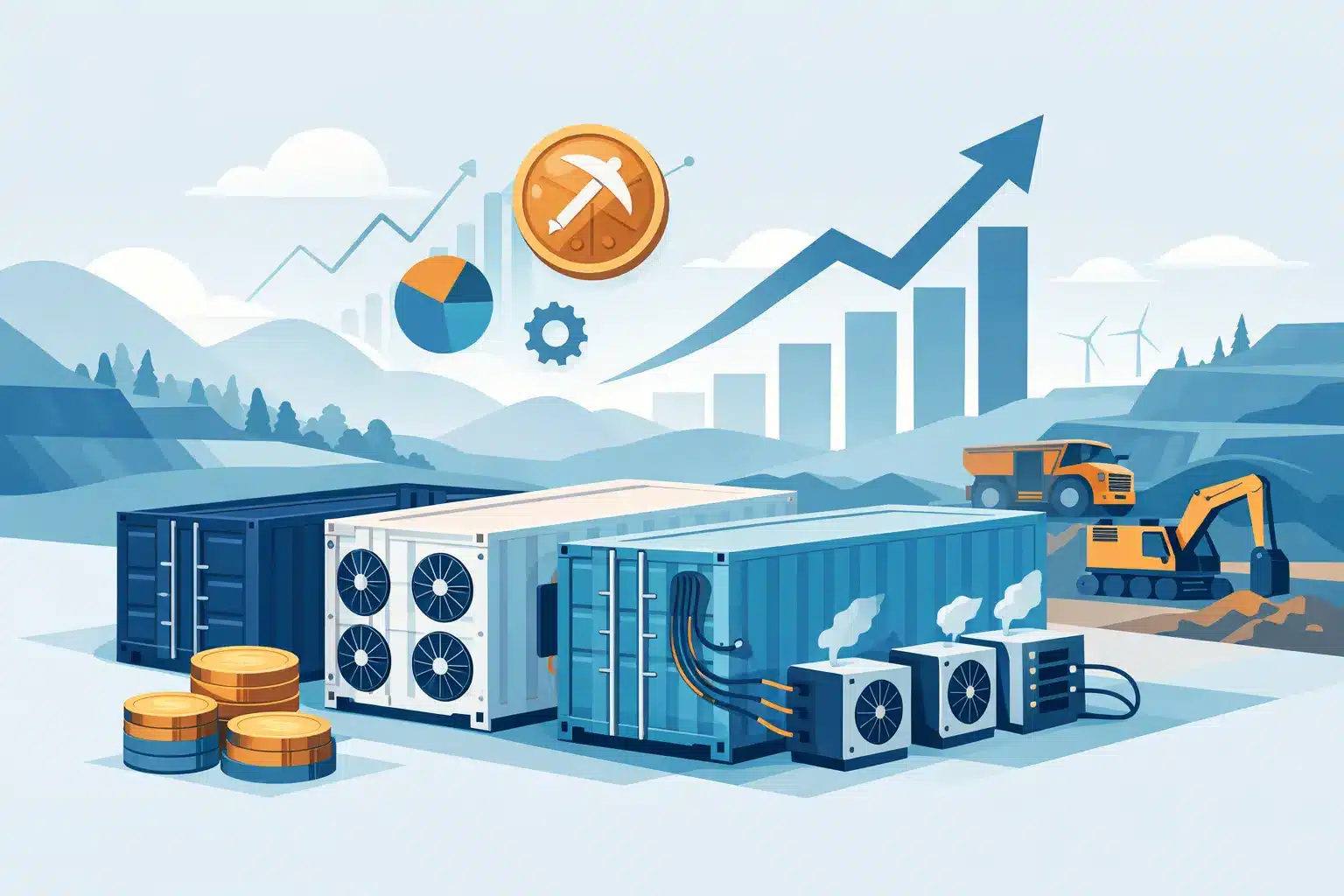
A profitable ASIC fleet is not created by buying miners alone. It depends on how quickly those machines reach stable operating conditions, how consistently they receive power, and how fast faults are found before they become lost hashrate. Mining container solutions bring these operational requirements into one deployable unit, giving operators a practical route from delivered hardware to active mining without building a conventional data centre from the ground up.
For an investor deploying a handful of machines, the container may sit behind a fully managed hosting service. For a professional operator commissioning hundreds of ASICs, it can become the repeatable building block of an expanding mining site. The same principle applies in both cases: infrastructure should protect uptime, control operating costs and make growth easier to manage.
What Mining Container Solutions Actually Provide
A mining container is a purpose-built enclosure that houses ASIC miners alongside the electrical, cooling, ventilation, networking and monitoring infrastructure required to run them. It is not simply a shipping container filled with hardware. A properly engineered system must account for the thermal output of every miner, electrical load distribution, cable management, filtration, fire protection, access control and safe maintenance access.
The main commercial attraction is speed. Instead of designing and constructing a fixed facility before mining can begin, an operator can prepare the site power connection and deploy a containerised unit once it is ready. That can reduce build complexity considerably, particularly where mining capacity needs to be added in phases.
Containers also create a clearer line between Capex and Opex. The container is a defined infrastructure asset with a known capacity, while electricity, repairs, monitoring and on-site labour become ongoing operational costs. This makes it easier to model fleet economics before committing capital.
The Design Decisions That Determine Uptime
The external container may look straightforward. Inside, the engineering choices are far from simple. A container that is poorly matched to its miners, climate or available power can create avoidable curtailment, high failure rates and difficult working conditions.
Cooling is a financial decision
ASIC miners turn most of their electrical input into heat. If that heat is not removed effectively, intake temperatures rise, fans work harder and machines may throttle or shut down. In a warm climate, cooling design becomes central to revenue protection rather than an optional specification.
Air-cooled containers typically use high-volume fans to draw filtered air through the miners and exhaust hot air outside. They can be cost-effective and relatively simple to service, but their performance relies on airflow design, ambient conditions and regular filter maintenance. Dust, salt air and high temperatures can increase maintenance requirements and shorten component life if the site is not prepared correctly.
Hydro-cooling containers take a different route. Water-cooled ASICs transfer heat through a closed-loop system, enabling high-density deployments with more controlled thermal performance. This can be highly effective for modern high-output miners, although the system requires pumps, heat exchangers, water treatment and technicians who understand the cooling loop. The right choice depends on the fleet, local climate, power cost, site water strategy and expected operating profile.
Power infrastructure must match the real load
A container’s headline miner capacity is only useful if the electrical system supports it safely. Operators need to assess incoming voltage, transformer capacity, switchgear, distribution boards, protection systems and the quality of the local grid or generation source.
Every ASIC model has a stated power draw, but planning should allow for auxiliary loads such as ventilation, pumps, lighting, networking and controls. It should also account for derating, peak conditions and any restrictions in the power purchase agreement. Buying more miners than the container or site can support is a costly way to create idle inventory.
Transparent kWh pricing matters just as much as physical capacity. A low hardware purchase price cannot compensate for an electricity arrangement that changes without notice or includes unclear demand charges. Before deployment, establish how energy is metered, billed and reconciled against the fleet’s consumption.
Monitoring turns hardware into an operating fleet
Containers need remote visibility from day one. Miner-management software should show hashrate, temperature, fan or pump status, pool connectivity, rejected shares and machine-level alerts. Without this information, minor issues can remain hidden until daily production has already been affected.
Remote monitoring does not remove the need for people on site. It makes their work more efficient. When technicians receive a precise alert, they can inspect the correct unit, replace the failed component and return the miner to service faster. For larger fleets, this difference has a direct impact on realised revenue.
When a Container Makes Sense – and When It Does Not
Containerised infrastructure is particularly effective for phased expansion, remote sites and operators who want predictable capacity blocks. A 1 MW or 2 MW deployment can be planned, commissioned and replicated without redesigning an entire building each time. It is also useful when speed to deployment has a higher value than architectural permanence.
However, a container is not automatically the best option for every project. A large, long-term site with substantial capacity may achieve better economics through a custom-built facility, especially where land, cooling systems and electrical infrastructure can be designed as one integrated campus. Noise restrictions, planning requirements, extreme weather and limited site access can also alter the equation.
The key is to avoid selecting a container only because it appears faster. The correct question is whether it delivers the lowest practical cost per operating megawatt over the intended life of the site. That requires looking beyond purchase price to installation, power connection, maintenance, transport, cooling energy and expansion plans.
A Practical Procurement Checklist
Before approving a mining container, confirm the proposed configuration against the actual fleet and site conditions. The following checks prevent many of the most expensive deployment errors:
- Miner compatibility: Confirm the exact ASIC models, unit count, power draw, dimensions and cooling format the container is designed to support.
- Usable electrical capacity: Review transformer, switchgear and distribution ratings, including auxiliary consumption and planned headroom.
- Thermal performance: Ask for operating assumptions for ambient temperature, airflow or coolant temperatures, filtration and expected heat rejection.
- Site readiness: Verify foundations, cable routes, crane or lorry access, drainage, network connectivity, security and local approvals.
- Service access: Ensure technicians can safely reach miners, PDUs, fans, pumps and controls without creating unnecessary downtime.
- Monitoring and support: Define who receives alerts, who performs first-line diagnostics, what spare parts are held and how repair turnaround is handled.
These details are not administrative extras. They determine whether a fleet reaches its planned hashrate quickly and remains close to it over time.
Deployment Should Start Before Delivery Day
The fastest deployments are planned well before the container arrives. Hardware procurement, site power, network configuration, pool credentials, racking layout and commissioning responsibilities should run on one coordinated schedule. If any one of these elements falls behind, paid-for miners can sit offline while difficulty and market conditions continue to move.
For hosted deployments, the provider should be able to explain the handover clearly: when miners are received, when they are installed, how serial numbers are recorded, when they are visible in monitoring software and how production reporting is delivered. BitHash approaches this as a full operational workflow, connecting ASIC sourcing, installation, hosting, monitoring and maintenance rather than treating the container as a standalone product.
Security also needs to be designed into the operating model. Physical access controls, CCTV, inventory records and clear incident procedures protect a fleet whose value can change sharply with hardware markets. Cybersecurity matters too, particularly for miner-management accounts, network devices and pool configurations.
Build for the Next Capacity Block
The strongest container strategy is rarely about filling one unit. It is about creating a repeatable operating standard for the next one. Standardised electrical layouts, spare-parts policies, monitoring dashboards and maintenance procedures reduce complexity as a fleet moves from dozens of miners to hundreds or thousands.
Start with the capacity you can power, cool and monitor confidently, then expand with infrastructure that gives every additional megawatt a clear path to productive uptime.