
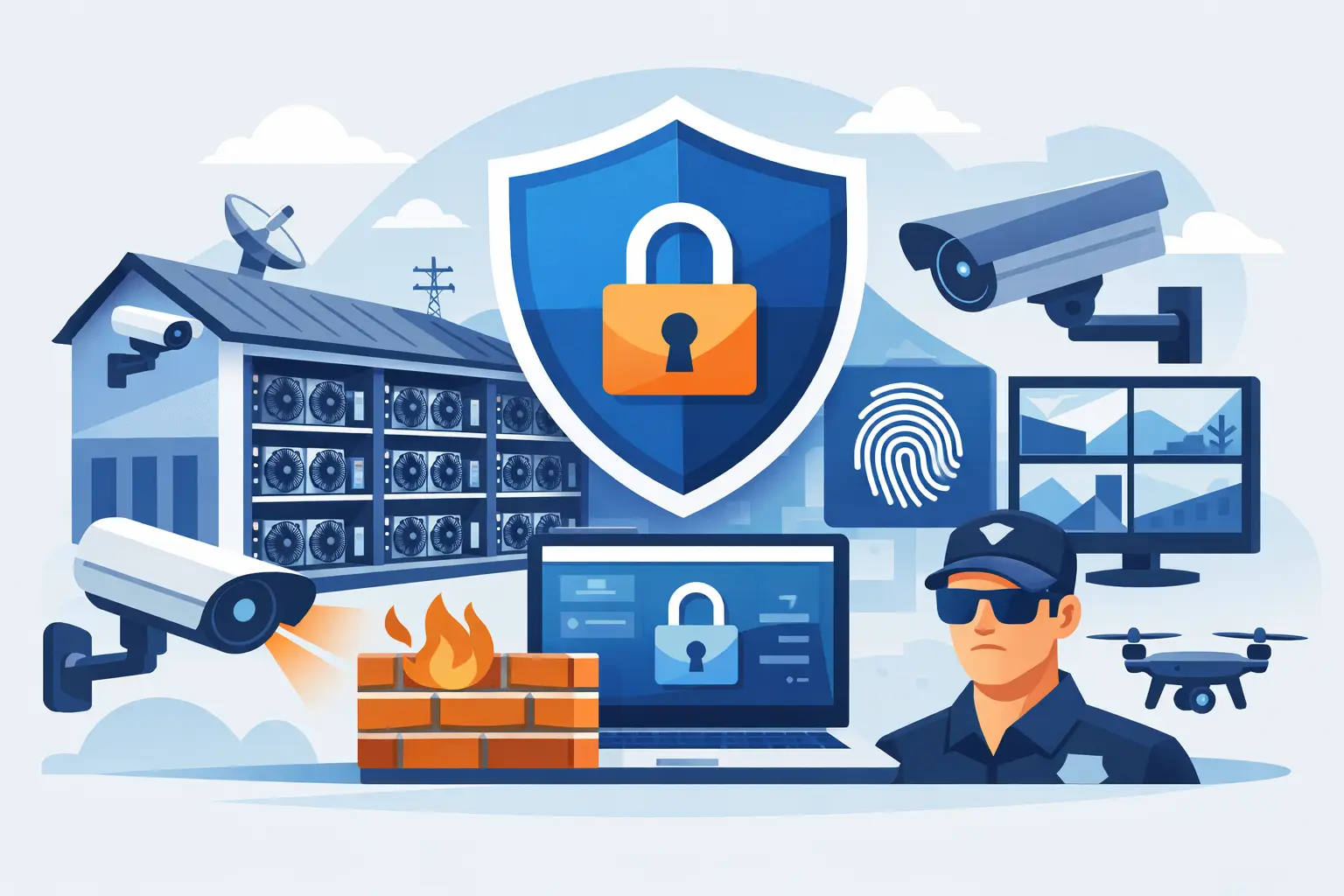
A mining farm can lose money long before a machine actually fails. One unauthorised visitor, an overheating rack, a compromised management account or a poorly handled power event can take hashrate offline and create an expensive recovery job. The right mining farm security features protect more than ASICs. They protect uptime, operational control and the predictability of your mining returns.
For a solo miner, security may begin with knowing where each unit is installed and who can touch it. For an industrial fleet, it becomes a layered operating system covering the site perimeter, access permissions, surveillance, network design, power infrastructure and incident response. The objective is the same at every scale: keep authorised machines hashing, keep risks contained and make every event traceable.
Mining Farm Security Features Start at the Perimeter
ASIC miners are compact, high-value assets. A rack of current-generation units can represent significant Capex, which makes physical security a commercial requirement rather than a box-ticking exercise. A professional facility should control access from the outer boundary through to the individual mining hall.
The first layer is a secured perimeter with defined entry and exit points. Fencing, controlled gates, adequate lighting and monitored external areas make opportunistic access far harder. Cameras should cover approach routes, loading areas, entrances, corridors and mining halls without leaving obvious blind spots. Coverage only matters if footage is recorded reliably, retained for an appropriate period and available when an incident needs to be reviewed.
Inside the site, access should narrow as equipment value and operational sensitivity increase. Reception areas, storage rooms, electrical rooms, network cabinets and mining halls should not all have the same access rules. Badge access, biometric verification or managed key systems provide a clear record of who entered a restricted area and when. This is particularly valuable when contractors, delivery teams and maintenance engineers attend the site.
Visitor management also deserves attention. A signed-in visitor with an escort is very different from an untracked person walking through an operational facility. Clear procedures reduce both theft risk and accidental disruption, such as a visitor disconnecting a cable or entering a hot aisle without suitable protection.
Protect the Machines From the Risks Inside the Facility
Security is not limited to intrusion. In mining, heat, dust, humidity, water and electrical faults can be just as damaging as physical theft. The strongest facilities treat environmental control as part of asset protection.
Temperature and airflow monitoring should operate continuously, not only when technicians are on site. ASICs can tolerate demanding conditions within their manufacturer specifications, but sustained heat stress affects stability, fan performance and component life. Sensors around racks, intake zones and exhaust paths help operators identify a developing thermal issue before miners begin to throttle or go offline.
Dust filtration and disciplined housekeeping matter in air-cooled environments. Fine dust restricts airflow, collects on heat sinks and increases the maintenance burden. At scale, poor cleaning standards can become a fleet-wide efficiency and reliability problem. A planned inspection schedule is more effective than waiting for fault alerts to appear.
For hydro-cooled mining, the risk profile changes rather than disappears. Leak detection, pressure monitoring, water-quality management and isolated pipework zones become central controls. A small leak can escalate quickly around high-density electrical equipment, so the facility needs immediate alarms, clear shut-off procedures and trained personnel who understand the cooling loop.
Fire detection and suppression must be designed around the actual site, electrical load and equipment layout. Early detection is critical. Thermal monitoring, smoke detection, protected cable routes and properly maintained suppression equipment all contribute to a faster response. The right approach depends on the building, local requirements and whether the operation is air-cooled or hydro-cooled, but a generic office-grade set-up is not enough for a high-load mining environment.
Power Security Is Uptime Security
A low electricity price means little if power quality repeatedly puts miners offline. Mining farms need a power design that protects equipment from unstable supply while allowing faults to be isolated quickly.
This begins with correctly specified switchgear, distribution boards, breakers and cabling. Each element must be sized for continuous mining loads, not simply short bursts of demand. Load balancing across phases is equally important. An overloaded circuit or poorly balanced distribution arrangement creates heat, trips and avoidable downtime.
Surge protection and grounding help defend sensitive electronics against voltage events. Monitoring systems should provide visibility into voltage, current, frequency and load behaviour so operators can identify anomalies before they become failures. Where a site uses backup generation, energy storage or multiple supply paths, the transfer process must be tested under real operating conditions.
Redundancy needs a commercial lens. Not every miner requires a fully redundant electrical path, and building one can raise hosting costs materially. The practical question is whether the expected reduction in downtime justifies the additional Opex and infrastructure investment. For a large fleet or dedicated data centre, redundancy may be essential. For a smaller portfolio, strong monitoring, quality components and rapid technical response may deliver better value.
Network and Account Controls Prevent Remote Losses
Modern ASIC operations are managed through networked tools, firmware, pool credentials and miner-management software. That convenience creates another attack surface. If an unauthorised party gains control of a fleet, they may change pool settings, divert hashrate, alter firmware or disrupt operations without ever entering the building.
A secure mining network separates operational technology from guest networks and ordinary office traffic. Miners, management servers, camera systems and administrative devices should not all sit on one unrestricted network. Segmentation contains potential problems and makes suspicious activity easier to investigate.
Management interfaces should use unique, strong credentials, multi-factor authentication where available and tightly controlled user permissions. A technician who needs to view machine status does not necessarily need authority to change wallet addresses, update fleet firmware or modify network settings. Role-based access limits the impact of an accidental change or compromised account.
Firmware management is another critical control. Only verified firmware from trusted sources should be deployed, with updates tested on a controlled group before a full fleet rollout. The latest release is not automatically the best release for every operation. A staged deployment protects against compatibility issues, unexpected performance changes and configuration errors that could affect hundreds of units at once.
Logging closes the loop. Good records show configuration changes, login attempts, machine reboots, pool updates and alert history. When hashrate moves unexpectedly, operators should be able to determine whether the cause was a network issue, a power event, a planned change or something that requires escalation.
Monitoring Must Lead to Action
Twenty-four-hour monitoring is only useful when alerts reach someone who can act. A dashboard full of red indicators does not protect revenue if no one has ownership of the response.
Effective monitoring combines machine-level data with site-level conditions. Hashrate, rejected shares, chip temperatures, fan speeds, error codes and pool connectivity tell one part of the story. Power quality, cooling performance, access events, camera status and network health tell the rest. Correlating these signals helps teams diagnose the root cause faster.
A practical incident plan defines thresholds and responsibilities. If a single miner drops offline, the response may be a scheduled technician check. If an entire row loses hashrate, the team may need to inspect network switches, distribution equipment or cooling immediately. If a management account records an unfamiliar login, credentials and permissions may need to be disabled before any hardware intervention begins.
Clients should also receive meaningful visibility. Clear reporting on uptime, machine status, maintenance activity and electricity consumption turns security from an unseen promise into an operational standard. This transparency matters most during a fault, when investors need facts rather than vague reassurance.
Choose Security That Matches Your Mining Model
The right level of protection depends on fleet size, hardware value, site geography, cooling method and the degree of operational control you want to retain. A home set-up may prioritise discreet storage, fire safety and secure remote access. A hosted fleet should prioritise the provider’s access controls, surveillance, network practices, maintenance capability and reporting discipline. A purpose-built data centre needs all of these controls integrated from the design stage.
Ask direct questions before placing hardware. Who can access the machines? Is entry logged? How is the site monitored after hours? What happens when an ASIC goes offline? How are firmware changes approved? Is there a documented process for power, cooling, fire and network incidents? Specific answers reveal more than broad claims about security.
BitHash approaches security as part of continuous mining operations: controlled facilities, round-the-clock oversight and hands-on technical support designed to keep equipment protected and productive. The best hosting relationship gives you confidence that a problem is being identified, recorded and handled before it becomes a prolonged interruption.
Security should never be treated as a cost sitting outside mining economics. It is one of the systems that protects hashrate, extends equipment life and supports more dependable returns. When evaluating a facility, look beyond the rack space and kWh price. The operation that can protect your machines when conditions are not normal is the one best positioned to keep them earning when they are.