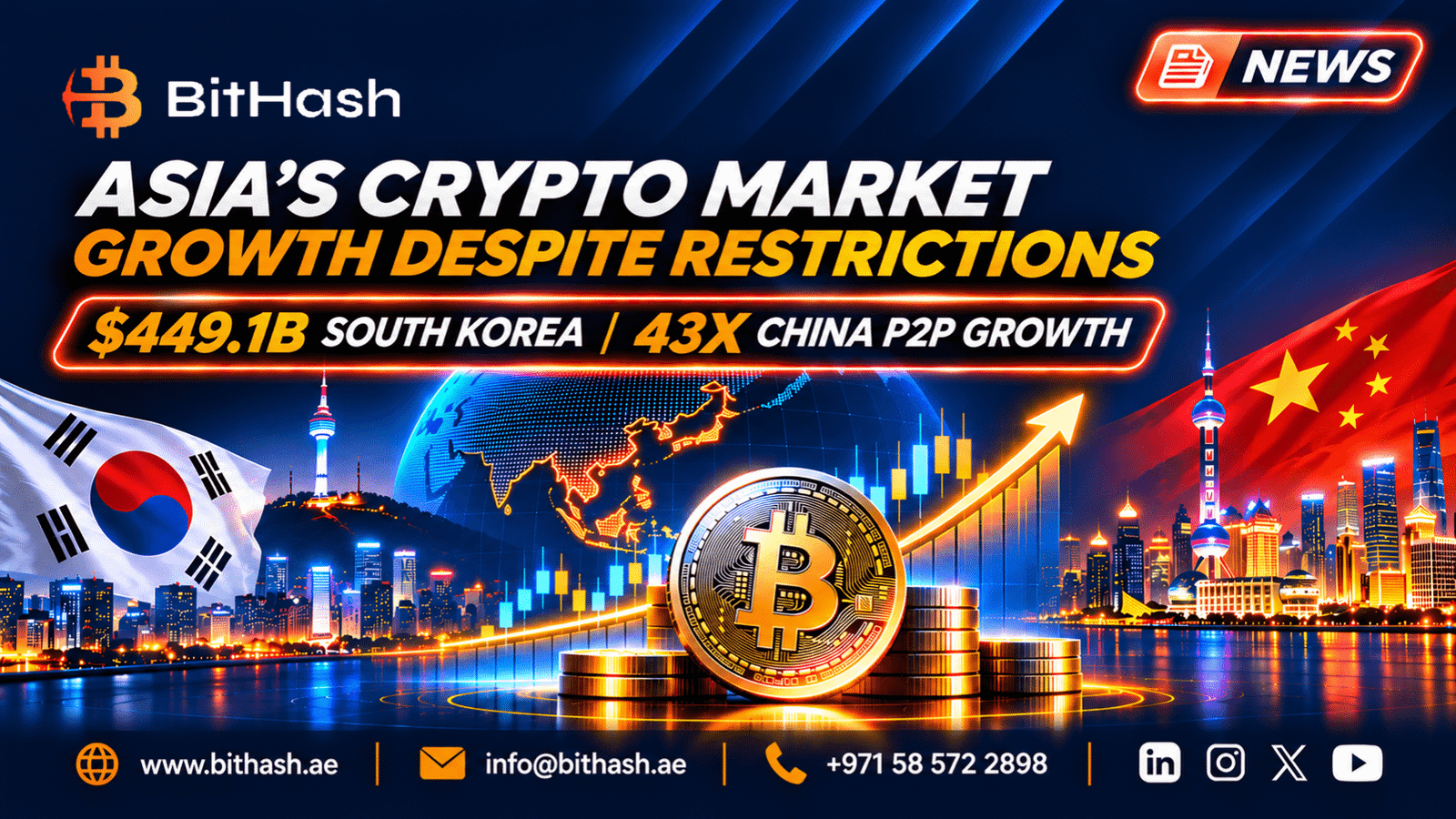
The Asia Crypto Market keeps getting bigger with some countries still having tight rules on digital assets. New numbers from Chainalysis show a jump in China’s peer-to-peer stablecoin activity. South Korea has become the crypto economy in East Asia by transaction value. At the same time places, like Hong Kong and Singapore are trying to bring more digital asset services into regulated systems. How people use crypto varies across the region. Some use stablecoins to send money while banks and financial firms are looking into asset custody and tokenized investments. Each market is growing at its speed, based on local laws and how much people want to use crypto.
Asia Crypto Market Growth Despite Restrictions
China is a clear example of crypto activity continuing despite strict restrictions. The number of unique wallets sending peer-to-peer stablecoin transactions in China grew 43 times between the first quarter of 2024 and the second quarter of 2026. From July 2025 to June 2026, China recorded $104.1 billion across 18.1 million transfers involving self-custodied stablecoin holdings. These figures point to growing stablecoin activity, although they do not explain the purpose of every transaction. As Chainalysis reports, measuring China’s crypto economy can be difficult because much of the activity takes place through peer-to-peer transfers rather than regulated domestic exchanges.
South Korea Leads the East Asia Crypto Market
South Korea had a crypto economy that was worth around $449.1 billion between July 2025 and June 2026. This made it the biggest in East Asia. Japan came next with $228.3 billion. Hong Kong had $192.2 billion. Still having transaction values does not always mean that crypto businesses are earning more money. In South Korea, profits, from exchanges dropped by 78% in the half of 2026. This was compared with the previous six months. The average daily trading volume went down by 44%. Customer deposits also fell by 35%. This shows that Asian cryptocurrency trading can remain substantial even when exchanges face weaker trading activity and falling profits.
Tokenization and Institutional Crypto Adoption
Regulation is shaping the next stage of digital asset development. On October 6, Securitize and South Korea’s LG CNS announced a partnership to explore tokenized funds, equities, stablecoins and digital asset infrastructure. South Korea’s financial regulator has also proposed rules for tokenized securities, including stocks, bonds and funds, with implementation planned for February 2027. Hong Kong is preparing licensing rules for digital asset trading, custody, advisory, and management services. Singapore is also developing institutional digital asset services and payment solutions. These efforts could support Asia crypto adoption by giving financial companies a clearer path to offer digital asset products. However, proposed rules still need to be implemented, and future growth will depend on customer demand and regulatory approval.
Asia Crypto Market: Key Figures to Watch
| Indicator | Latest reported figure |
| Growth in China’s P2P stablecoin wallets | 43x |
| China stablecoin transfers | $104.1 billion |
| China transfer count | 18.1 million |
| South Korea crypto economy | $449.1 billion |
| South Korean exchange operating profits | Down 78% |
| Japan’s crypto economy | $228.3 billion |
What Comes Next for Crypto in Asia?
Several trends could shape the region’s digital asset market in the coming months:
- Stablecoin adoption in Asia: More peer-to-peer transfers could increase demand for digital dollar based payments.
- Crypto regulations in Asia: Licensing rules will affect which companies can offer services in each market.
- Tokenized assets: Financial firms are exploring blockchain based versions of traditional investments.
- Institutional participation: Regulated custody, settlement and investment services could attract more financial companies.
- Market risks: Price swings, lower trading volumes, security problems and regulatory changes could slow growth.
Conclusion
The Asia Crypto Market is developing in different ways across the region. Stablecoin activity is rising in China, South Korea remains a major crypto hub, and financial centers are building regulated digital asset services. Whether this growth continues will depend on user demand, practical regulations and how safely businesses can operate within each country’s laws.
BitHash Media Relations
Dubai Corporate Press OfficeFor press kits, executive interviews, or verification: info@bithash.ae