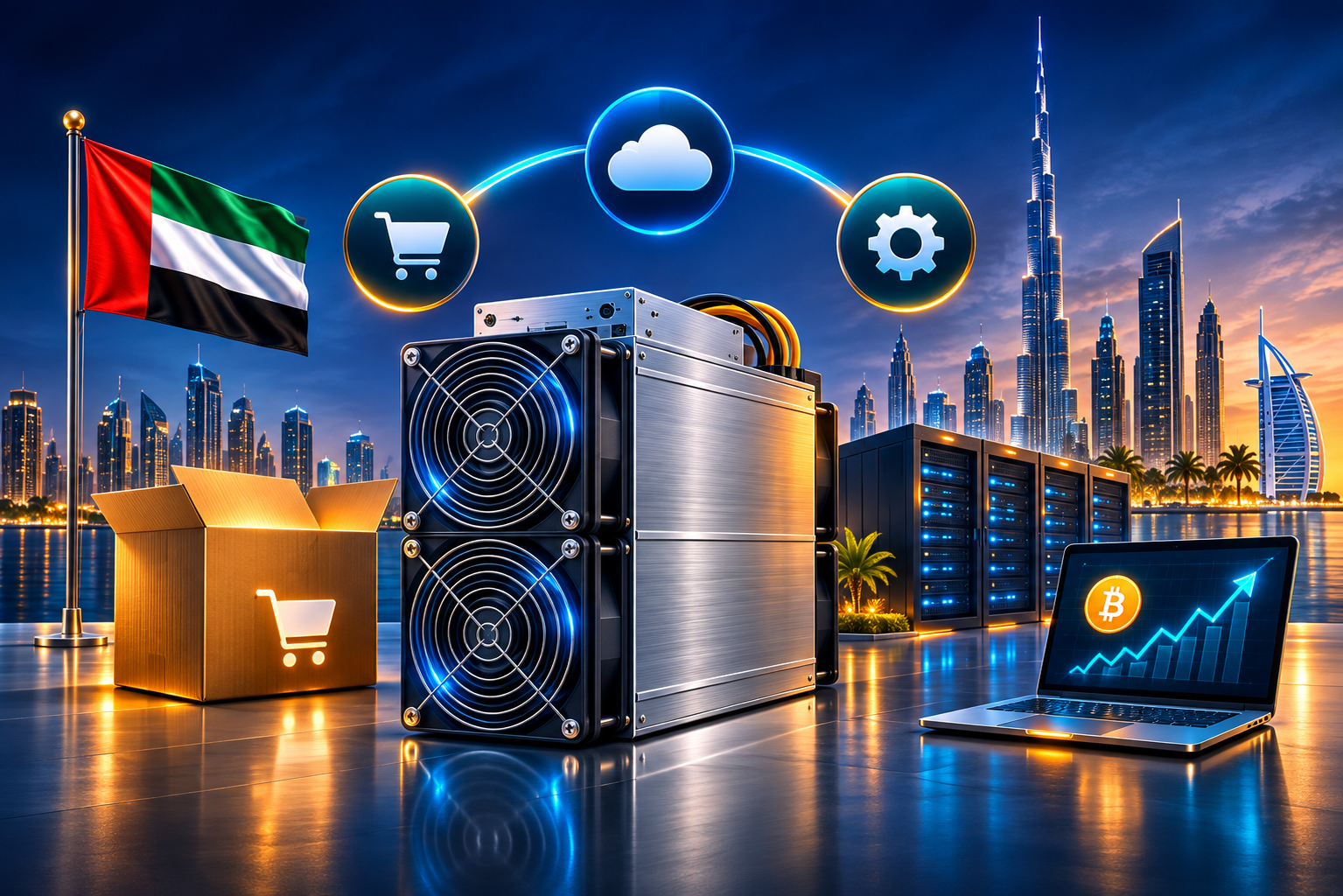
For crypto miners UAE operations are not won by buying the ASIC with the highest advertised hashrate. They are won in the hours after delivery: when the machine is energised, cooled correctly, connected to a pool, monitored, and kept productive through heat, dust, firmware issues and market volatility. A miner that is theoretically efficient but offline is not an asset producing Bitcoin. It is Capex waiting for attention.
The UAE has become a serious location for digital-asset infrastructure because it combines commercial connectivity, a pro-innovation environment and access to professional data-centre services. But the opportunity still demands discipline. Electricity pricing, machine efficiency, cooling design, hosting terms and response times all affect the return on every terahash.
Why Crypto Miners UAE Need an Infrastructure Plan
A home setup can be a useful learning exercise. It is rarely the right long-term answer for a portfolio of modern ASICs. Current-generation miners draw significant power, produce sustained heat and require stable network connectivity. A few machines can quickly create an operational burden that distracts from the investment case.
The first calculation is straightforward: hashrate multiplied by expected uptime produces productive hashrate. In practice, achieving that uptime requires much more than plugging in a machine. Power must be provisioned safely. Heat must leave the room efficiently. The network must remain stable. Hardware needs physical security, and someone must be able to act when a fan fails, a hashboard reports errors or a pool connection drops.
That is why professional hosting should be assessed as infrastructure, not simply as rented rack space. A low advertised kWh rate can look attractive until curtailment, repair delays, unclear service charges or weak cooling reduce the number of productive hours. Transparent Opex often delivers a better result than a headline price with hidden operational gaps.
For investors buying one or several ASICs, managed hosting turns a complicated physical operation into a monitored asset. For fleet operators, it makes expansion possible without rebuilding the same operations team, security model and electrical capacity at every new site.
The Economics Behind a Productive ASIC
An ASIC’s purchase price is only the first line in its cost base. The more useful question is what it costs to generate each unit of hashrate over its operating life. That includes the machine, shipping, import handling where applicable, installation, electricity, cooling, pool fees, repairs and downtime.
Efficiency is normally expressed in joules per terahash. Lower numbers are better because the miner uses less energy for the same work. Yet a highly efficient model may command a premium price, so the best choice depends on the available power rate, planned holding period and capital budget. A machine with a lower purchase price may make commercial sense at a favourable electricity rate, while a newer, more efficient unit can offer stronger resilience when network difficulty rises.
Bitcoin price and network difficulty make every projection conditional. No provider can responsibly promise a fixed mining return. Difficulty can increase, transaction fees fluctuate, and the value of mined Bitcoin changes continuously. A sensible model should show several scenarios rather than one optimistic figure: conservative, expected and favourable. It should also include a realistic uptime assumption, not 100 per cent.
Electricity is a commercial term, not a footnote
Power cost is the central recurring expense for most air-cooled ASIC mining. Before committing hardware, clarify whether the stated price includes electricity only or also covers racking, labour, monitoring, cooling and basic maintenance. Ask how billing works, whether there is a minimum commitment, and what happens if a machine is switched off for repair.
For larger deployments, electricity arrangements may involve a PPA, dedicated capacity or custom infrastructure planning. These are not details to leave until after the miner order is paid. Hardware delivery without confirmed electrical capacity can leave valuable equipment idle at precisely the point when the investment should begin earning.
Uptime needs a practical definition
A provider may advertise high uptime, but the definition matters. Does it refer to site power availability, internet availability or the individual miner’s actual hashing time? Those are related, but they are not identical. A site can have power while a specific ASIC remains down because of a damaged control board or a cooling fault.
Look for 24/7 monitoring, alerting, on-site technical capability and a clear fault-handling process. The key measure is not just how quickly an alert appears on a dashboard. It is how quickly a qualified technician can diagnose the cause, source the right part and return the miner to service.
Cooling Determines More Than Temperature
The UAE climate makes cooling strategy a direct business decision. Air-cooled machines can perform well in properly designed facilities, but they depend on disciplined airflow management, filtration and heat extraction. Warm intake air, poor aisle containment or excessive dust can reduce performance and shorten component life.
Hydro-cooling is increasingly relevant for high-density deployments. By moving heat through liquid rather than relying solely on air, hydro-cooled miners can operate with more controlled temperatures and potentially support greater rack density. The trade-off is higher infrastructure complexity. Pumps, heat exchangers, fluid quality and leak management all need specialist oversight.
Neither approach is universally superior. Air cooling can be simpler and well suited to many portfolios. Hydro-cooling becomes compelling where density, thermal control and scaled deployment justify the additional infrastructure. The correct choice follows the site design and fleet objective, not a marketing label.
What a Hosting Partner Should Actually Deliver
Hosting is valuable when it removes operational friction without hiding the underlying economics. The strongest partners provide a clear chain of accountability from hardware sourcing through installation, active monitoring and maintenance.
For a first-time miner, that means receiving guidance on ASIC selection, a transparent quotation and a clear route from payment to live hashrate. For a professional operator, it means capacity planning, deployment sequencing, asset records, miner-management software and reporting that supports operational decisions.
The practical questions are often revealing. Where will the machines be installed? Who owns the equipment while it is hosted? How is serial-number inventory recorded? What security controls protect the site? How are failed units isolated and diagnosed? Is repair handled on site, sent to a specialist facility, or treated as the customer’s responsibility?
Speed also matters. A rapid deployment process can reduce the period between Capex commitment and productive operation, particularly when market conditions are moving quickly. BitHash, for example, positions deployment within 24 hours of payment confirmation where capacity and installation requirements allow. That speed only has value when it is backed by proper commissioning, power readiness and continuing support.
Build for Scale Without Buying Too Far Ahead
Mining portfolios often grow in stages. An investor may start with a small number of machines, validate reporting and cash flow, then add capacity as confidence and market conditions permit. A hosting arrangement should support that progression without forcing the customer into an oversized commitment from day one.
At the same time, scaling slowly can create procurement risk. Popular ASIC models may become harder to source, while power capacity at well-run sites is finite. The answer is not necessarily to order the largest possible fleet. It is to create a phased plan with defined triggers: a target power rate, a preferred machine class, a budget ceiling and a decision point for the next tranche.
Experienced operators should also separate fleet growth from fleet quality. Adding older machines can increase total hashrate while weakening efficiency and increasing maintenance exposure. In some cases, replacing a less efficient unit is more valuable than simply adding another one.
Make Every Terahash Accountable
The best mining setup is not the one with the loudest efficiency claim or the cheapest headline hosting rate. It is the one that gives you visibility over what each machine is doing, what it costs to run, and who is responsible when performance slips.
Before purchasing, model the downside as carefully as the upside. Confirm power, cooling, monitoring, repair terms and deployment timing in writing. Then choose an infrastructure partner that treats uptime as a daily operational responsibility, because that is where mining returns are protected long after the ASIC leaves the box.
BitHash Editorial
Verified AnalystBitHash Infrastructure, UAE Colocation & Mining Intelligence Team