A 300 kW mining deployment can become a heat-management problem long before it becomes a space problem. That is where hydro ASIC miners change the equation. By moving heat into a controlled liquid loop rather than pushing it through rows of high-speed fans, they allow operators to run more hashrate in less floor space – but only when the surrounding infrastructure is designed to support them.
For an investor buying a handful of machines, hydro cooling is not automatically the best answer. For a growing fleet, a containerised deployment, or a purpose-built data centre with constrained space and ambitious uptime targets, it can be a decisive operational advantage. The question is not whether liquid cooling is more advanced. It is whether its higher infrastructure requirement produces a better return for your specific mining plan.
What makes hydro ASIC miners different?
Air-cooled ASICs use onboard fans to force air across heat sinks. It is a familiar, flexible design, but it creates two persistent operational issues: substantial noise and a large volume of hot exhaust air. As fleet density increases, extracting that heat reliably requires wider aisles, more airflow engineering, filtration and often more fan power.
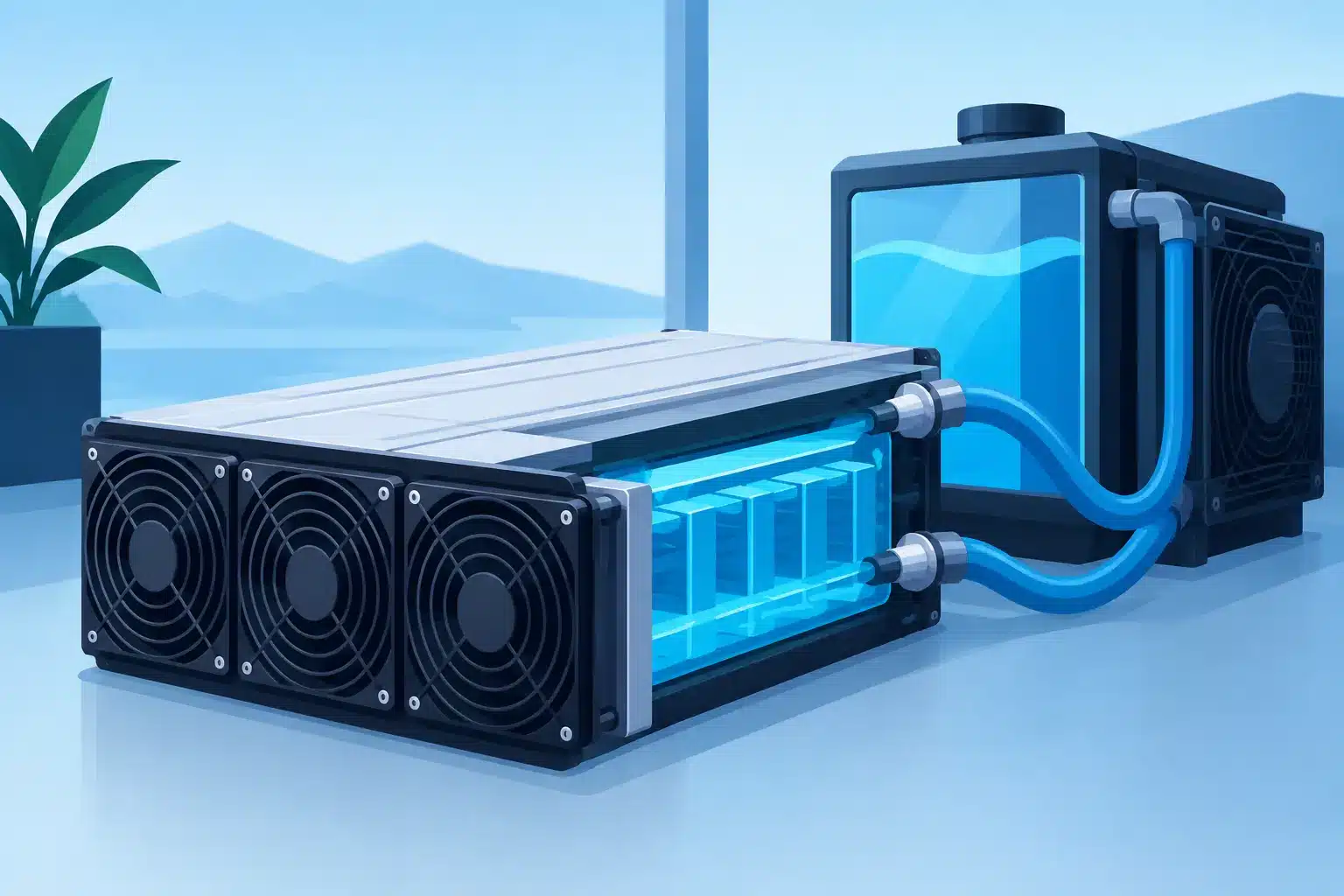
Hydro ASIC miners use cold plates and internal coolant channels to carry heat away from the hashboards. A pump circulates coolant through the miners and towards a heat-rejection system, such as dry coolers, cooling towers or heat exchangers connected to a secondary water circuit. The miner is not simply placed in water. It operates as part of a managed thermal system.
This design can support higher rack density and significantly lower machine-level noise because the high-speed fans are removed. It also provides more stable chip temperatures when flow, pressure and water quality are properly controlled. Stable temperatures matter because excessive heat accelerates component stress, increases fault risk and can force machines to reduce performance or stop altogether.
Hydro units are therefore infrastructure-led hardware. Their hashrate specifications may attract attention, but their value is realised through the quality of the cooling loop, electrical system and operating team behind them.
When hydro ASIC miners make commercial sense
Liquid-cooled mining is most compelling where power capacity is valuable but physical space is limited. A facility may have an attractive electricity arrangement and sufficient transformer capacity, yet lack the building volume or airflow design needed for a large air-cooled fleet. Hydro cooling can increase the amount of compute deployed per square metre without turning the site into a high-temperature, high-noise environment.
It is also a strong fit for industrial operators seeking a more controlled operating environment. In a hot climate, air-cooled systems must constantly cope with changing ambient temperatures, dust and recirculated heat. Hydro systems still have to reject heat to the outside environment, so they do not make climate irrelevant. They do, however, create a more controlled thermal path between the ASIC chip and the final heat-rejection equipment.
The trade-off is capital cost and complexity. Pumps, manifolds, piping, heat exchangers, sensors and water treatment all add to the project scope. A hydro fleet may also require specialist maintenance procedures and spare components that an air-cooled operation does not. For a small deployment without a compatible hosting environment, the savings in fan power or floor space may not justify the added cost.
The strongest case is usually one of these: a high-density fleet, a dedicated mining room, a large container deployment, or a long-term site where better thermal control can protect uptime and enable expansion.
The infrastructure behind a reliable hydro deployment
Buying the miners is the straightforward part. The performance of a hydro operation depends on whether the facility can maintain the correct coolant conditions every hour of the day.
The cooling loop needs engineering, not improvisation
A well-designed system starts with hydraulic calculations. Each model has requirements for coolant flow rate, inlet temperature and pressure. The facility must provide enough flow to every unit, including miners at the far end of the loop, without creating excess pressure or uneven cooling.
The primary loop circulating through miners is often separated from the external heat-rejection loop by a heat exchanger. This approach helps protect expensive ASIC hardware from contaminants and allows operators to manage water chemistry more carefully. Coolant quality is not a minor detail. Poor filtration, corrosion, scale or biological growth can restrict flow, reduce heat transfer and damage components over time.
Redundancy also matters. If a single pump, controller or cooling circuit failure can take down an entire hall, the apparent efficiency of the design comes with unacceptable operational risk. Larger facilities commonly build redundancy into pumps, controls and electrical feeds, then monitor inlet and outlet temperatures, pressure differentials, leak alerts and flow rates continuously.
Electrical design still determines the ceiling
Hydro cooling reduces the need for onboard fans, but it does not reduce the fundamental electrical discipline required by a mining site. Switchgear, transformers, distribution boards, cable sizing and protection systems must all be matched to the continuous load of the fleet.
Operators should assess the full site load, not just ASIC nameplate power. Pumps, dry coolers, control systems, networking and other auxiliary equipment all consume electricity. The relevant figure is the total energy required to produce the hashrate, including cooling overhead. A lower fan load can improve this picture, but the final result depends on local conditions and equipment selection.
Monitoring turns thermal data into uptime
A hydro site should not wait for a miner to go offline before identifying a problem. Rising outlet temperatures, falling flow or a drifting pressure reading can reveal an issue before hashboards are affected. Miner-management software should sit alongside facility monitoring so that operational teams can connect a hashrate drop with a cooling or electrical event quickly.
This is where managed hosting has real value. The customer sees machine performance and power use, while the onsite team manages alarms, physical inspections, replacement work and the cooling plant itself. At scale, that division of responsibility is often more efficient than attempting to run a specialist liquid-cooling system remotely.
Evaluate economics beyond miner efficiency
A hydro ASIC’s joules-per-terahash rating is essential, but it is only one line in the model. The commercial decision should include hardware price, installation cost, hosting rate, electricity price, cooling overhead, expected uptime, maintenance provision and the useful life of the equipment.
For example, an air-cooled machine with a lower purchase price may deliver better short-term cash flow at a small site. A hydro model may require more upfront Capex, yet create stronger economics over time if it enables a denser build-out, reduces thermal interruptions or gives access to a professionally engineered hosting environment.
Ask how electricity is billed. A transparent rate should make clear whether cooling power, management fees and other operating costs are included or charged separately. For larger fleets, understand whether pricing is fixed, indexed or linked to a power purchase agreement. An attractive kWh rate loses value if curtailment, congestion or hidden auxiliary charges repeatedly reduce effective operating hours.
It is equally important to model less favourable conditions. Bitcoin difficulty can rise, network economics can change and machine resale values can fall. Hydro infrastructure should be assessed as a multi-year operating asset, not justified solely by a strong month of mining revenue.
Questions to ask before committing to a hydro fleet
Before placing an order, get precise answers on the operational design. The right partner should be comfortable discussing engineering details, not only machine specifications.
- Which ASIC models are supported, and what flow, pressure and inlet-temperature range do they require?
- How is heat rejected at the site, and what happens during peak ambient temperatures?
- Is there redundancy for pumps, cooling circuits, power distribution and network connectivity?
- How are leaks, water quality, flow and temperature monitored around the clock?
- What is included in the hosting price, including electricity, maintenance, repairs and cooling overhead?
- How quickly can replacement machines or parts be deployed if a unit develops a fault?
For investors who want a single accountable operator, BitHash can combine hardware sourcing with hydro hosting, monitoring and maintenance rather than leaving the customer to coordinate multiple suppliers.
Build for the operating reality, not the brochure
Hydro cooling is not a shortcut around mining economics. It is a way to control one of mining’s most persistent constraints: heat. When matched with dependable power, transparent operating costs and experienced site management, it can support a cleaner, denser and more scalable fleet.
The best next step is to model your intended capacity against the actual facility design. If the cooling loop, power architecture and service response are ready for the fleet you plan to run, hydro mining can turn thermal control from an operational burden into a genuine advantage.
BitHash Editorial
Verified AnalystBitHash Infrastructure, UAE Colocation & Mining Intelligence Team