For investors searching for used ASIC miners UAE options, the price tag is only the opening number. A pre-owned miner can reduce upfront Capex and get a portfolio producing faster, but it can also arrive with degraded hashboards, worn fans, missing warranty cover, or an efficiency profile that no longer works at your electricity rate. The right purchase is not simply the cheapest machine. It is a verified machine with a clear route to profitable, professionally managed operation.
Why Used ASIC Miners UAE Appeal to Serious Buyers
The second-hand market is attractive because it can make proven mining hardware available at a lower entry cost than a new-generation unit. That matters for first-time miners looking to test a strategy, as well as fleet operators adding capacity without committing all capital to the latest release cycle.
A used ASIC can be a sensible asset when its hashrate, power draw and expected remaining service life fit your operating plan. Models with an established repair ecosystem are often easier to maintain, while units that have already been run at scale can have known performance behaviour. The trade-off is that age, operating history and seller quality matter far more than they do with factory-fresh stock.
In the UAE, the strongest proposition is usually not a loose machine in a box. It is a tested miner supplied with transparent technical records and a credible deployment plan. Hardware, shipping, installation, electricity, cooling, monitoring and repairs all affect the return. Treat them as one operating decision.
Start With Unit Economics, Not the Purchase Price
A low acquisition cost can hide an expensive machine. Before agreeing to buy, model the miner using its actual hashrate and measured power consumption, not the original manufacturer specification. Hashboards can lose performance over time, and an older unit may draw more power than its theoretical rating to achieve its stated output.
Your calculation should account for network difficulty, pool fees, BTC price assumptions, electricity pricing, hosting charges, repair allowance and downtime. It should also allow for the fact that mining revenue changes daily. A machine that looks attractive at one BTC price or difficulty level may have little margin after a sustained change in either.
Efficiency is the deciding metric for many buyers. Compare joules per terahash alongside the delivered price. A less expensive miner with weaker efficiency can consume the saving every month through higher Opex. Conversely, a newer used model with a better efficiency profile may justify a higher purchase price if it remains viable over a longer operating period.
Do not build the case around peak revenue. Use a conservative scenario, then ask whether the machine still supports your required return after hosting and maintenance. If the answer depends on uninterrupted perfect performance, the asset is priced too tightly for the risk involved.
How to Inspect a Used ASIC Miner Properly
A credible seller should be able to demonstrate the exact unit, not just provide catalogue images of its model. Ask for the serial number, a recent test video, operating screenshots and a record of any repairs. Where practical, the machine should complete a sustained burn-in test rather than a brief power-on check.
During inspection, confirm that all hashboards are detected and that the reported hashrate is stable. Look beyond the headline total. A unit can appear healthy for a few minutes while showing rejected shares, board instability or temperature drift once it reaches operating temperature.
Pay close attention to these common warning signs:
- Hashrate materially below the expected range, especially where one board is underperforming.
- Excessive fan noise, fan errors or irregular fan speeds that can point to heat or control-board issues.
- Corrosion, dust build-up, burnt connectors or water marks around boards and power supplies.
- Frequent hardware errors, unstable chip temperatures or repeated automatic restarts.
- Modified firmware with no clear disclosure of its source, settings or restoration process.
Repairs are not automatically a reason to walk away. A properly repaired board, supported by diagnostic records and post-repair testing, can operate reliably. The concern is undocumented work, recurring faults or a unit that has been assembled from mismatched parts without traceability.
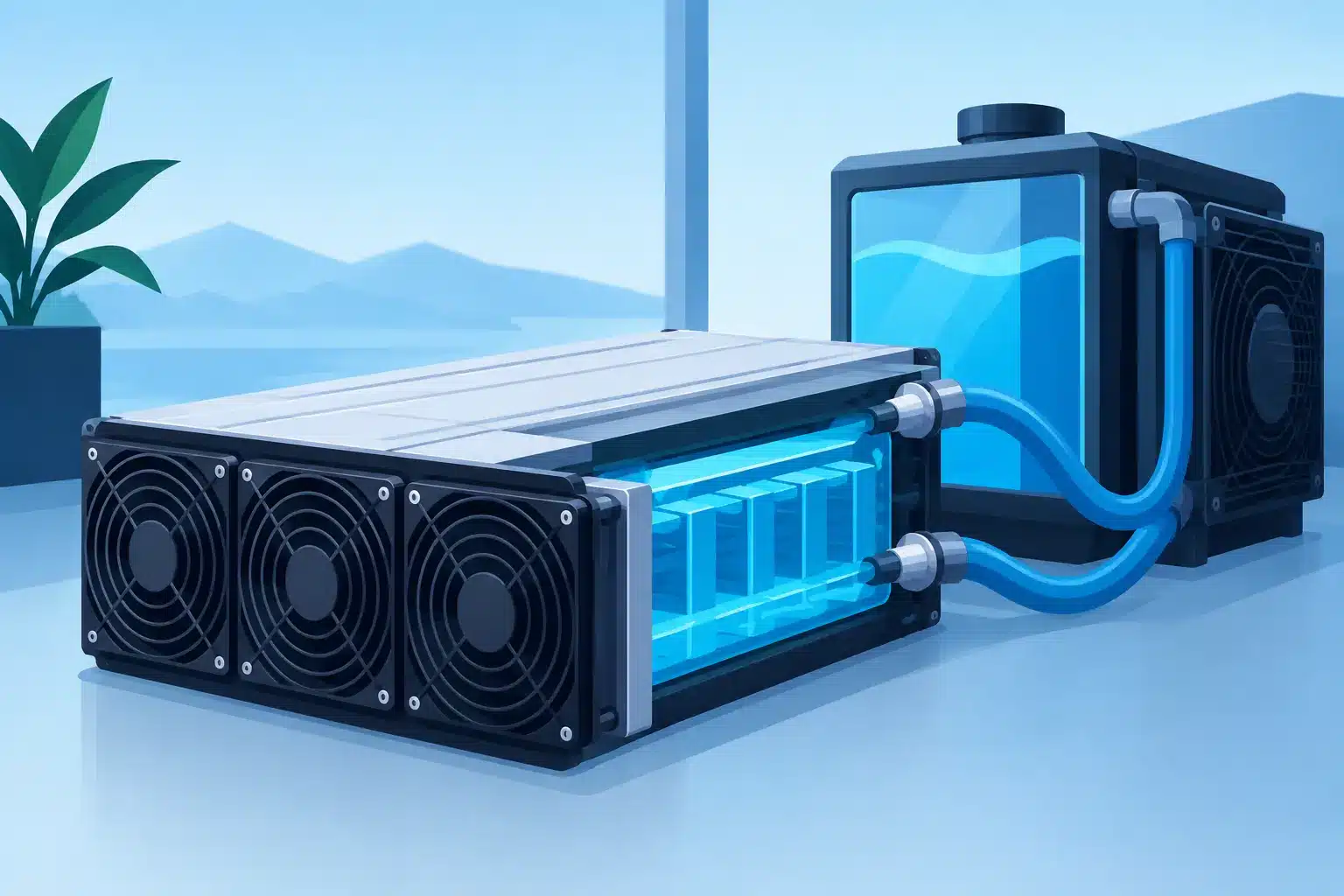
Ask how the miner was cooled and where it was previously deployed. Hardware operating in a clean, professionally managed facility generally faces a different risk profile from units kept in dusty, poorly ventilated spaces. Air-cooled machines exposed to sustained heat and dust may need more frequent cleaning and component replacement. Hydro-cooled units require a different check: inspect for coolant leaks, connector condition and compatibility with the intended cooling system.
Verify the Seller and the Commercial Terms
Used hardware transactions need more than a verbal assurance. The invoice should identify the model, quantity, serial numbers, condition, price and what is included. Clarify whether power supply units, cables, racks or immersion and hydro-cooling components form part of the sale.
It also helps to establish whether the seller is the previous operator, a broker or a reseller. Each can be legitimate, but the level of direct knowledge varies. A broker may source good stock, yet should still provide unit-level evidence rather than broad claims about condition.
Warranty terms deserve careful reading. Many pre-owned units have no original manufacturer warranty remaining. A supplier warranty or dead-on-arrival period can still provide useful protection, but understand what it covers, who pays for transport, how faults are diagnosed and how long a repair normally takes. A warranty has limited value if there is no practical repair path behind it.
For larger orders, consider buying a small sample batch first. Test it under the same hosting conditions planned for the wider fleet. This creates real data on hashrate, error rates, temperature behaviour and power draw before you commit to a larger deployment.
Hosting Can Protect the Value of Your Hardware
Buying the miner is only half the project. A well-priced unit can become unprofitable through poor electrical infrastructure, inadequate ventilation, slow repairs or avoidable downtime. Hosting quality therefore belongs in the investment decision from day one.
Look for transparent kWh pricing, clear terms on service charges, physical security, 24/7 monitoring and defined maintenance procedures. Ask how the provider manages failed units, whether spare parts are held on site and how quickly technicians investigate an offline miner. For a fleet, miner-management software should provide visibility of individual machine status, hashrate and performance trends.
Cooling is equally commercial. Air-cooled equipment may suit a smaller portfolio, but high-density deployments can benefit from hydro-cooling or immersion where the infrastructure and economics justify it. These systems can support more controlled operating temperatures, but they require specialist design, compatible equipment and disciplined maintenance. The best choice depends on fleet size, site capacity and power strategy.
A managed provider can remove much of the administrative burden by coordinating receipt, installation, commissioning, monitoring and repair. BitHash supports this end-to-end approach for clients who want hardware sourcing and operational accountability in one place, rather than managing several disconnected suppliers.
When a Used Miner Is the Wrong Choice
Pre-owned equipment is not always the value play. If a model is approaching the point where its efficiency cannot compete with current hardware at your available power price, a lower purchase cost may only delay an uneconomic outcome. The same applies when a unit has limited parts availability or no qualified repair support.
New hardware may be the better decision when you need manufacturer warranty protection, the lowest available joules per terahash, predictable deployment specifications or a longer operating runway. For institutional buyers, standardising on a current model can simplify spares, technician training, power planning and fleet reporting.
There is also a middle ground. A mixed fleet can combine efficient new-generation machines for core capacity with carefully selected used units for lower-Capex expansion. This works only when each model is tracked separately and evaluated against its own revenue, efficiency and maintenance profile.
A Smarter Purchase Process
Begin with your target: are you seeking immediate hashrate, lower initial Capex, a trial portfolio or scalable fleet capacity? Then define the maximum electricity cost and minimum efficiency your plan can support. Those two numbers narrow the market quickly.
Next, shortlist models with credible repairability and a suitable operating history. Request evidence for each unit, price the full delivered and deployed cost, and run downside scenarios. Once selected, arrange secure logistics and a hosting slot before the miners arrive. A machine earning nothing while waiting for power capacity is capital sitting idle.
The best used ASIC purchase is one you can measure, monitor and maintain from the first day of operation. Buy only when the condition is proven, the economics still work under pressure and the infrastructure is ready to keep the machine hashing long after delivery.
BitHash Editorial
Verified AnalystBitHash Infrastructure, UAE Colocation & Mining Intelligence Team